
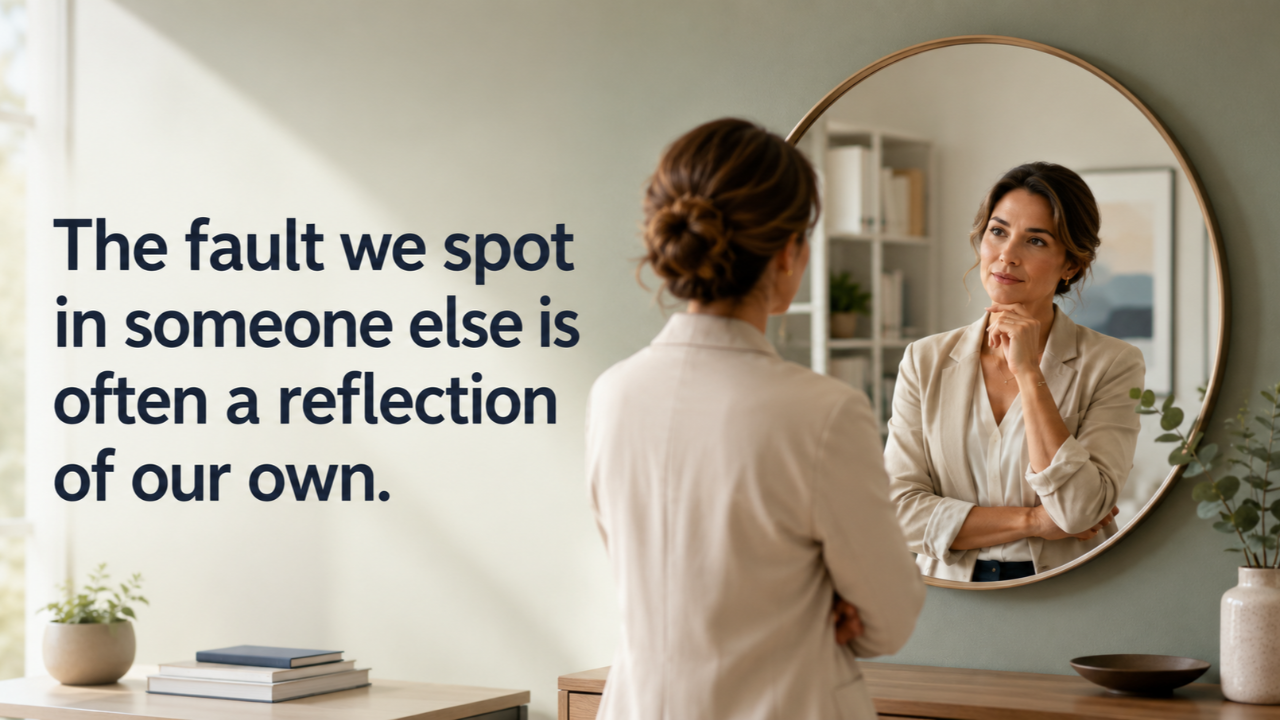
The Mirror Effect: Why The Faults You Spot In Others Are Often Your Own
Jun 26, 2026You and I are a little different. I'd go as far as to say special, and I don't say that to flatter either of us.
Here is why I say it. We read. We watch. We soak up ideas. We go where learning takes place, whether that's a room full of fellow succeeders, a webinar, a book, or a quiet half hour with a notebook. That simple commitment to keep learning sets us apart in a world that so often settles for the ordinary, the basic, the status quo.
After more than fifty years in business, with my share of both successes and failures, I've come to hold one belief above almost all others. I do not have all the answers. And I'd bet you feel the same, because that is exactly why you keep learning.
But there is a curious side effect of being a committed learner, one that took me years to notice in myself. Today I want to share it with you, because once you see it, it quietly changes how you treat other people, and how kindly you treat yourself. I call it the mirror effect.
The day we stop learning is the day we stop earning.
What You Will Learn In This Article
- Why People Like Us See The World Differently
- The Everywhere Classroom
- The Trap That Comes With Knowing Good Stuff
- The Mirror Effect
- Choosing Empathy Over Judgement
- How To Turn Annoyance Into Self-Improvement
- Growth, Not Perfection
- Your Next Step
Why People Like Us See The World Differently
Over the years I've spent a small fortune on my own learning. Seminars, mentors, books, audio programmes by the hundred. I am, and I say it proudly, a lifelong learner. I suspect you are too, or you wouldn't be reading this.
That habit does something to us. It sharpens how we see. When you have spent real time and money understanding how people communicate, how they sell, how they build trust, you cannot switch that understanding off. It comes with you everywhere you go.
And that is a gift. It means you are always growing. But, as you will see in a moment, it also comes with a small trap attached, and the trap is worth understanding before we go any further.
The Everywhere Classroom

Here is the first thing I want you to take away. Learning does not only happen in hotel rooms filled with clever people, or on a Zoom call with your peers. Everything around us is what I call the everywhere classroom.
There are lessons in every interaction, every observation, every experience, if only we choose to look for them.
Think about your travels through an ordinary day. The way a stranger moves through a crowded train carriage can teach you a great deal about spatial awareness and consideration for other people. A passionate conversation you overhear in your local coffee shop might hand you a fresh perspective on something you thought you understood completely. Even a frustrating exchange with a poor customer service representative becomes a masterclass in exactly what not to do in your own dealings with clients.
Nothing is wasted, you see, once you decide that everything is a lesson. The good shows you what to copy. The bad shows you what to avoid. Both are useful, and both are free.
The Trap That Comes With Knowing Good Stuff
Now here is the trap I promised you. Because we know good stuff, we spot other people getting it wrong. And it can be any sort of it.
Our accumulated knowledge, experience and expertise becomes a lens through which we see the world, and that lens tends to highlight other people's shortcomings rather brightly. You will recognise the kind of thing I mean.
- They open badly. Jumping straight into a topic with no rapport and no context, so the conversation never quite settles.
- They monopolise. Telling story after story about themselves, showing no real interest in the person in front of them.
- They listen with their nose. Certainly not with their ears. Their body language tells you the engagement simply isn't there.
- They drift. Starting with no direction and reliably achieving it, wandering through a conversation with no purpose or clarity.
There's a lovely expression that captures the heart of it. The skill is to be interested, not interesting. When you've learned that, you notice instantly when someone hasn't.
And here's the honest part. It is very easy, in that moment, to feel a quiet sense of superiority. After all, we've invested the time, the effort and often the money to hone our skills. But that feeling is precisely where we go wrong, and precisely where the real value is waiting.
The Mirror Effect

So let me explain what I mean by the mirror effect, because it has changed how I move through the world.
I've realised that very often, when I spot someone else making a mistake, it is a mistake I am making too. Or one I used to make and only stopped by accident, by default, rather than because I sat down and thought it through.
That realisation can be uncomfortable. It can be downright embarrassing. But it is also one of the most powerful reminders for personal growth I have ever found.
Think about it this way. Perhaps it is only by knowing the wrong way to do something that we are able to recognise it when someone else does the very same thing. The thing that irritates us in another person is so often a reflection of something in ourselves. That is the mirror. They show us, without meaning to, exactly what we need to look at in our own behaviour.
Often, when I spot someone making a mistake, it's one I'm making too.
Choosing Empathy Over Judgement
Once you see the mirror, something rather wonderful happens. It nudges you to look at what you notice with empathy and self-reflection, rather than with judgement.
Think about the last time you found yourself irritated by someone's behaviour, perhaps in a meeting. Did they interrupt you, or talk over someone else? Did they sit there and fail to contribute a single useful thing?
Before we let the frustration get the better of us, we can pause for just a moment and think, you know, I bet I've shown that very same behaviour somewhere, without even realising it. And that small moment of self-analysis turns an annoyance into an opportunity for self-improvement.
I'll be candid with you. Being aware of the mirror effect often holds me back from judging other people harshly, and that pleases me, because I know I can be quick to judge. It is who I am. Forming fast opinions is a natural human trait, and I have it as much as anyone. But this awareness gives me the pause I need, to reflect, and to approach the situation with a good deal more understanding.
And the benefits run deeper than simply being nicer to be around. By recognising the flaws in other people, and then looking honestly for them in ourselves, we build a far richer understanding of human behaviour and emotion. When we then meet people with empathy rather than judgement, we create stronger, warmer, more genuine connections. For those of us in the helping industry, that is not a soft skill. It is the whole game.
How To Turn Annoyance Into Self-Improvement
Let me make this practical, because a nice idea that stays an idea is worth very little. Here is the simple practice I use, and you are welcome to make it your own.
- Notice the good, not only the bad. Train yourself to spot what people do well, just as readily as what they could improve.
- Pause before you react. When someone irritates you, let that be the signal to stop for a beat rather than to judge.
- Ask the mirror question. Where do I do this too? Be honest. The answer is usually yes, somewhere.
- Choose understanding. Approach the person with empathy rather than a verdict. You'll connect, not just correct.
- Treat the moment as a lesson. Every meeting, even the difficult ones, becomes a classroom the instant you decide it is one.
Do that often enough and something shifts. The people who used to annoy you quietly become your teachers. Your irritation becomes information. And every single day starts handing you small, useful lessons you would otherwise have walked straight past.
A question to sit with this week
The next time someone genuinely irritates you, ask yourself honestly: where in my own life do I do the very same thing? Then decide what you'll do about it.
Growth, Not Perfection
Now, I want to be clear about what this is not, because it would be easy to take it too far.
The goal here is not to root out every last flaw, or to reach some impossible standard of perfection. Heaven forbid. That way lies misery, and frankly it isn't realistic for any of us.
The goal is simply to hold a mindset of continuous learning and growth, where every interaction, even the most challenging one, becomes a chance for self-reflection and a small step forward. It is an ongoing practice, not a destination you arrive at.
It does ask something of us. It asks a willingness to face our own shortcomings honestly, which is never the most comfortable thing in the world. But the rewards, in my experience, are quite fantastic. You become a calmer, kinder, more observant person. You build better relationships. And you keep on growing, year after year, long after other people have decided they already know enough.
Every meeting becomes an opportunity for self-improvement.
Your Next Step
If you take one thing from all of this, let it be the gentle habit of turning the mirror on yourself before you turn the spotlight on someone else. It will make you better company, and it will make you better at the work you do, because understanding people is the heart of helping them.
This idea of continuous learning sits right at the centre of how I think about business and life, and I've written about it in some depth. You can read more in my free Persuasion Book, where the very first lessons are built on the simple truth that none of us has all the answers, and that's a good thing.
And if you'd like to keep growing alongside a room full of fellow learners in the helping industry, the kind of people who go where learning takes place, come and join us inside The Paid Up Club, where we sharpen these ideas together, month after month.
So here is my parting thought for you. Be a little more aware of what people do well, and what they could do better. And then, importantly, ask whether any of it is a reflection of you. That single question, asked kindly and often, will quietly change everything.
Go out there, make a positive difference, and get rightfully, regularly and richly rewarded for the value you deliver. And in the meantime, I wish you every success in all your adventures.
The skill is to be interested, not interesting.
Stay connected with bite-size videos and updates!
Gain an unfair advantage and join fellow achievers who receive tgiMondays - FREE weekly bite-sized videos and blogs on business and personal growth and inspiration from my latest off the edge thinking and ideas.
We hate SPAM. We will never sell your information, for any reason.
