
How To Write Headlines That Sell: The Proven Formulas Behind The Greatest Ads Ever Written
Jun 23, 2026Let me start with a number that should make you sit up.
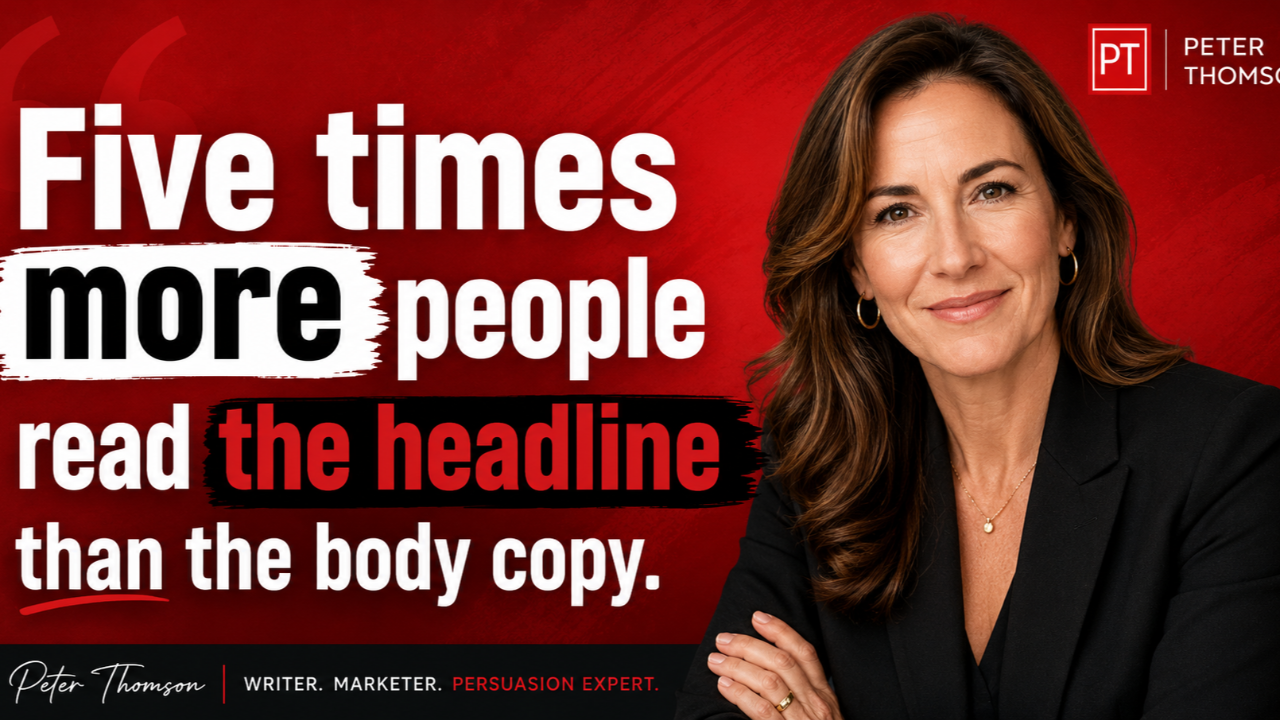
Five times more people read the headline than read the body copy underneath it. Five times. So if your headline doesn't land, you haven't lost a little bit of your effort. You've lost about eighty percent of it before anyone has read a word of your actual message.
In my last article I wrote about how to write a hook, the thing that stops someone in their tracks and earns the right to be read. A headline is that same idea, dressed for work. It's the hook doing its job at the top of your page, your email, your post or your book cover.
And here's the thing I've come to believe after more than forty years of writing copy, both brilliant and, I'll happily admit, occasionally awful. You and I do not get paid for how clever our headlines are. We get paid for how well they work. So today I want to give you the proven formulas, the ones that have sold billions of pounds worth of products, and show you exactly why they work, so you can use them in your own business this week.
Unless your headline sells your product, you have wasted ninety percent of your money. That was David Ogilvy, and he was right.
What You Will Learn In This Article
- Why Your Headline Is The Most Important Thing You Write
- The Only Job A Headline Has
- Away Or Towards: The Choice That Changes Everything
- Seven Headline Formulas You Can Use Today
- The Two Checklists I Run Every Headline Through
- Where Your Headlines Are Quietly Working
- Your Next Step
Why Your Headline Is The Most Important Thing You Write
My dear friend Ted Nicholas, who sadly passed away some years ago and who taught me more about persuasion than almost anyone, said something I have never forgotten. He said most people write the headline last, after they have written all the copy, which is exactly the moment they have run out of juice. He said it should be the first thing you work on, and the thing you spend the most time on.
He was right. The headline sits at the very top of what I call the hierarchy of persuasion. It is the most valuable real estate you own. Get it wrong and nothing below it matters, because nobody travels far enough down the page to find out how good the rest of your message is.
Think about it in plain money terms. If five times more people read the headline than the body, and your headline fails to pull them in, then most of the time, energy and money you spent on everything else has simply evaporated. That is why I want you to treat the headline not as decoration you add at the end, but as the engine you build first.
The simple truth
A headline is not there to be admired. It is there to get the first sentence read. That is its entire purpose, and we measure it by results, not by applause.
The Only Job A Headline Has
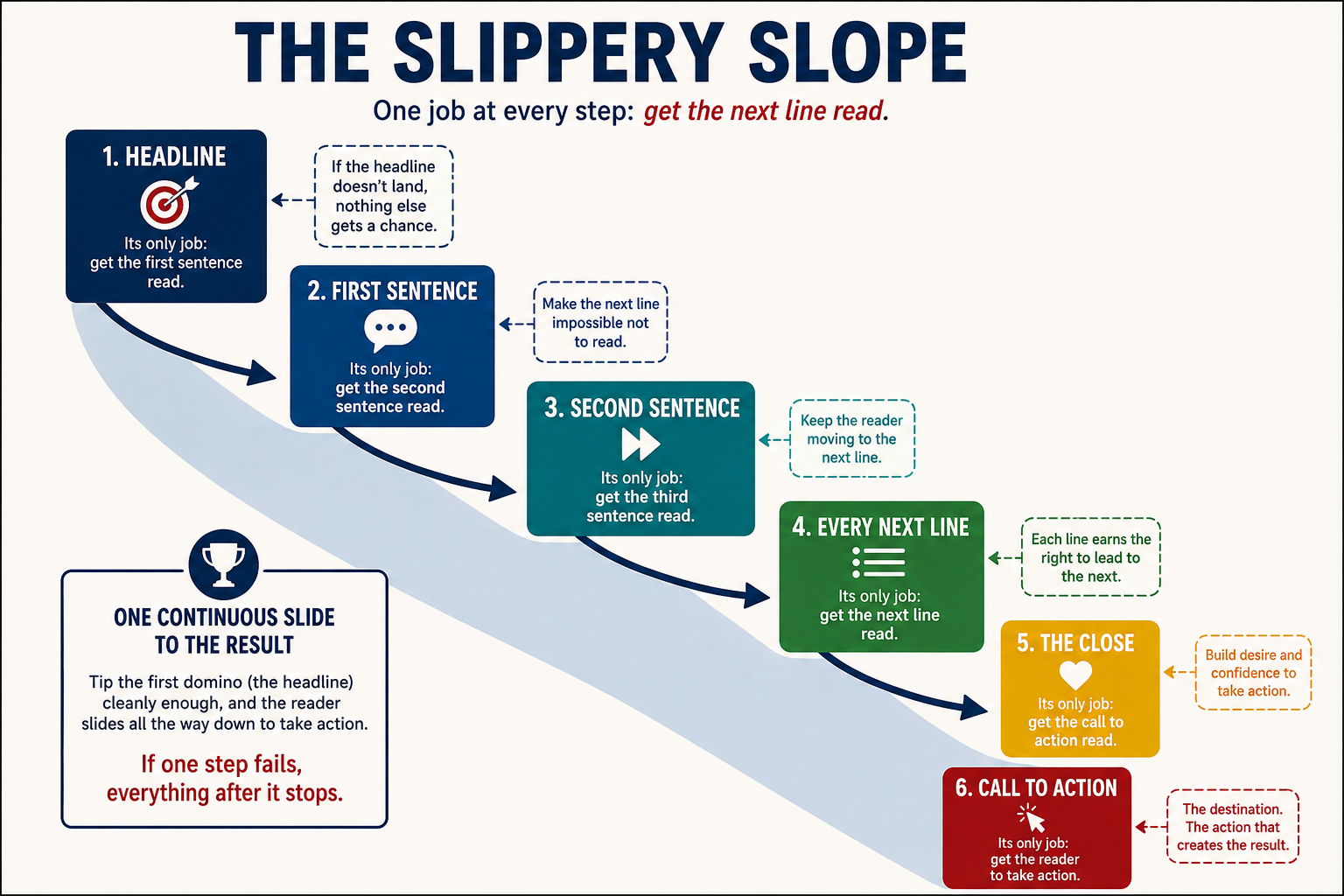
Joe Sugarman, one of the finest copywriters who ever lived, described it beautifully. He called it the slippery slope. The only job of the headline is to get the first sentence read. The only job of the first sentence is to get the second sentence read. And so it goes, all the way down to the call to action.
We used to call the same idea domino marketing. Picture a long line of dominoes. If you can just tip the first one, the headline, cleanly enough, it knocks over the first sentence, which knocks over the second, and the reader slides happily all the way to the bottom of the page where you ask them to act.
So when you judge your headline, do not ask, is this impressive? Ask instead, does this make the very next line impossible not to read? That is a completely different and far more useful question. And it changes how you write, because suddenly every word is earning its place or being thrown out.
The headline tips the first domino. If it doesn't, nothing else gets a chance to fall.
Away Or Towards: The Choice That Changes Everything
Here is one of the most useful distinctions in all of marketing, and once you see it you will never write a headline the same way again. Every headline is either away motivated or towards motivated.
An away motivated headline speaks to what the reader wants to escape. A problem, a pain, a fear, a loss. A towards motivated headline speaks to what they want to gain. A goal, a benefit, a happier future. Both work. The art is knowing which to reach for, and when.
Over many years of testing, I have found that away motivated headlines tend to pull harder with a cold audience, people who do not yet know you. Why? Because, as I explained in the hooks article, the brain reads threat faster than reward. Loss looms larger than gain. So when someone has never heard of you, naming the thing they are quietly worried about cuts through faster than promising them something lovely.
The most famous example of mine is a report I created over twenty-five years ago. The title was this:
The 7 BIG mistakes business owners are unwittingly making, costing them a fortune in lost turnover, lost profits, and what's even worse, lost personal cash. And how to avoid them.
That single away motivated title formed the heart of my marketing for years, and brought thousands of leads to the top of my funnel. Look at what it does. It names the person, the business owner. It names the problem, the seven mistakes. It piles on the pain, lost turnover, lost profit, lost personal cash. And then it offers the relief, how to avoid them.
The towards motivated version of the same idea might read, the seven little known secrets of increasing turnover, profit and personal cash. That works beautifully too, and often pulls better once people already know and trust you. So my advice is simple. With a cold audience, lead with away. As warmth and trust grow, test towards against it. And always, always test, because your market will teach you things no expert ever could.
Away motivation is the catalyst for action. Towards motivation is the continuation of action.
Seven Headline Formulas You Can Use Today
[ Image: a swipe file of classic headlines laid out on a desk, vintage advertising style. ]
As Ted Nicholas once told me, with the internet it is not a case of teaching an old dog new tricks. It is a case of teaching a new dog the old tricks. The psychology never changes. So here are seven proven patterns. Do not copy them word for word. Use each one as a template and pour your own offer into it.
1. The “these mistakes” formula
“Do you make these mistakes in English?” is one of the most successful headlines ever written. The original draft said, do you make mistakes in English, and it failed, because it felt accusatory and people became defensive. Add one small word, these, and it becomes magnetic. These, not those, because these feels close, personal, right here about me. Add a number for specificity, are you making these three pricing mistakes, and it pulls even harder. People simply have to read on to check whether they are guilty.
2. The AIDA structure
AIDA stands for Attention, Interest, Desire, Action. Your headline grabs Attention, the opening builds Interest, the body creates Desire, and the close calls for Action. There is a longer version I rather like called PAIDAR, which adds Planning at the front and Result at the end. Whichever you use, the headline carries the whole load of that first A. If you do not win Attention, the other letters never get a turn.
3. The open loop, or story headline
“They laughed when I sat down at the piano, but when I started to play.” John Caples wrote that, and it is pure genius. It opens a loop in your mind, tells the story of an underdog, and you cannot rest until you know what happened next. A word of caution for our market, though. If your reader recognises the trope, it can backfire, because they read it knowingly. So borrow the engine, not the exact words. “They doubted me until...” gives you the same irresistible loop without the predictability.
4. The surprising juxtaposition
“The Lazy Man's Way To Riches” sold an extraordinary amount for Joe Carbo. Why does it work? Because of the clash between two words you would never expect together, lazy and riches. Had it said the hard work way to riches, nobody would have blinked. The same trick powered Volkswagen's “Think Small,” which leaned into the car's supposed weakness and turned its size into honesty. Find two ideas that should not sit together, put them side by side, and the brain cannot look away.
5. The label headline
Sometimes the most powerful thing you can do is simply name your reader. “Attention coaches, consultants, speakers and trainers...” A pre-head that labels exactly who the message is for makes the right person feel it was written for them and them alone. Pair the label with the problem you solve, and you have a headline that selects its audience before it has even made its promise.
6. The specific, understated detail
David Ogilvy spent three weeks studying a car until he found one buried fact, that at sixty miles an hour the loudest sound was the electric clock. He could have written, this is a very quiet car, and the reader would have resisted it. The clock works because the reader draws the conclusion themselves. So stop reaching for tired adjectives like world class and bespoke. Find the one concrete, true detail that proves your point. As Roy H. Williams told me, lose the adverbs and improve the verbs. Not, he ran quickly. He dashed.
7. The Paraprosdokian, or surprise ending
This is a favourite of mine. A Paraprosdokian is a line with an unexpected twist at the end. Bob Monkhouse's “They laughed when I said I'd become a comedian. Well, they're not laughing now.” Or, history doesn't tell you who was right, it only tells you who was left. The surprise creates delight, and delight makes people remember you. Used in a title or a hook, it earns a smile and a second look.
A practical idea
Pick one formula, take what you sell, and write ten headlines from it. Then feed the psychology in this article into a tool like ChatGPT or Claude and ask for thirty more. You'll have a swipe file of your own in twenty minutes.
The Two Checklists I Run Every Headline Through
Once you have written a batch of headlines, you need a way to judge them quickly and honestly. I use two simple checklists. The first is the four Us.
- Is there a reason to act now, rather than someday? Use this when your marketing genuinely calls for action, not when you are building a slow, long term relationship.
- Have they heard this exact line a hundred times before? A worn out formula can backfire, so make it your own.
- Ultra specific. Is it concrete enough to feel true? Precise numbers and real detail create what I call verisimilitude, the appearance of truth.
- Does it answer the reader's oldest question, what's in it for me, and does it answer it fast?
The second checklist is the four Cs, and I run my finished line through every one of them before it goes anywhere.
- Understood in a single read, with no effort and no confusion.
- Not one wasted word. Every word must earn its keep, like a box of cereal earning its place on a supermarket shelf.
- It pulls. You feel the urge to read on whether you mean to or not.
- Believable, not hype. The moment a reader smells exaggeration, you have lost their trust and their attention.
Run a headline through those two short lists and you will spot the weak ones immediately. Be ruthless. The kindest thing you can do for your reader is delete the lines that do not pull, so the one that does gets all the attention it deserves.
Every word must earn its place. If it doesn't, out it goes.
Where Your Headlines Are Quietly Working
Here is something worth pinning above your desk. You are writing headlines far more often than you realise, and most of them are doing their job badly because you never thought of them as headlines at all.
The title of your book is a headline. “Why Men Don't Listen And Women Can't Read Maps” sold tens of millions of copies on the strength of its title alone. The subject line of your email is a headline. The first line of your LinkedIn post is a headline. And, importantly, so is the line that sits under your name on your LinkedIn profile.
Most people fill that LinkedIn line with their job title. Managing Director. Consultant. Founder. But your reader does not care about your title. They care what you can do for them. So lead with the benefit, who you help and what they get, and get it into the first sixty or so characters, because that line is often shortened when it appears elsewhere on the platform. Then add a keyword or two so the right people can find you in search.
And do not forget the humblest headline of all, the title of your free report or lead magnet. If you would like a head start, I put together a resource called Magnetic Titles with thirty different title styles and examples of books you'll instantly recognise that use each one. It pairs perfectly with everything in my free Persuasion Book, which goes deeper into the psychology behind all of this.
One rule for video headlines
Never open a video with your name. “Hi, I'm Peter Thomson and I'm considered the...” is the fastest way to lose a viewer. Start with the headline. Lead with the hook. Earn the right to introduce yourself later.
Your Next Step
If you take one thing from all of this, let it be that the headline is where your marketing is won or lost, and where your skill is most richly rewarded. It is not the part to dash off at the end. It is the part to build first, test hardest, and care about most.
And remember, the headline only opens the door. Behind it sits the whole craft of persuasion, the structure that turns a curious reader into a confident buyer, and turns the value you deliver into the fee you truly deserve.
That is exactly what I wrote my book to give you. You can get PAID! here, and it lays out the pricing and persuasion frameworks that take you far beyond the headline.
And if you would like to keep sharpening this skill alongside me and a room full of people in the helping industry, come and join us inside The Paid Up Club, where we work through this material together, month after month.
So here is my question for you. Take the most important headline in your business, the one on your home page, your lead magnet or your profile, and ask honestly, does it tip the first domino? If not, you now know exactly how to fix it.
Go out there, make a positive difference, and get rightfully, regularly and richly rewarded for the value you deliver.
Make it simple. Make it memorable. Make it inviting to look at. And make it fun to read.
Stay connected with bite-size videos and updates!
Gain an unfair advantage and join fellow achievers who receive tgiMondays - FREE weekly bite-sized videos and blogs on business and personal growth and inspiration from my latest off the edge thinking and ideas.
We hate SPAM. We will never sell your information, for any reason.
