
How To Write A Hook That Makes People Stop, Read And Buy
Jun 19, 2026Let me ask you something, and I want you to be honest with yourself when you answer it.
If your expertise at delivering what you do doubled overnight, would your income double too?
I happen to think the answer is no. I really do.
Because here is what I have come to believe after more than forty years of doing this. Most failures in businesses like ours are marketing failures, not competence failures. Most plateaus are sales process failures, not competence failures. We can all do what we do, and do it to a high standard. That is rarely the thing holding us back.
You and I work in what I lovingly call the helping industry. We help people solve problems, capitalise on opportunities, and become more successful than they currently are. And in that world, the thing that makes the difference to your level of success is not, to begin with, how good you are at the work itself.
It is your skill at marketing and sales. And one of the most important parts of that skill is the humble little thing we are going to talk about today: the hook.
Five times more people read the headline than read the body copy. Get the hook wrong and about 80% of your budget has gone.
What You Will Learn In This Article
- What A Hook Actually Is (And Why It Matters So Much)
- How The Brain Decides In Seconds
- Curiosity Is An Itch Caused By A Gap
- Why Negative Framing Often Wins
- The Four Questions To Run Every Hook Through
- Hooks That Made History, And Why They Worked
- Where To Use Your Hooks
- How To Get Unstuck When The Page Is Blank
- Your Next Step
What A Hook Actually Is (And Why It Matters So Much)
A hook is the very first thing your prospect meets. It is the headline on your landing page. It is the first line of your LinkedIn post. It is the subject line of your email. It is the opening few seconds of your video.
Headlines are hooks and hooks are headlines, and vice versa. The words change depending on where you use them, but the job is identical. The job is to earn the right to be read.
My dear friend Ted Nicholas, who sadly passed away some years ago and who taught me so much, said something that has stayed with me ever since. He said most people write the headline after they have written the copy, which is exactly when they have run out of juice. He said it is the most important thing you write, and it is where you should spend the most time.
He was right. The opening is the most valuable real estate you own. The headline sits at the top. The teaser copy on the envelope sits at the top. If you get that bit wrong, nobody reads the next bit. It is as simple, and as unforgiving, as that.
The simple truth
The only job of the headline is to get the first sentence read. The only job of the first sentence is to get the second sentence read. And so on, all the way to the call to action.
How The Brain Decides In Seconds
Before we touch a single technique, you and I need to understand what the brain actually does when it meets a hook. Because once you understand that, everything else makes sense.
Here is the first thing to hold onto. Your prospect's brain is a filter, not a sponge. It is a finite processing engine, and it cannot take everything in. So it filters very hard and very fast.
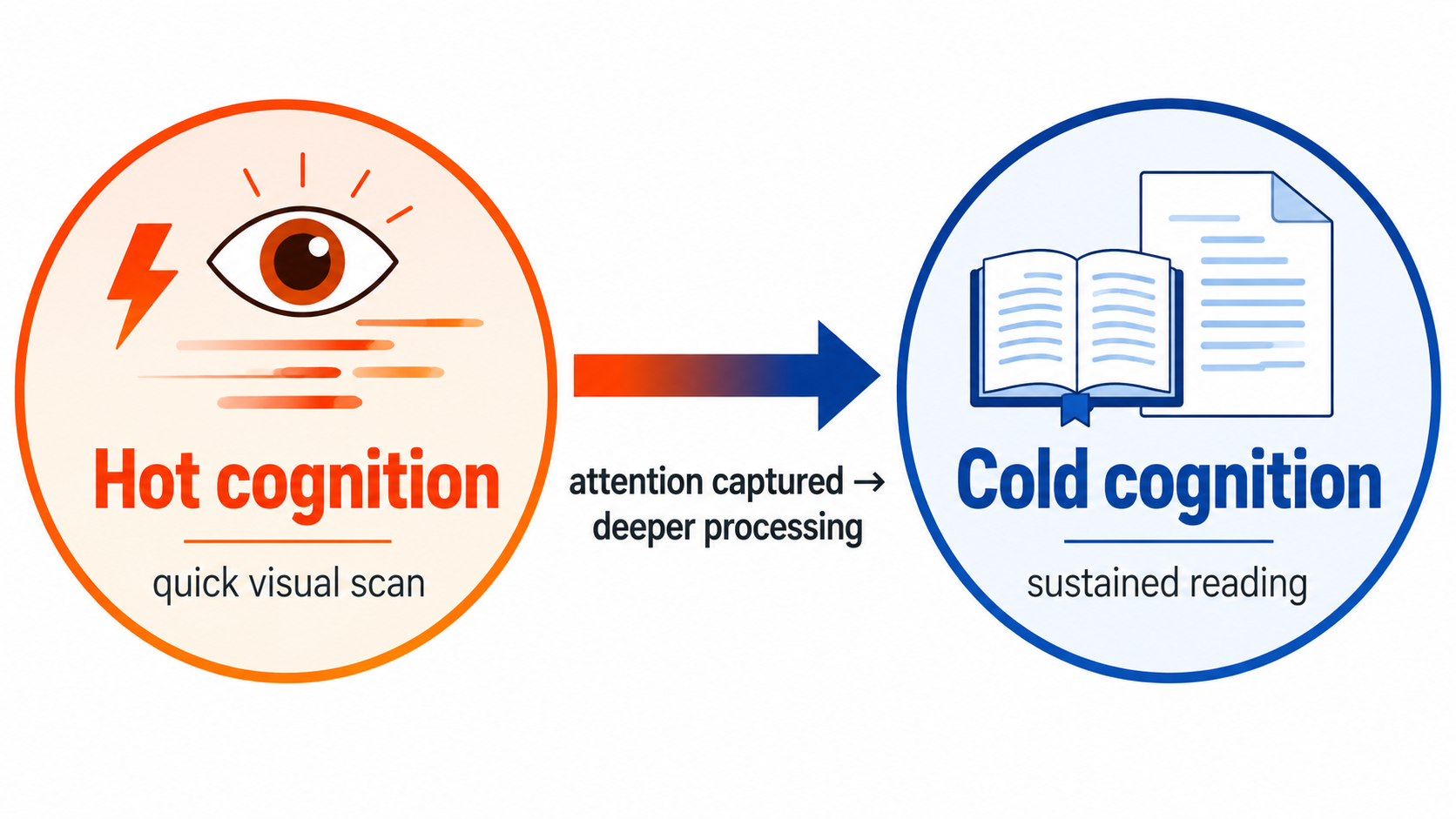
When someone sees your words, two things happen in sequence. First there is a quick visual scan, which the researchers call hot cognition. Then, only if that scan finds a reason to continue, there is a longer, sustained attention, which is called cold cognition.
Your hook is not really there to beat a stopwatch. It is the motivational trigger that makes someone say, yes, I will spend the energy to read on. A good hook lowers the cost of paying attention. It reduces the mental effort and primes the pathway, so the rest of your message lands more easily, and is even remembered better afterwards.
The limbic system is sitting there asking very fast, very primitive questions about your words. Is this a threat or a reward? Is this useful or ignorable? If the brain cannot quickly see a reason to engage, it discards your message to save energy.
Which brings us straight back to the oldest principle in all of marketing. What's in it for me? If you are not answering that question quickly, all the cleverness in the world will not save you, because nobody is reading far enough to find it.
The hook is not a decoration. It is the moment you answer the brain's first question: is this worth my energy?
Curiosity Is An Itch Caused By A Gap
Now here is where it gets interesting, because the brain is fundamentally a difference detecting machine. That is what it is built to do. It looks for novelty, for contrast, for change, for the unexpected. Certainty is boring to it. Ambiguity is magnetic.
You have heard me say it before. Without contrast, everything sounds expensive or cheap, and you do not know which. So you take control of the reader's thinking using difference.
This is why curiosity works so powerfully. Curiosity is an itch caused by a gap. It is what psychologists call an aversive state, which simply means it is uncomfortable and we want to escape it. A gap between what we currently know and what we feel we could know creates a small tension, and the brain wants to resolve that tension.
So your hook should deliberately open a gap. Tease the reward early, and the brain will chase the resolution. But, and this is the craft of it, do not give everything away. The moment you resolve the gap in the hook itself, the curiosity is gone and so is the reader.
Think of it this way. If you walk down the street with nothing on, nobody stays interested for long. Walk down the street with just a few clothes on, and suddenly there is intrigue. You cannot give everything away.
The balance to aim for
Be specific enough to matter, vague enough to intrigue. Give people the scaffolding, not the whole building. Enough that they think, that's interesting, let me look at more.
There is good evidence for this. An analysis of thousands of randomised headline experiments found a clear curve. More than half of headlines fail because they are too concrete. They resolve the gap, so there is nothing left to be curious about, and the click through rate falls. A much smaller proportion fail for being too vague. The sweet spot, as so often in life, sits in the middle.
And when you do want to add specificity, add accurate detail rather than bland generality. There is a lovely old word for this, verisimilitude, the appearance of truth. Precise numbers create it. Bland numbers do not. “Are you making these three pricing mistakes” pulls far harder than “are you making pricing mistakes.”
Why Negative Framing Often Wins
Here is something that surprises a lot of people, and it is worth testing in your own marketing rather than taking my word for it.
The brain reads threat faster than reward. It is the rustle in the grass that grabs us, not the beautiful sunset on the far hillside. We evolved that way for very good reasons. So negative linguistic triggers are processed faster and felt more strongly than positive ones.
Let me say that again, because it matters. Negative triggers are processed faster and felt more strongly.
This connects to the work of Daniel Kahneman and Amos Tversky, and their Prospect Theory. If you have not read Kahneman's book Thinking, Fast and Slow, please do. The central finding is that we are more motivated by the avoidance of loss than by the potential of an equivalent gain.
In one large body of randomised testing, every extra negative word lifted click through by a little over two percent, while every extra positive word cost about one percent. I once changed a single word, twice, on a client's landing page, and that one word change was worth well over a million pounds to them in a year. Tiny changes, properly tested, make an enormous difference.
Now, I am not telling you to be relentlessly negative. That is not it at all. I am telling you to frame around the problem, to test away from motivation against towards motivation, and to let the results decide. There is also a subtle emotional point worth knowing. Anger and fear tend to drive public sharing, but sadness and gentle unresolved tension tend to drive the quiet, private click. Match the emotion to the action you actually want.
Specific enough to matter. Vague enough to intrigue. Fast enough to beat the scan.
The Four Questions To Run Every Hook Through
Let me make this practical for you. Whenever you have written a hook, a headline or an opening line, run it past these four checks before you let it out into the world.
- Is it visual enough to grasp instantly, yet vague enough to leave a gap worth resolving?
- Can you frame it around the problem rather than the solution? Have you at least tested an away motivated version?
- Pattern interrupt. Does something unexpected happen quickly, so the difference detecting brain looks up and pays attention?
- What's in it for me. Does it answer the brain's first question fast, so the filter clears and the reader moves into the detail?
And then a second, simpler set of tests that Ted Nicholas taught me. Run every line through four stages. Is it boring? If so, change it. Is it boring but necessary? Then rewrite it until it earns its place. Is it exciting? Is it hot? People do not read everything you write. They skim. You never quite know which bit they will land on, so every bit had better be good.
Think of each word like a box of cereal on a supermarket shelf. That shelf space is worth real money. If the supermarket is going to let you sit there, your box had better earn its place. Treat your words exactly the same way. Every word must earn its keep, and if it does not, out it goes. Be ruthless.
The four Cs to finish on
Clear, understood in one read. Concise, not a word wasted. Compelling, it pulls. Credible, believable, not hype.
Hooks That Made History, And Why They Worked
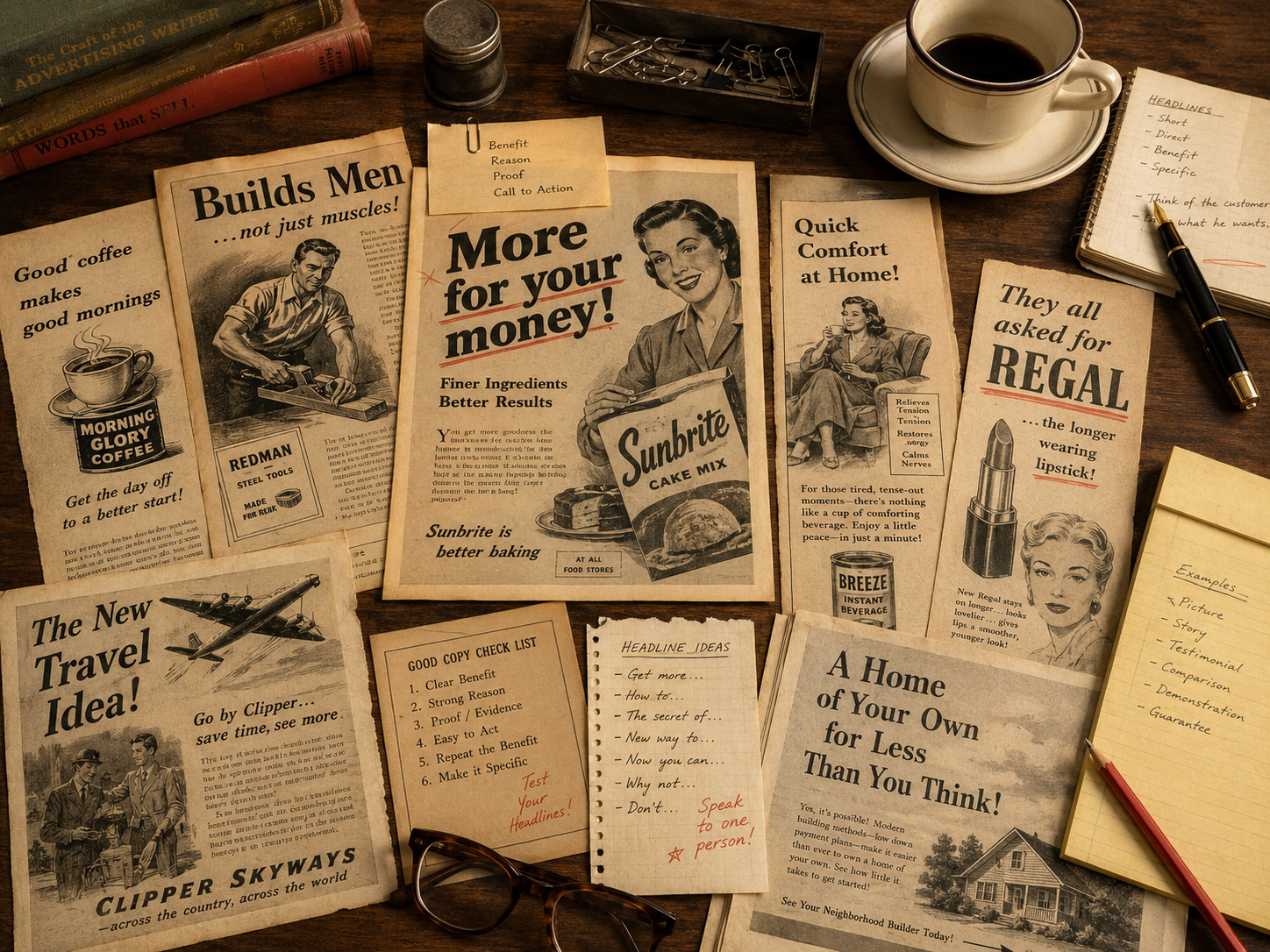
As Ted Nicholas once said to me about the internet, it is not a case of teaching an old dog new tricks. It is a case of teaching a new dog the old tricks. The psychology does not change. So let us look at a few of the greats and pull out what actually makes them work.
The electric clock: David Ogilvy
Ogilvy spent three weeks studying a car's engineering until he found the one buried fact, that at sixty miles an hour the loudest thing you could hear was the electric clock. You do not get that from three minutes of thinking. The specific, understated detail works because the reader builds the conclusion themselves. Say “this is a very quiet car” and they resist you. Give them the clock, and they get there on their own.
So stop reaching for tired adjectives like world class and bespoke. Find the one concrete, true detail that proves your point. As Roy H. Williams told me, get rid of the adverbs and improve the verbs. Do not write “he ran quickly down the road.” Write “he dashed down the road.” You can feel it. Here is a question worth sitting with: what is the electric clock in your business?
They laughed when I sat down: John Caples
“They laughed when I sat down at the piano, but when I started to play.” It is genius. It opens a loop, tells a story of an underdog, and you simply have to know what happened next. There is a useful formula underneath it, AIDA, Attention, Interest, Desire, Action. But a word of caution for our market: if your reader recognises the trope, it can backfire, because they read it through a knowing frame. So borrow the structure rather than the exact line. “They doubted me until...” gives you the same engine without the predictability.
Do you make these mistakes in English
The original version, “do you make mistakes in English,” did not work, because it felt accusatory and people got defensive. Add one small word and it becomes magnetic: “do you make these mistakes in English.” That word these, not those, draws people right in, because these is up close and personal. Add a number and you sharpen it further: “are you making these three pricing mistakes.”
Enter the conversation: Robert Collier
Collier's principle is the one I would tattoo on every marketer if they would let me. Enter the conversation already taking place in the prospect's mind. You do not have to start a new conversation. You join the one they are already having. “My ideal client lies awake worrying about...” and then you name the real thing they worry about. If you have done your research, that lands like a thunderclap.
Don't try to find the right people. Craft the right message. It will find the right people.
Where To Use Your Hooks
A good hook is never wasted, so ask yourself where this one will work hardest for you. Is it an email subject line? The first line of a LinkedIn post? A headline on your landing page? The opening of a video?
One small but important rule for video. Do not start with your name. “Hi, my name's Peter Thomson and I'm considered the...” Boring. Start with the hook. I learned this back in 1984 when I started a leasing business. We would phone a prospect, confirm we had the right person, and then go straight in: “If ever there was a way you could place more of the trucks you sell on lease, so you could make more money more easily, how interested would you be?” Straight into the hook. No preamble. If they said not really, we thanked them and moved on. If they leaned in, we had a conversation.
And remember Joe Sugarman's slippery slope. The job of the headline is to get the first sentence read. The job of the first sentence is to get the second read. We used to call it domino marketing, each piece tipping the next over, all the way to the call to action. Whatever you write, ask whether the first sentence truly makes the reader want the second.
One last principle that changes everything once you take it on board. Address one person. Do not write “some of you” or “all of you.” Even in a video to thousands, they watch it alone. They read your words alone. So picture one real person, label them, and speak only to them. Do not write to a stadium.
How To Get Unstuck When The Page Is Blank
People often ask me how to get going when the page is blank and nothing comes. Here is my honest answer, and it has taken me from blank paper to completed books. Three little words: and, because, of.
First decide what you are trying to achieve with the piece, which opens the mental filter. Then simply start with the word and, and keep writing whatever your mind offers. One of the best pieces of copy I ever wrote began exactly this way: “And as I drove away from Avonside with my dog Mike, I moved the mirror in my car so I couldn't look back. I didn't, I haven't, and I never will.” That all came because I started with the word and.
Because works the same way. “Because you're reading this with me now, there's something I know about you. Let me tell you what it is.” You would read on. You could not help it.
And of, too. “Of all the skills I've examined that make a consultant successful, there is perhaps one that stands head and shoulders above the others. It surprised me when I realised it. It surprised my clients when I shared it. And it surprised my bank manager when I showed him what happened afterwards.” Off you go.
One last thought on the tools you and I now have. AI is genuinely brilliant at generating hooks, both ChatGPT and Claude. Feed a tool the psychology in this article, give it what you are selling, and ask it for thirty hooks. It will do it in seconds. But remember the warning a Stanford professor gave about learning. AI can put you in a helicopter and drop you on the mountain top, and you can stand there and say you did it. But you did not do the climb, and the climb is where the learning lives. Use the tools, by all means. Just do not skip the understanding.
Remember this above all
Specific enough to matter, vague enough to intrigue, fast enough to beat the scan. Answer “what's in it for me” quickly, and you clear the filter so people read on.
Your Next Step
If you take one thing from all of this, let it be that your marketing skill, not just your delivery skill, decides how successful you become. And the hook is where that skill is most concentrated and most rewarded.
Of course, the hook is only the opening move. Behind it sits the whole craft of persuasion, the structure that turns interest into a buying decision and value into the fee you deserve.
That is exactly what I wrote my book to give you. You can get PAID! here, and it lays out the pricing and persuasion frameworks that go far beyond the opening line.
And if you would like to keep building this skill alongside me and a room full of people in the helping industry, come and join us inside The Paid Up Club, where we work through this material together, month after month.
So here is my parting question for you. What is the electric clock in your business, and what is the one hook you are going to write this week to put it to work?
Go out there, make a positive difference, and get rightfully, regularly and richly rewarded for the value you deliver.
Make it simple. Make it memorable. Make it inviting to look at. And make it fun to read.
Stay connected with bite-size videos and updates!
Gain an unfair advantage and join fellow achievers who receive tgiMondays - FREE weekly bite-sized videos and blogs on business and personal growth and inspiration from my latest off the edge thinking and ideas.
We hate SPAM. We will never sell your information, for any reason.
