

Why Value Pricing Fails (And How to Make Sure Yours Doesn’t)
Jul 30, 2026In this article
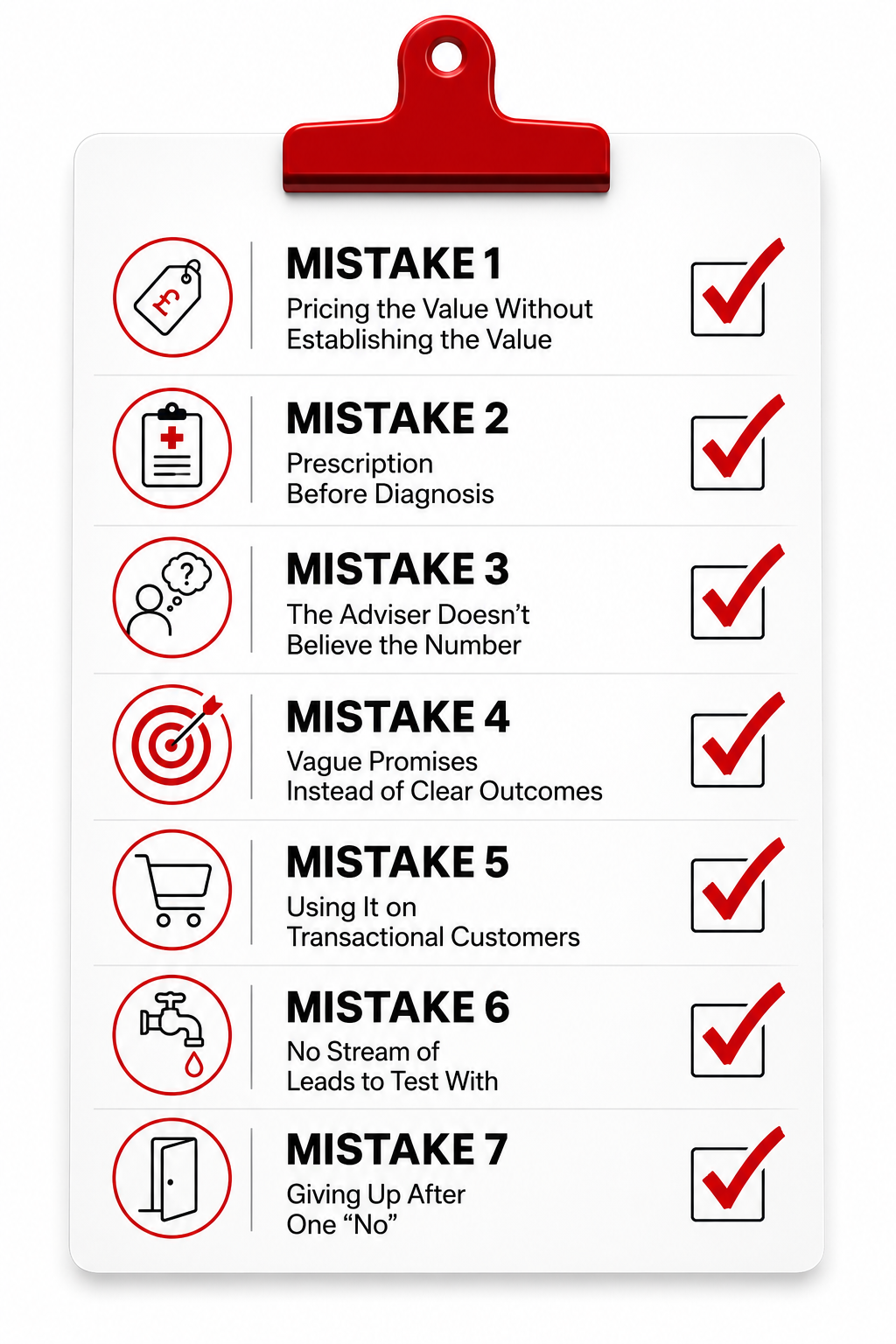
- Mistake 1: Pricing the Value Without Establishing the Value
- Mistake 2: Prescription Before Diagnosis
- Mistake 3: The Adviser Doesn’t Believe the Number
- Mistake 4: Vague Promises Instead of Clear Outcomes
- Mistake 5: Using It on Transactional Customers
- Mistake 6: No Stream of Leads to Test With
- Mistake 7: Giving Up After One "No"
- Your First Value-Priced Proposal, Step by Step
- Make Yours Succeed
Here’s something you won’t often hear from someone who teaches pricing.
Value pricing fails. Regularly.
I’ve watched consultants read a book on value-based fees, double their prices on Monday, lose three proposals by Friday, and quietly go back to their old day rate by the end of the month. Convinced, forever after, that "value pricing doesn’t work in my market".
But here’s the thing you and I both need to understand.
Value pricing doesn’t fail because the principle is wrong. It fails because of how it’s applied. And the failures follow such predictable patterns that we can list them, name them, and design them out of your business one by one.
Shall we?

Mistake 1: Pricing the Value Without Establishing the Value
This is the big one. The mistake that causes more failed proposals than all the others combined.
The consultant quotes a value-based fee, but the client has never been walked through what the problem is costing them or what the solution is worth.
So the client compares the fee with the only anchor they have. The old day rate. Or a competitor’s day rate. And of course the new fee looks enormous.
In paid! I share a conversation I had with a company that had 300 salespeople. Before any fee was discussed, we established together that underperformance was costing them around 2,000 pounds per salesperson per month, and had been for about two years.
That’s 14.4 million pounds.
Only after the client said "yes, it is that astonishing amount" did we talk about my fee. Against 14.4 million, almost any sensible fee looks small.
This is the Contrast Principle. Having used the idea for over 50 years in business, I’m convinced price objections more easily follow when contrast is not created.
No contrast, no context. No context, no sale.
Mistake 2: Prescription Before Diagnosis
There’s an old saying in medicine. Prescription before diagnosis is malpractice.
It’s malpractice in our world too.
If you quote a fee before you’ve properly diagnosed the client’s situation, you’re guessing. And the client can feel you guessing.
The diagnosis is where the value conversation happens. It’s where the numbers surface. Skip it, and you’ve thrown away the very foundation your fee was supposed to stand on.
Mistake 3: The Adviser Doesn’t Believe the Number
Let me give you a sentence I’ve repeated for decades, because it’s true.
You will never get paid more than you truly believe you are worth.
Peter Thomson
When a consultant quotes a fee they don’t yet believe in, the disbelief leaks out. In the hesitation before the number. In the apologetic tone. In the rush to offer a discount nobody asked for.
Clients don’t reject the fee. They reject the doubt.
Fortunately, belief is built by evidence. As you test higher fees and new clients readily accept them, your belief in your value grows. My first test was 2.5 times my old rate. Accepted immediately. My belief has never been the same since.
Start with a fee that stretches you rather than one that snaps you.
Mistake 4: Vague Promises Instead of Clear Outcomes
"Improved performance." "Better alignment." "A more strategic approach."
Would you pay 25,000 pounds for any of those? Neither would I.
As Chip and Dan Heath put it in their book Decisive, resistance is created through a lack of clarity.
Value pricing lives or dies on specificity. Specificity has verisimilitude. "An extra 180,000 pounds in fee income within 12 months" is a promise a client can weigh a fee against. "Better results" is not.
- State what the offering is, what it has, and what it does.
- Say why you’ve chosen to deliver it this way. (Almost nobody explains their why, which is exactly why you should.)
- Put numbers on the outcome wherever the client’s own figures allow.
Mistake 5: Using It on Transactional Customers
Years ago I interviewed Roy H Williams, known as The Wizard of Ads, and he taught me a distinction that changed how I choose clients.
The transactional customer is their own expert. They know exactly what they want, they shop three suppliers, and they buy on price. It is purely a transaction.
The relational client looks to you to be the expert. They buy trust, guidance and outcomes. Price becomes only a factor, not the factor.
Value pricing works beautifully with relational clients. It fails, almost every time, with transactional buyers, because they have already decided that hours are the product.
So when value pricing "fails", ask first: did it fail, or was it simply presented to the wrong person?
A rule I live by
When we deal with the right clients, all the major problems become minor. When we deal with the wrong ones, all the minor problems become major. Choose accordingly.
Mistake 6: No Stream of Leads to Test With
Here’s a practical failure point almost nobody talks about.
Testing higher fees takes a little courage, and courage is much easier to find when the next enquiry is already in your inbox.
If you have one prospect a quarter, every quote feels like life or death, so you quote low to be safe. If you have a steady stream of qualified leads, you can test a bolder fee on the next conversation and learn from what happens.
That’s why lead generation and pricing confidence are the same project wearing different hats. Build the stream, and the testing takes care of itself.
Mistake 7: Giving Up After One "No"
One rejected proposal is not a verdict on value pricing. It’s one data point.
In direct marketing we talk about the control. The version that’s currently working. We test new versions against the control, keep what wins, and drop what doesn’t.
Your fees deserve the same discipline. Test different prices. Test different offerings and offers. Find the level at which the maximum number of the right clients say yes.
When was the last time you tested your price? And when was the last time you raised it? If both answers begin with "ugh", you now know exactly where to start.
Your First Value-Priced Proposal, Step by Step
Let’s finish the diagnosis with a prescription. Here’s how to run your next proposal so that none of the seven failures can touch it:
- Choose a relational prospect. Someone who wants an expert and an outcome, not a rate card.
- Book a diagnosis conversation, not a pitch. Your only job is questions. The situation, the cost of the problem, the value of solving it, and the value of that value.
- Let the client speak the big number aloud. "Does that sound about right?" Their confirmation is the foundation everything else stands on.
- Describe the offering fully. What it is, what it has, what it does, and why you deliver it this way.
- Present the fee immediately after the contrast. Never in a separate email a week later, stripped of all its context.
- Then be quiet. State the investment warmly and let the silence do its work. The silence is not your enemy.
Run that sequence once and you’ll notice something remarkable. The fee stops being the scary part. The scary part, it turns out, was quoting without any of this in place, and you’ve been doing that for years.
And if the first one doesn’t land? Wonderful. You now have a control to test against, and a specific stage of the sequence to improve. That’s not failure. That’s the method working.
Make Yours Succeed
So there they are. Seven reasons value pricing fails, and not one of them is "because clients won’t pay".
Clients pay for value every single day. Our job is simply to establish it, quantify it, believe it, and present it to the right people in the right order.
For the complete system, including the Contrast Principle conversation word for word, my book paid! is waiting for you at peterthomson.com/paid-book.
Value pricing done badly fails. Value pricing done well changes lives.
Let’s make sure yours is the second kind.
Seven mistakes. Seven fixes. And every one of them within your control this week. Which, when you think about it, is rather wonderful news for a Monday morning.
Stay connected with bite-size videos and updates!
Gain an unfair advantage and join fellow achievers who receive tgiMondays - FREE weekly bite-sized videos and blogs on business and personal growth and inspiration from my latest off the edge thinking and ideas.
We hate SPAM. We will never sell your information, for any reason.
