

What is Value Pricing? A Straight-Talking Guide for Coaches and Consultants
Jul 23, 2026Table of Contents
How to Start Using Value Pricing
Testing Your Price: The Habit That Keeps Value Pricing Alive
Let me ask you a question before we go any further.
When you last set your fees, did you start with the time the work would take you, or the difference the work would make to your client?
Be honest now.
If you started with time, you are in very good company. Most coaches, consultants, trainers and advisers do exactly the same. And most of them, as a direct result, are undercharging. Often by a long way.
Value pricing is the antidote to that problem. So let me walk you through what it is, why it works, and how you and I can start using it today.
Value Pricing in One Sentence
Here is the simplest definition I can give you.
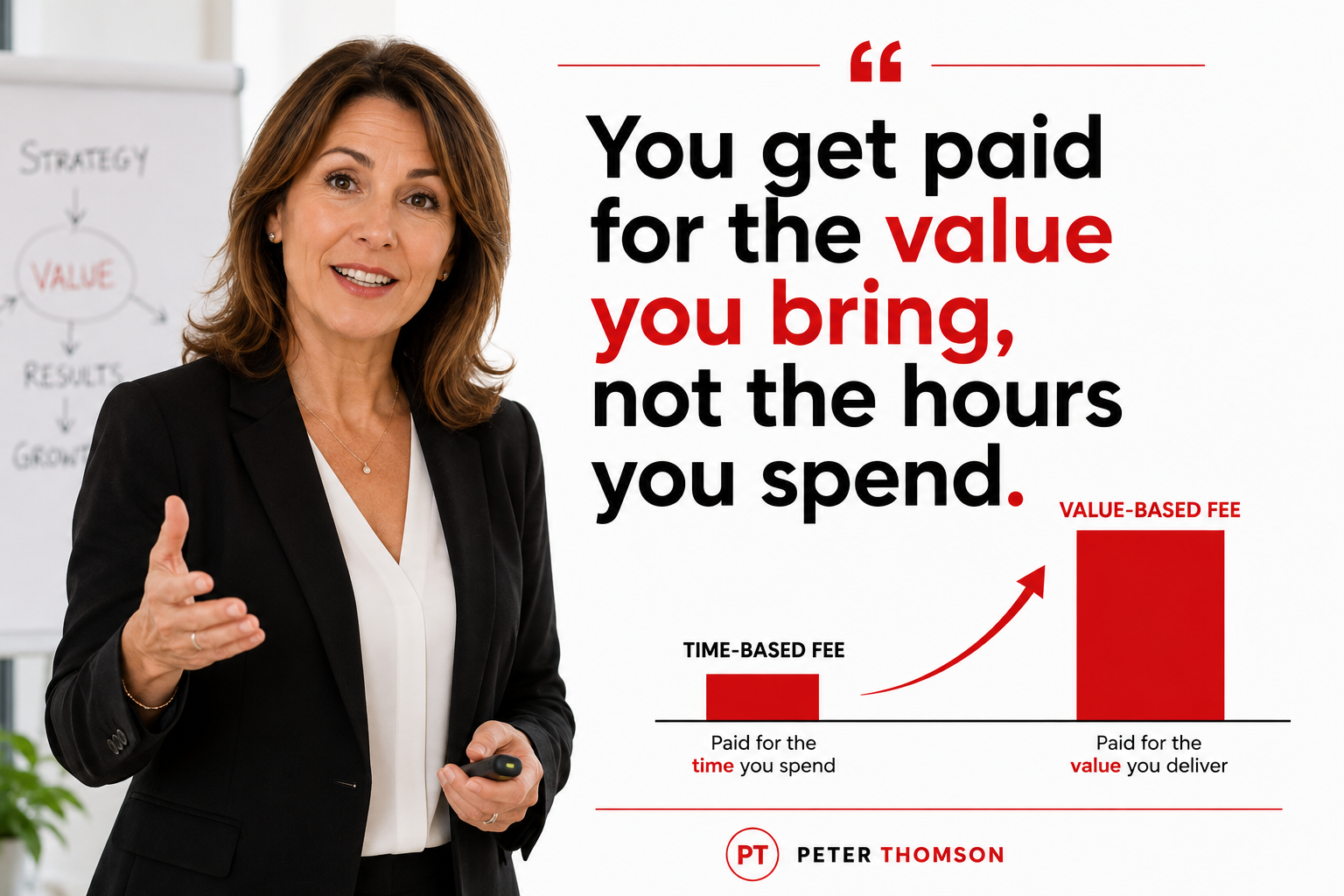
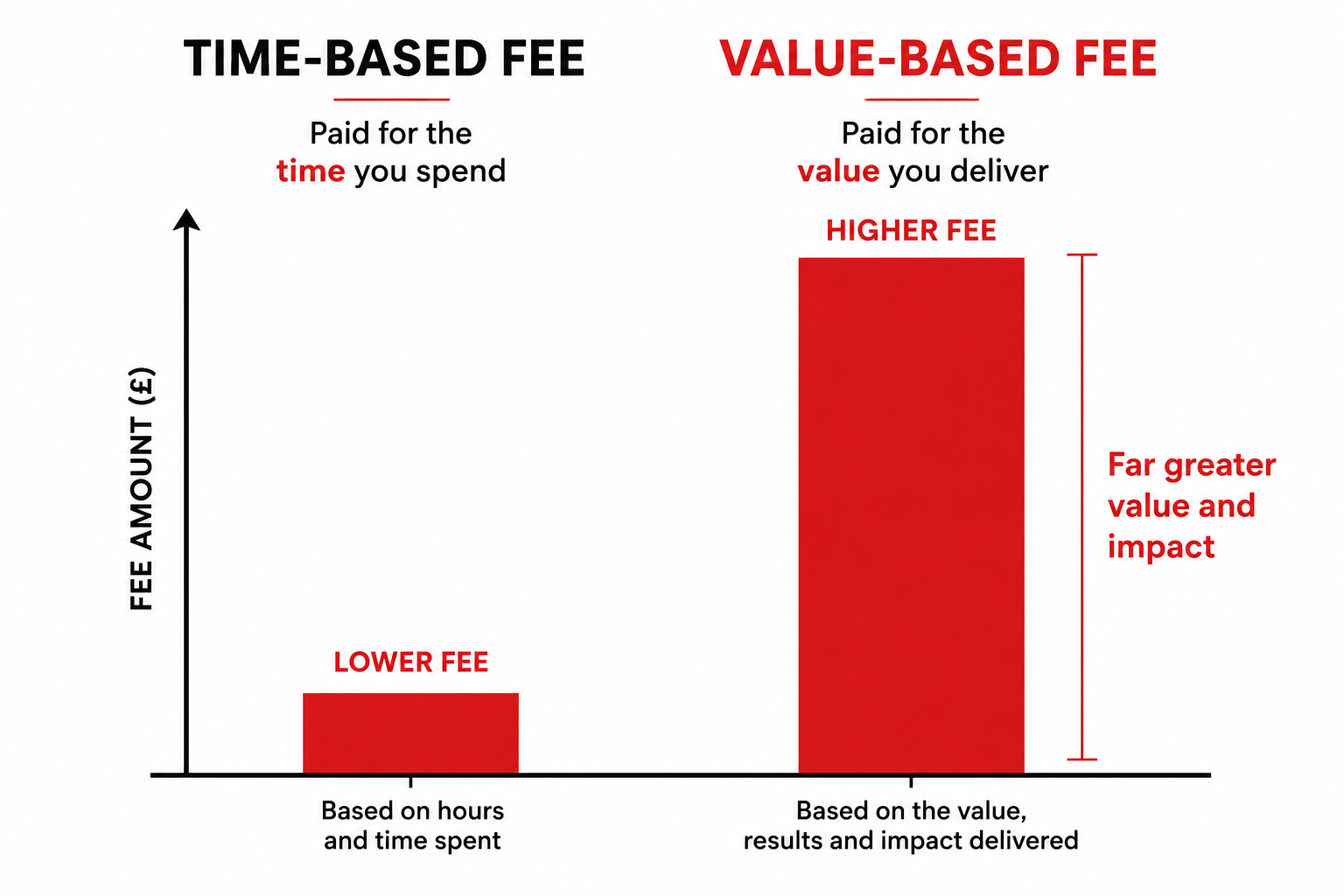
Value pricing means setting your fee based on the value your client receives from your help, rather than the time you spend delivering it.
That is it. One sentence.
And yet that one sentence, properly applied, has added hundreds of thousands of pounds to the incomes of the consultants and coaches I have worked with over the years.
You don’t get paid for the hour. You get paid for the value you bring to the hour.
Jim Rohn
Jim Rohn said that, and he was right. The hour is simply the container. The value is what you pour into it.
The Pricing Attribution Error
In my book paid! I describe what I call The Pricing Attribution Error.
Here is how the problem occurs.
A consultant (let’s call him John) decides his fee rate by valuing himself and his time. He looks at what feels comfortable, perhaps adds a little extra for profit, and that becomes his daily rate.
Please don’t do that.
When you set fees by the time you spend rather than the impact you have, you create five problems all at once:
- Reduced income. You cap your earnings at the number of hours you can work.
- Lower client belief. A low fee quietly tells the client your help can’t be worth much.
- Wasted time. You end up working more hours to earn what the value alone should have paid you.
- Poor positioning. You look like every other time-seller in your marketplace.
- Lower significance in your own eyes. And that one hurts the most.
Set your fees, not by the value of your day, but by the value of the benefits your client receives from your intervention, your advice, and your help.
A Simple Thought Experiment
Let me prove the principle to you with three quick examples.
Imagine, just for a moment, you worked purely on a contingency basis. You receive a commission on the increased financial results your client achieves by using your ideas.
- Your client gains an extra 10,000 pounds in profit. Would a 1,000 pound commission (10 per cent) be fair and reasonable? Yes, of course it would.
- Your client gains an extra 100,000 pounds in profit. Would a 10,000 pound commission be fair and reasonable? Yes, of course it would.
- Your client gains an extra 1,000,000 pounds in profit. Would a 100,000 pound commission be fair and reasonable? Yes, again.
So here is the question that matters.
Why would we charge the same fee rate when the values received by our clients vary so considerably? Even if we spent exactly the same amount of time with each of them?
The moment you can’t answer that question, you have understood value pricing.
I call this Price Pliability. It’s not the hours you put in, it’s what you put into the hours.
The Value of the Value
Now let’s go up a level, because this is where value pricing becomes genuinely powerful.
If the value you deliver in monetary terms is, say, 100,000 pounds, then the next level question is this. What’s the value of that value?
Your client gains an extra 100,000 pounds using your ideas. That money, on its own, is just numbers on a computer screen.
What’s the real value of that money to your client?
Is it a greater feeling of security? Is it a new car, a family holiday, presents for a partner and children? Is it time to enjoy other activities, or the ability to care for an elderly relative?
When you and I see the true difference our ideas make to our clients’ lives, we begin to realise why they will gladly pay fair and reasonable fees for our help.
Try this today
Take your best current client. Write down the financial value your work has created for them. Then write down what that money means in their life. That second answer is what you are really selling.
What Value Pricing Is Not
Let me be very clear about something, because this matters to me.
Value pricing is not about squeezing every possible pound out of unsuspecting people. It is not sleight of hand and it is not sleazy.
All of these ideas are based on value delivered. First we create the value. Then, and only then, do we charge in proportion to it.
When we focus on value, our clients and prospects feel that focus in everything we say and do. In every word. In every gesture.
Far better to build a business in this way. One we can be proud of. One where we can look back and say, "Yes, I made a positive difference in the world."
My motto has always been, only first-class business and that in a first-class way.
David Ogilvy
How to Start Using Value Pricing
You don’t need to change everything overnight. Here is a simple sequence to begin with:
- Diagnose before you quote. Ask questions that surface the size of the problem in pounds and pence before any fee is mentioned.
- Quantify the gain. Agree with the client what success is worth, in their numbers, not yours.
- Ask the value of the value. What will that gain mean in their life and business?
- Price against the value, not the diary. Your fee should look small next to the outcome, and it will.
- Quote a higher fee to the next enquiry and watch what happens. My first test was 2.5 times my old rate. It was accepted on the spot, and led to over 300,000 pounds of business with that one company.
That last point deserves repeating. When was the last time you tested your price? If your answer is "some years ago", then perhaps today is the day.
Testing Your Price: The Habit That Keeps Value Pricing Alive
Over the years I’ve asked many consultants, coaches and other professionals two simple questions.
"When was the last time you tested your price?" And, "When was the last time you raised your price?"
Both questions usually receive the same answer. "Ugh, some years ago!"
Value pricing isn’t a decision you make once. It’s a discipline you practise. In direct marketing we call the version that’s currently working the control, and we constantly test challengers against it. A new offer. A new structure. A higher price.
Your fees deserve exactly the same treatment. Test different prices with different offerings and offers, and find the level at which the maximum number of the right clients happily say yes.
And here’s something we’ve all experienced from the other side of the table. A quote from a supplier or tradesperson that felt too low, and instantly destroyed our confidence in the outcome. A price can be so small it frightens people. Your prospects feel that too.
One practical note. Testing takes a little courage, and courage comes far more easily when you have a regular stream of qualified leads to test with. If every enquiry feels like your last, you’ll always quote low to be safe. So build your lead flow and your fees together. Each one strengthens the other.
Where to Go From Here
Value pricing is a subject you and I could talk about for days, and on this site we practically do.
And if you’re ready to go deeper, my book paid! walks you through the whole method. The attribution errors, the proven pricing models, the Contrast Principle, and how to get rightfully, richly and regularly rewarded for the value you deliver.
You can get your copy at https://www.peterthomson.com/paid-book.
Because here’s the truth we both know.
You will never get paid more than you truly believe you are worth. So let’s start building that belief today, shall we?
Wishing you continued success
Peter
Peter Thomson
The next £5,000 a month may already be inside your business. Find out where with Your Gap Finder (free, 18 questions, about four minutes): https://yourgapfinder.com
Experience The British Business Coaches & Consultants Academy free for a month: https://www.peterthomson.com/bbcca
Stay connected with bite-size videos and updates!
Gain an unfair advantage and join fellow achievers who receive tgiMondays - FREE weekly bite-sized videos and blogs on business and personal growth and inspiration from my latest off the edge thinking and ideas.
We hate SPAM. We will never sell your information, for any reason.
