
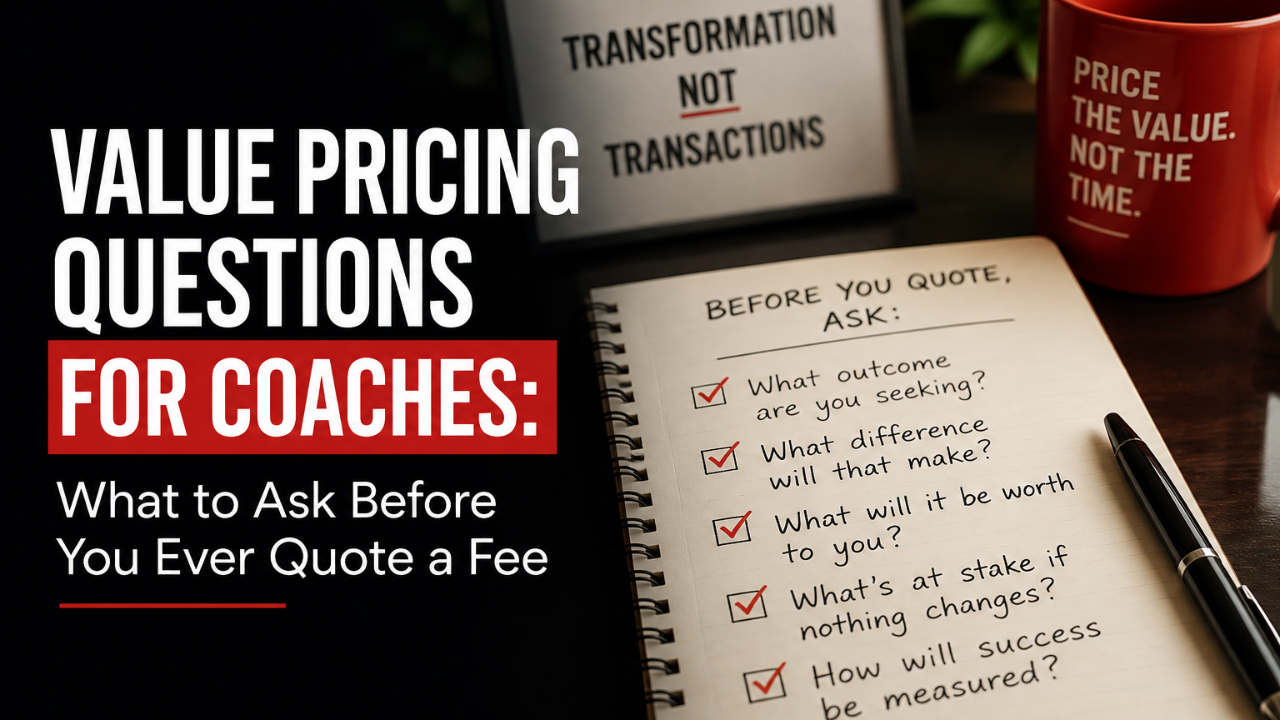
Value Pricing Questions for Coaches: What to Ask Before You Ever Quote a Fee
Aug 18, 2026In this article
- Why Questions Beat Presentations
- Stage 1: The Situation Questions
- Stage 2: The Cost-of-the-Problem Questions
- Stage 3: The Value-of-the-Solution Questions
- Stage 4: The Commitment Questions
- The Questions to Ask Yourself
- The Questions to Retire
- Putting It All Together
The quality of your fees is decided long before you state them.
It’s decided in the questions you ask.
Ask small questions, and you’ll be quoting against a small picture of the problem. Ask the right questions, in the right order, and by the time your fee arrives it’s standing next to a number so large it looks positively modest.
Over more than 50 years in business I’ve refined the questions I ask before any fee is ever mentioned. Today I’m going to hand them to you, with the thinking behind each one, so you can make them your own.
Have a notebook ready. You’ll want to write these down.

Why Questions Beat Presentations
First, a principle. Prescription before diagnosis is malpractice.
When you present your services before you’ve diagnosed the situation, you’re asking the client to value your solution against a problem neither of you has measured. Of course the fee feels arbitrary. It is.
Questions do three jobs at once. They give you the information to prescribe well. They help the client see their own situation clearly, often for the first time. And they establish, in the client’s own numbers and words, the value your fee will later sit beside.
And there’s a device I want you to use throughout. Make a statement, then ask a question. If the client answers the question, they accept the statement. Watch how often it appears below.
Stage 1: The Situation Questions
Begin with where they are. Gently, curiously, without a whiff of selling.
- Tell me about the business as it stands today. What’s working well?
- And what would you like to be different?
- How long has that been the case?
- What have you already tried?
That last question is one of my favourites, because it does two things. It stops you proposing something they’ve already attempted. And it quietly establishes that the problem doesn’t solve itself, which is exactly why they’re talking to you.
Stage 2: The Cost-of-the-Problem Questions
Now we put numbers on the pain. This is where the Contrast Principle begins its work.
Notice the technique in this real conversation from my own client work, with a company of 300 salespeople:
- "What might you be losing in sales per person per month? Would that be 10,000 pounds a month, 1,000 a month, or 2,000 a month?"
- "And how long has this situation been going on? Is it five years, one year, or two years?"
- "Let’s look at what that’s cost you. 300 salespeople, 2,000 pounds a month each, over two years. That’s 14.4 million pounds. Does that sound about right?"
See what’s happening? I offer a range and let the client choose the number. Their number, not mine. Then we multiply it out together, and I ask them to confirm the total.
The client’s reply was, "I’ve never thought about it that way, but yes, it is that astonishing amount."
When the client speaks the number aloud, they own it. And every fee discussed afterwards is measured against it.
Key craft point
Always offer a range with the highest figure first. "Would that be 10,000 a month, 1,000, or 2,000?" The client picks the honest middle, and it’s still a number big enough to matter.
Stage 3: The Value-of-the-Solution Questions
Cost tells us what staying stuck is worth. Now we measure what moving is worth.
- If this were working exactly as you’d want, what would the next twelve months look like?
- What would that be worth in revenue or savings, in round numbers?
- What becomes possible then that isn’t possible now?
- And who else benefits when this is solved? Your team? Your family?
Then comes the question I’m best known for, and it takes everything a level deeper.
What’s the value of the value?
An extra 100,000 pounds is just numbers on a computer. What does it become? A greater feeling of security? A new home, a family holiday, care for an elderly relative, time to enjoy life?
When a client tells you what the money means, you’re no longer discussing a project. You’re discussing their life. And people invest very differently in their lives than in their projects.
Stage 4: The Commitment Questions
Before any fee, I want to know we’re both serious. So, kindly:
- On a scale of one to ten, how important is solving this in the next six months?
- What happens if you do nothing?
- If we agreed the right approach together, is there anything that would stop you going ahead?
These questions protect both of you. A client who answers "three out of ten" has told you something valuable, and you’ve both been saved a doomed proposal.
Remember, you and I are looking for the relational client who wants an expert, not the transactional buyer hunting the cheapest hours. The commitment questions reveal which one is sitting in front of you.
The Questions to Ask Yourself
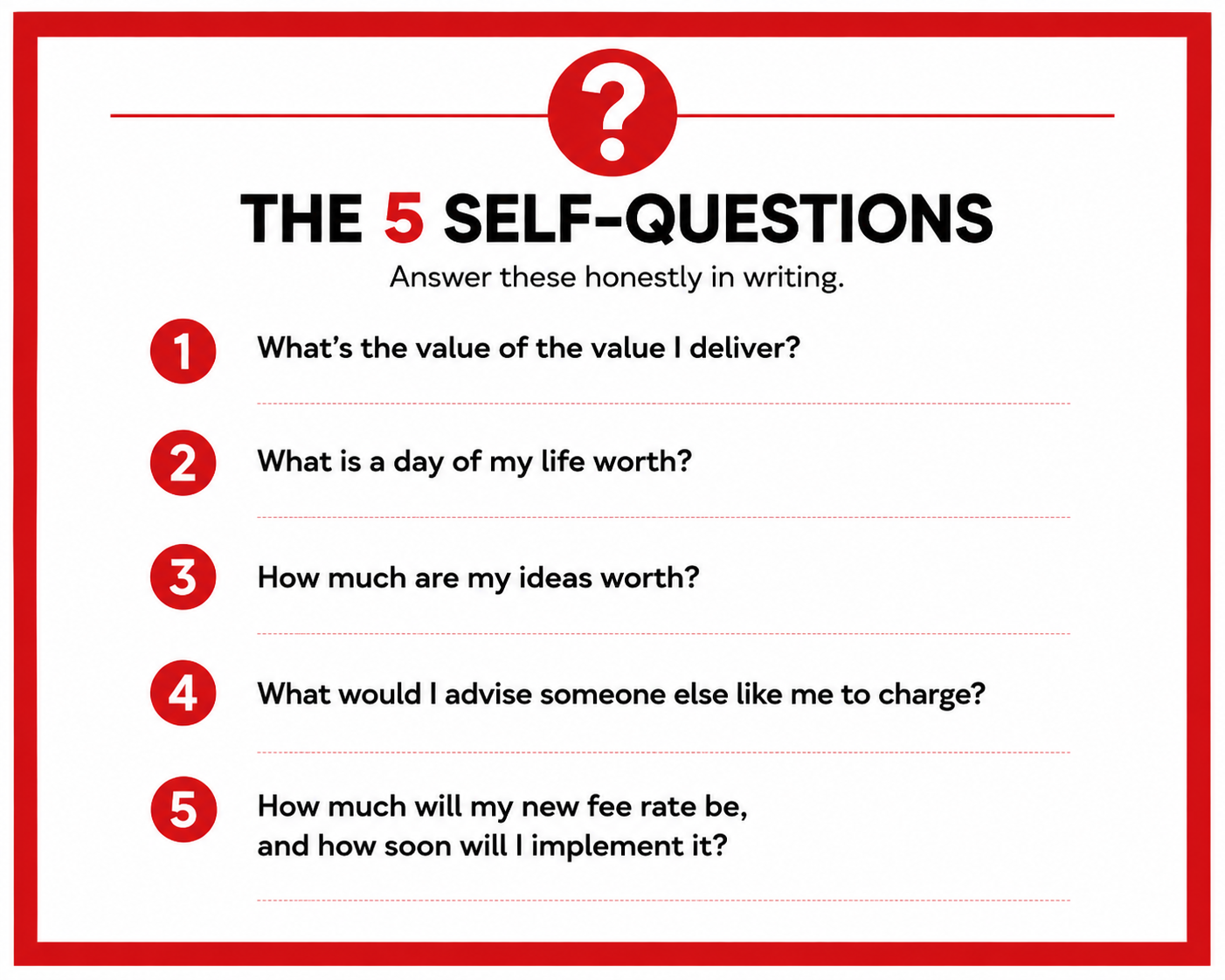
One more set, and these might be the most valuable on the page. In paid! I ask readers to answer these in writing:
- What’s the value of the value I deliver?
- What is a day of my life worth?
- How much are my ideas worth?
- What would I advise someone else like me to charge?
- How much will my new fee rate be, and how soon will I implement it?
That fourth question uses what I call the Advice-Giving Effect. When we show someone else what to do, we’re also showing ourselves. You already know the answer you’d give a friend in your position. Did I hear you say, "Now!"?
The Questions to Retire
Just as important as the questions we ask are the ones we stop asking. Three in particular deserve a dignified retirement:
- "What’s your budget?" This question hands the pricing of your value to a number set before anyone measured the problem. Budgets were built for expected costs. Your job is to reveal an unexpected value. Measure the problem first, and budgets have a way of growing to meet it.
- "How many days do you think you’ll need?" The moment you ask this, you’ve agreed that days are the product. They aren’t. The outcome is.
- "Does that price work for you?" Asked with an apologetic tilt of the head, this invites a negotiation nobody had started. State the investment warmly, then be quiet, and let the silence do its gentle work.
And a word on listening, because questions are only half the craft.
When the client answers, write their words down. Their exact words. When you later present your offering, use their phrases back to them. "You told me the stress is costing you more than the salary gap." Nothing you could invent will ever persuade a client like their own sentence, returned to them with care.
Silence matters too. After a big question, especially "what would solving this be worth?", resist the urge to fill the pause. The best answers in my 50 years of these conversations arrived after a silence I very nearly interrupted.
Putting It All Together
Here’s the sequence on one line. Situation, cost of the problem, value of the solution, value of the value, commitment. Then, and only then, the fee.
Run that order and something rather lovely happens. The fee stops being a confrontation and becomes a conclusion. The client has built the case for it themselves, one honest answer at a time.
The complete question-by-question approach, including the full Contrast Principle conversation, is in my book paid!, and you can get your copy at peterthomson.com/paid-book.
The right questions, asked with genuine care, serve everyone. The client sees their situation clearly. You quote with confidence. And the value you deliver finally gets measured before it gets priced.
And a final encouragement. Questions like these feel unfamiliar for the first two or three conversations, the way any new skill does. By the fifth, they feel natural. By the tenth, you’ll wonder how you ever quoted without them, and so will your bank manager.
Practice makes permanent, as I like to say. So practise the right sequence from the start. Rehearse the questions aloud before your next enquiry call, exactly as you would rehearse a presentation, until the words feel like yours rather than mine. Fluency in these conversations is a skill, and like every skill worth having, it rewards deliberate practice generously. Ten conversations from now, this will simply be how you talk.
So, which question will you ask first?
Stay connected with bite-size videos and updates!
Gain an unfair advantage and join fellow achievers who receive tgiMondays - FREE weekly bite-sized videos and blogs on business and personal growth and inspiration from my latest off the edge thinking and ideas.
We hate SPAM. We will never sell your information, for any reason.
