
Value Pricing for Consultants: How to Charge for Impact, Not Attendance
Aug 11, 2026In this article
- The Consultant’s Trap
- Start With the Diagnosis, Not the Proposal
- Six Proven Pricing Models for Consultants
- Positioning: Becoming the Harrods of Your Niche
- Choose Relational Clients, Kindly Decline the Rest
- Raising Fees With Existing Clients
- The Invoice You Raise to Yourself
- Your Consulting Practice, Repriced
Attention, fellow consultant. This one is written for you.
Because of all the professionals I’ve worked with over the past five decades, consultants are the ones most likely to be sitting on a fortune of undercharged value.
You solve problems worth hundreds of thousands of pounds. You get paid for days.
Does that seem right to you? It has never seemed right to me.
So let’s fix it. Properly, practically, and without a single sleazy tactic anywhere in sight.
[Image placeholder: Consultant in a client boardroom, confident and relaxed]
The Consultant’s Trap
Here’s how the trap gets built, and see if any of this sounds familiar.
When you started consulting, you needed a number for the "what do you charge?" question. So you looked at your old salary, divided by working days, added a margin, and glanced at what other consultants charge.
And there it was. A day rate. Built entirely from your costs and your comparisons, with the client’s outcome nowhere in the calculation.
That is the Pricing Attribution Error. Setting fees by the time we spend rather than the impact we have and the value we deliver.
The trap tightens over the years, because every client who accepted the old rate becomes "evidence" that the rate is correct. It isn’t. It’s only evidence that you asked for it.
It’s not the hours you put in, it’s what you put in those hours.
Peter Thomson
Start With the Diagnosis, Not the Proposal
Consulting has a wonderful advantage over most professions. Diagnosis is already part of the work. We simply need to move it before the fee instead of after.
Before any proposal, sit with your prospective client and quantify three things together:
- The cost of the problem. What is the current situation costing per month? How long has it been going on? Multiply it out and let the client say the total aloud.
- The value of the solution. If this were fixed, what would the next two years look like in revenue, savings or capacity?
- The value of the value. What would that gain mean for the business and the people in it? Security, growth, calmer leadership, better jobs?
I once ran exactly this conversation with a company of 300 salespeople. Lost sales of around 2,000 pounds per person per month, running for two years. That’s 14.4 million pounds, and the sales director had genuinely never totalled it before.
Once that number was on the table, the fee for solving it was never going to be the sticking point.
Six Proven Pricing Models for Consultants
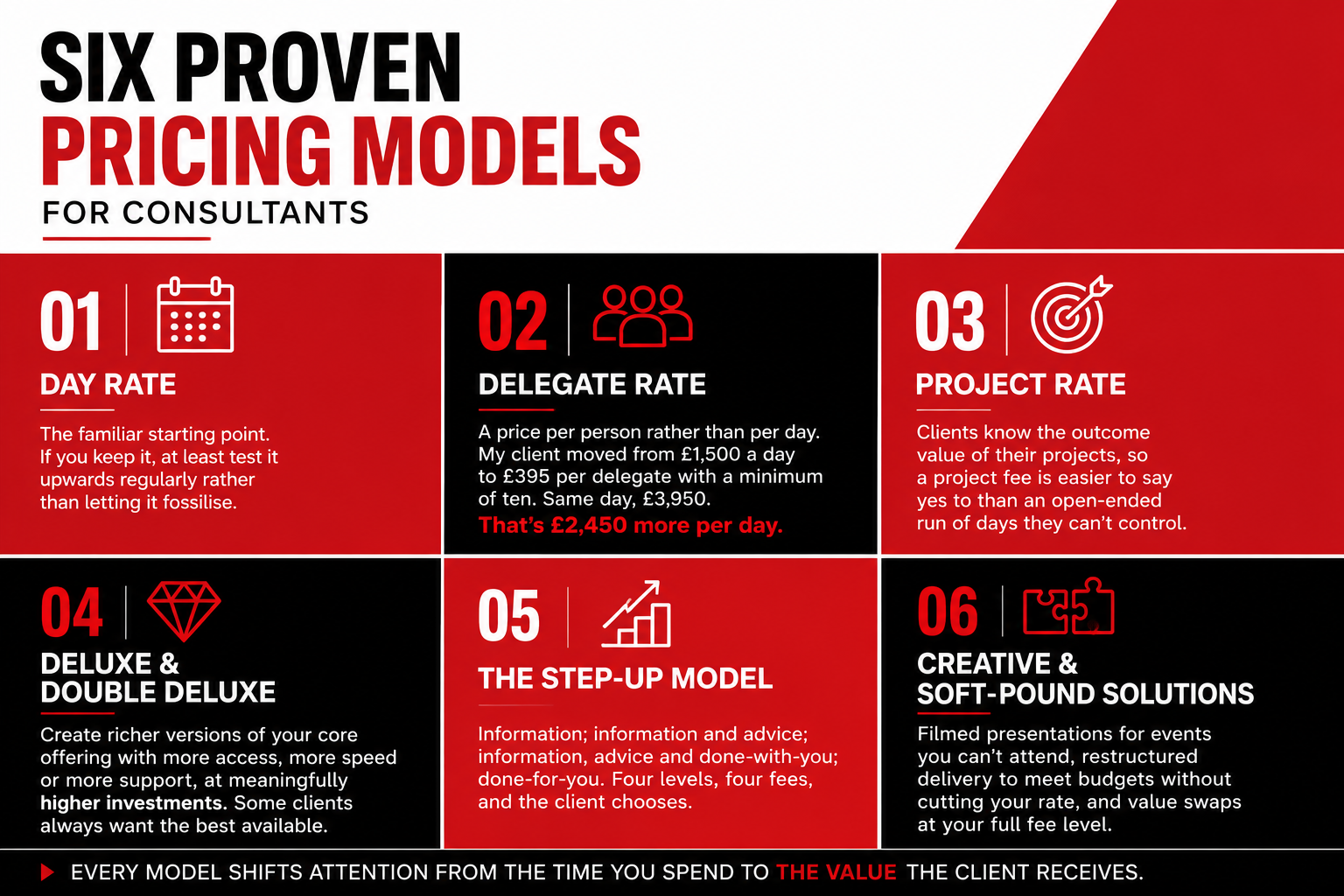
In my book paid! I devote a whole chapter to proven pricing models. Here they are in brief, and I’d encourage you to test the ones that feel right. Perhaps even the ones that feel uncomfortable at first!
- Day rate. The familiar starting point. If you keep it, at least test it upwards regularly rather than letting it fossilise.
- Delegate rate. A price per person rather than per day. My client, a presentation skills trainer, moved from 1,500 pounds a day to 395 pounds per delegate with a minimum of ten. Same day, 3,950 pounds. That’s 2,450 pounds more per day, happily accepted.
- Project rate. Clients know the outcome value of their projects, so a project fee is easier to say yes to than an open-ended run of days they can’t control.
- Deluxe and Double Deluxe. Create richer versions of your core offering with more access, more speed or more support, at meaningfully higher investments. Some clients always want the best available.
- The Step-Up Model. Information; information and advice; information, advice and done-with-you; done-for-you. Four levels, four fees, and the client chooses.
- Creative and soft-pound solutions. Filmed presentations for events you can’t attend, restructured delivery to meet budgets without cutting your rate, and value swaps at your full fee level.
Notice the theme. Every model shifts attention from the time you spend to the value the client receives.
Positioning: Becoming the Harrods of Your Niche
A quick question. Why does the same tray command one price at a car boot sale and quite another in Harrods?
The brand of the supplier. That’s the whole answer.
Your fees sit on the shelf of your positioning. So as a consultant, invest deliberately in the factors that build your supplier brand: trust, reputation, testimonials, your visibility, your time in business, and (the strongest one of all in my experience) author status.
A strange and wonderful thing happens as soon as we become an author. Our feeling of self-worth increases, and this new confidence shines through everything we say and do. That’s how you establish author-ity.
Even a short report or white paper with your name on it changes how prospects meet you. A full book changes it completely.
Positioning phrase to borrow
Try "In my private practice, I only work with five major clients at any one time, because of the focus each one deserves." Wonderful positioning, with an honest dose of scarcity built in.
Choose Relational Clients, Kindly Decline the Rest
Value pricing works with clients who want an expert, not a supplier of hours.
The transactional buyer already knows exactly what they want and shops purely on price. Serve them if you wish, but don’t expect a value conversation to land.
The relational client looks to you for judgement and outcomes. With them, price becomes only a factor, never the factor.
And a gentle warning from someone who learnt it the long way. When we deal with the right clients, all the major problems become minor. When we deal with the wrong ones, all the minor problems become major. Choose your clients as carefully as they choose you.
Raising Fees With Existing Clients
The question every consultant asks me. "Peter, this is fine for new clients, but what about my existing ones?"
Three suggestions:
- Test with new enquiries first. Build your evidence and your belief where there’s no history to manage. My first test, at 2.5 times my old rate, was accepted on the spot and led to over 300,000 pounds of business.
- Attach increases to new offerings. A new programme, a new level of access or a new outcome justifies a new investment far more naturally than a letter announcing a rise.
- Give notice, give reasons. When you do raise fees with existing clients, say why. Reasons build trust, and clients respect a professional whose value is visibly growing.
And when was the last time you actually did any of this? If the honest answer is "some years ago", then you already know what this week’s task is.
The Invoice You Raise to Yourself
Before we finish, here’s an exercise from paid! that changes how consultants spend their days, usually within a week of trying it.
Imagine you must raise an invoice for your time at the end of every single day. If you haven’t been working for a client, then you’ve been working for yourself. So the question becomes, how much will you charge yourself for your day?
Say you’ve valued your day at 1,000 pounds (and for most consultants reading this, it should be far more). If day one of the month passes without a client invoice, tomorrow you need to generate 2,000 pounds of value. Miss the second day, and the third must carry 3,000.
Suddenly the low-value tasks that fill a consultant’s diary reveal themselves for what they are. Was that afternoon of formatting really worth a quarter of a 1,000 pound day? Was that meeting?
The exercise isn’t about guilt. It’s about respect. Once a day of your life carries a stated value, you become wonderfully careful what you trade it for. And clients, curiously, sense that care. People pay more, and more happily, for time that is visibly precious.
Your Consulting Practice, Repriced
Imagine your practice twelve months from now. Fewer, better clients. Fees connected to outcomes. A diary with room to think. And an income that finally reflects the difference you make.
None of that requires new qualifications. It requires a new relationship with your own value.
Start with the foundations at What is Value Pricing?. If you also serve individual clients, my companion piece at Value Pricing for Coaches will help.
And for the complete consultant’s toolkit, every model, every conversation, every word, get your copy of paid! at peterthomson.com/paid-book.
And do keep this page handy for the day a prospect asks the old question, "So what’s your day rate?" You’ll smile, because you’ll know exactly what to do. Ask about the problem first.
You’ve spent a career becoming excellent.
Now let’s get you rightfully, richly and regularly rewarded for it.
Stay connected with bite-size videos and updates!
Gain an unfair advantage and join fellow achievers who receive tgiMondays - FREE weekly bite-sized videos and blogs on business and personal growth and inspiration from my latest off the edge thinking and ideas.
We hate SPAM. We will never sell your information, for any reason.
