
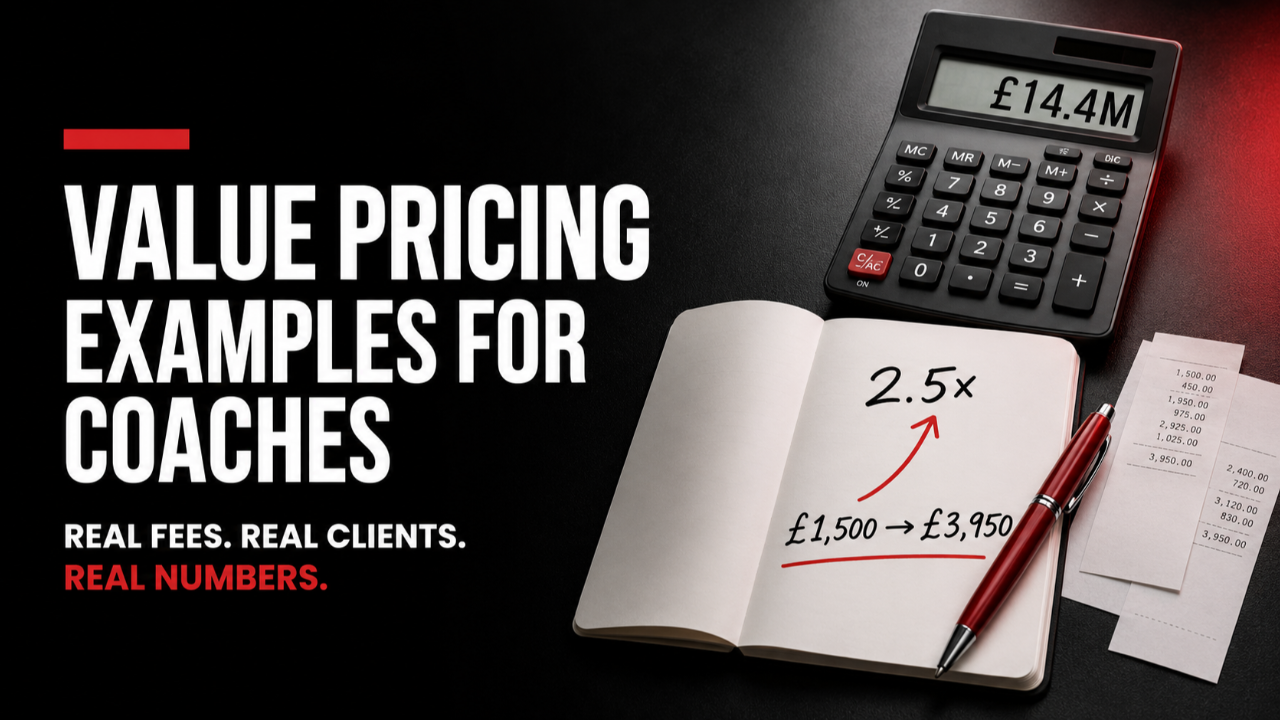
Value Pricing Examples for Coaches: Real Fees, Real Clients, Real Numbers
Aug 27, 2026In this article
- Example 1: The 2.5 Times Fee Test
- Example 2: The Delegate Rate
- Example 3: The 14.4 Million Pound Contrast
- Example 4: The Soft-Pound Deal at Full Rate
- Example 5: Eighteen Events, Four Dates
- Example 6: The Creative Restructure
- The Pattern Behind Every Example
- Your Own Example Starts This Week
Theory is comfortable. Numbers are convincing.
So today, no theory. Just real examples of value pricing from my own five decades in business and from the clients I’ve worked with. The actual fees, the actual conversations, and the lesson hiding inside each one.
Some of these numbers may make you slightly uncomfortable. Good. That feeling is usually the sound of an old belief loosening.
Ready? Let’s look at the evidence together.

Example 1: The 2.5 Times Fee Test
Many years ago I was the MC and a speaker at a seminar. After my session, a businessman approached me about training his sales team, and asked my day rate.
I’d been considering raising my fees for a while. This was the first chance to test the new price. So I quoted 2.5 times my normal rate.
He readily accepted.
My immediate thought? I should have quoted even higher!
That relationship went on to produce over 300,000 pounds of business. That’s 180,000 pounds more than my old rate would have generated. And because the company’s turnover grew by more than 10 million pounds through the ideas we implemented, everyone received wonderful value.
The lesson: the old fee wasn’t a market rate. It was a belief. The market accepted the new number without a murmur; only my belief had ever objected.
Most people reach the limit of their belief well before they reach the limit of their talent.
Jeff Pettitt
Example 2: The Delegate Rate
One of my clients is a successful trainer who teaches executives to speak confidently in public. When we met, his average day rate was 1,500 pounds. Massive undercharging for the results his delegates achieved.
Here’s the idea I gave him. Stop charging for the day. Charge a Delegate Rate of 395 pounds per person (hardly expensive for training executives to speak in public!) with a minimum of ten delegates.
He tested it. It was readily accepted.
Ten delegates at 395 pounds equals 3,950 pounds. That’s 2,450 pounds more per day. Same trainer, same room, same day.
The lesson: change the unit and you change everything. A price per person, per location or per campaign attaches your fee to the value spread, not the hours spent. Could you use a price per X in your business? Many of my clients have, and reaped their fair rewards.
Example 3: The 14.4 Million Pound Contrast
A major company approached me about training their 300-strong sales team. Rather than a course that would take the team off the road, I proposed a personalised ten-part programme built from my Accelerated Business Growth System.
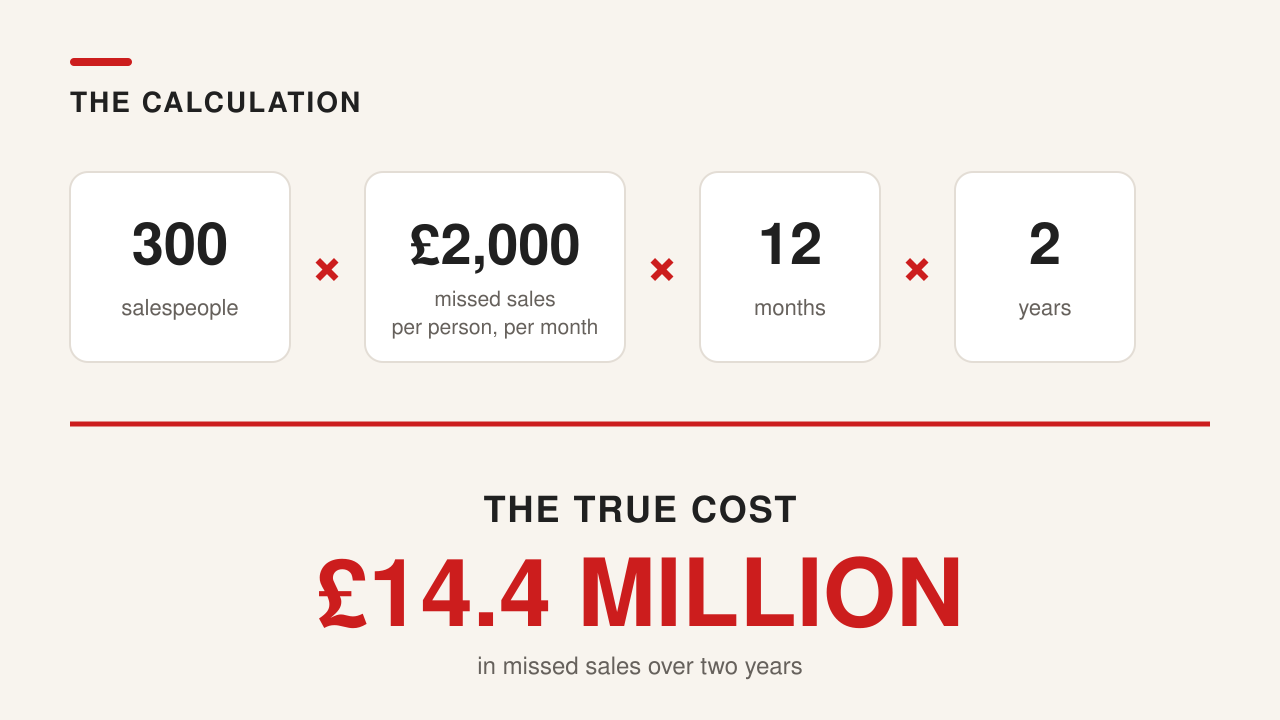
Before any price, we had this conversation. How many salespeople? 300. What might each be losing in sales per month? At least 2,000 pounds, the client said. And for how long? About two years.
So we did the multiplication together. 300 people, times 2,000 pounds, times 12 months, times two years. 14.4 million pounds.
"I’ve never thought about it that way," said the client, "but yes, it is that astonishing amount."
Only then did we discuss the investment in the programme. And measured against 14.4 million pounds, it was never going to be a difficult conversation.
The lesson: contrast before any price. Always. The mind cannot judge a fee in isolation. It can only compare. Your job is to make sure it compares against the true size of the problem.
Example 4: The Soft-Pound Deal at Full Rate
About 20 years ago, a furniture manufacturer asked for my help with their marketing. I quoted my usual fee at that time, 5,000 pounds a day. They were happy to proceed, and then suggested a soft pound deal.
Instead of paying the 5,000 pounds, they supplied me with a three-piece suite retailing at 12,000 pounds (their cost, 5,000 pounds). Properly declared as 5,000 pounds of income, and an excellent trade for everyone.
The lesson: sometimes it’s not the money we need, it’s what we would buy with the money. And notice the quiet rule underneath. If your fee rate is low, every swap happens at that low exchange rate. If your fee rate is high, so is every exchange you ever make. Your headline fee sets the value of everything downstream.
Example 5: Eighteen Events, Four Dates
A client asked me to speak at 18 events with a total attendance of 7,000 of their customers. My diary could make four of the dates. The old model says: lose the other fourteen.
Instead, I offered a personalised video of my presentation, tailored with examples of their products and services, to play at the events I couldn’t attend.
The client was happy. The audiences were happy. In fact, even on screen rather than in the room, I was still rated the top speaker at those events. And I was paid for value delivered at all 18, while attending four.
The lesson: when you price on value rather than attendance, your time stops being the limit of your income. Your knowledge, experience and expertise can be in eighteen rooms at once.
Example 6: The Creative Restructure
A large corporate client wanted me to train their 270 salespeople through a series of two-day events around the country. One problem. Their budget didn’t match the fee I was proposing for that many days.
Now, the standard responses at this point are to discount (never) or to walk away (sometimes necessary, but a shame for everyone).
Instead, I suggested a third route. One large one-day event with all 270 people together, followed by a shorter series of single-day sessions around the country.
Fewer days of my time meant a lower total investment for them, at my full rate for every day involved. The budget was met, the outcome was delivered, and the contract was secured.
The lesson: when budget and fee don’t meet, change the shape of the delivery, never the value of your day. Your rate is the one thing that must hold. Everything else about how the value is delivered can flex around it.
This matters more than it first appears. Every discount teaches the client, and worse, teaches you, that the rate was negotiable all along. A restructure teaches the opposite. The rate is fixed because the value is real. The delivery is flexible because you’re on their side.
The Pattern Behind Every Example
Look back across those five stories and you’ll see the same shape repeating:
- The value existed before the price changed. Nothing was inflated or invented. The fee simply caught up with the value.
- The client’s numbers led the conversation. Their lost sales, their turnover, their outcomes.
- Every new price was a test. Quoted once, accepted or adjusted, learnt from. That’s how a control is built and beaten.
- Everyone finished happy. Fair fees for real value is a business you can be proud of. Only first-class business, and that in a first-class way, as David Ogilvy put it.
And notice what none of the examples required. No pressure. No tricks. No nastiness anywhere.
Your Own Example Starts This Week
Here’s my gentle challenge to you.
Somewhere in your business right now is a fee waiting to be tested. A quote you’re about to send at the old rate. A programme priced per session instead of per transformation. A day rate that could become a delegate rate.
Pick one. Test it once. Write down what actually happens.
Every one of these examples, along with the complete system they came from, lives in my book paid!. Get your copy at peterthomson.com/paid-book.
Before you go, a thought about why examples matter so much in this subject. Pricing courage is rarely built by argument. It’s built by evidence. Every story above was, at the time, one professional deciding to test one number, once. None of them knew the outcome in advance. All of them found the market far more willing than their fears had predicted.
Your evidence will do more for your belief than anything I can write. But borrowed evidence is a fine place to start, and now you have six pieces of it. Keep them somewhere visible for the week ahead, and reach for the one that fits the moment whenever your nerve needs a little company before a quote.
One of my clients tested a single idea from that book and added 2,450 pounds to every working day.
What might one idea be worth to you?
Peter
Peter Thomson
'The UK's Most Prolific Business Development Author'
Peter
Peter Thomson
'The Uk's Most Prolific Business Development Author'
PS: If you'd like my help implementing any of these ideas, let's set up a time to speak. Send an email to RAchel Groves - [email protected] and she will organise it.
Stay connected with bite-size videos and updates!
Gain an unfair advantage and join fellow achievers who receive tgiMondays - FREE weekly bite-sized videos and blogs on business and personal growth and inspiration from my latest off the edge thinking and ideas.
We hate SPAM. We will never sell your information, for any reason.
