
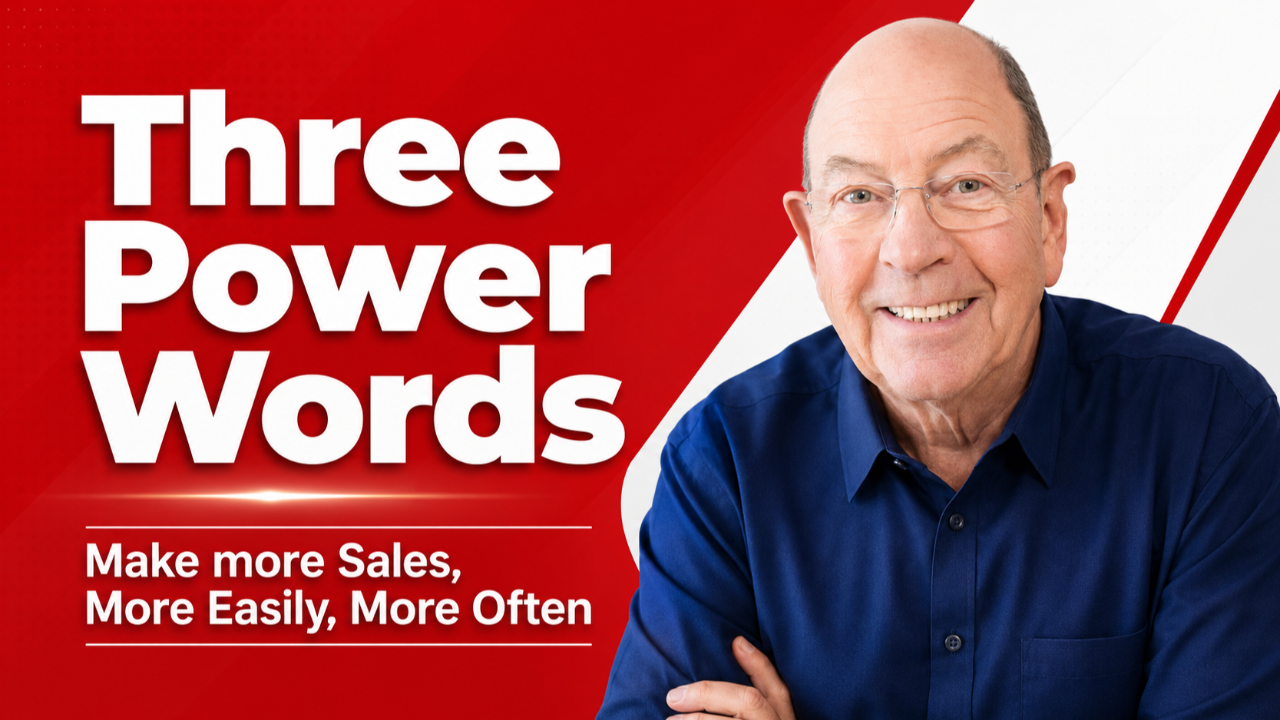
Three Power Words That Quietly Increase Your Conversion Rates
May 19, 2026Let me share something with you that I have been using for more than twenty years, and that I believe will help you make more sales, help more people, and make more money at the same time.
It is not a clever funnel. It is not a new piece of software. It is simply the words you choose.
Over my twenty seven years of helping coaches, consultants, speakers, trainers and small business owners build a business and a life of choice, I have learnt that the right word, used in the right place, changes everything. The same offer, the same audience, the same product, and yet a different result. All because of the words.
So in this article I want to give you three power words you can start using today, plus two bonus words at the end that bring real emotion into your message.
The same offer. The same audience. A different result. All because of the words.
One day I was walking through the Touchwood centre in Solihull, in the middle of England, with my wife. We stopped at a coffee shop before the shopping started, and there on the counter where you pay was a small printed sign.
It said three words. Sexy people tip.
And the tip bowl was full.
Now, because I am endlessly fascinated by marketing, I asked the person behind the counter whether that sign actually changed how much they were tipped, and whether they had tested it.
They had. They told me they had tried asking for money to buy football tickets. They had tried asking for drinks for the staff. But the one that beat them all was those three simple words.
Three words. A measurable difference. No extra cost, no extra effort, just a better choice of language.
That is what this article is about. The difference certain words can make to your marketing, and the specific words you and I can use.

Power word one: Free
The first word is free.
This is one I made a mistake with for years, because I assumed something that simply was not true.
In the early days I thought that if I had something valuable and I gave it away free, then of course everybody would want it. Wouldn't they?
No, they would not. And here is the reason why.
Even when something is free, there is still something the reader has to do. They have to give you their attention. They have to give you their email address. They have to give you their time. So free is never truly free to them.
You probably already use content marketing in some form. Perhaps you send out a checklist, a free report, or you run a webinar or some online training at no charge. That is good. But here is the part most people miss.
If you do not give the free item a value, it is not free. It is for nothing. And for nothing is worth exactly that.
When you attach a clear value to something, a price, a number, a sense of what it would normally cost, and then you give it away free, the word free does its work. The reader now understands what they are receiving and what they are saving.
Try this: Take your free report or checklist and give it a stated value before you give it away. Not Download my free guide, but Download my guide, normally part of a paid programme, yours free today. Same guide. The word free now means something.
If you would like the full picture of how a free lead generator turns into well qualified clients, I have written about that in detail in my book PAID! and inside The Paid Up Club community. I will point you to both at the end.
Power word two: You
The second word is you.
There is a common expression among copywriters, and I am a copywriter myself. I love writing copy and I love reading about writing copy. The expression is this. Do not we all over your copy.
You have seen it everywhere. Websites that say we do this, and we have been in business for that long, and we, we, we. The whole page is about them.
We do not need to be we-ing all over everything. We need to be you-ing on everything.
Remember that the reader is one person. Not a crowd. When I stand on a stage I can say all of you, some of you, in your minds, because I am speaking to a room. But writing is different. Writing is one person, alone, reading. So write to that one person and talk to them directly.
Instead of we do this, write you and I know this. Swing the language right over to the reader's side of the page.
A friend of mine is a professional speaker who came second in the world speaking championships. He told me a coach once made him go through his material and count every time he said I or we, against every time he said you. The aim was to get that needle swinging hard towards you. When he did, the whole message became far more acceptable to the audience.
We do not need to be we-ing all over everything. We need to be you-ing on everything.
You can do the same with anything you have written. A web page, an email, a sales letter. Read it back and count. Then rewrite it so the reader is the hero of every sentence.
Power word three: Yes
The third word seems strange at first. It is the word yes.
To understand why it works, let me introduce you to an idea called syntactic ambiguity. It sounds complicated. It is not. Trust me.
Syntactic ambiguity is when you use a word at the start of a second sentence that would also fit perfectly at the end of the sentence in front of it.
Here is how it works in marketing. You ask a gentle, rhetorical question. Something like, that makes sense, doesn't it?
Notice the little tag on the end. Doesn't it. Wouldn't it. Isn't it. These are yes tags. They quietly invite agreement.
Then you begin the next sentence with the word yes.
That makes sense, doesn't it? Yes.
Read it again and you will feel it. The word yes sits perfectly at the start of the new sentence, and it also completes the question that came before it. The reader has agreed with you without quite noticing they did.
You have seen this used on order pages, perhaps without realising. The language suddenly changes. It stops being me speaking to you and becomes you speaking as yourself. Yes, please send me my copy of this, and add the bonuses.
When you read those words, you read them as though you wrote them. I call this integrity based prestivoxitation. Prestidigitation is sleight of hand. This is sleight of voice. Used with integrity, where you make the reader the author of the words, it is one of the most powerful things you can do in writing.
A note on integrity: These words work because they are true and because they serve the reader. Use them to help the right person say yes to something that genuinely helps them. Never to push the wrong person into something that does not.
Bonus words: Hate and Love
I promised you a bonus, and in fact there are two. The bonus words are hate and love.
Both are powerful because marketing, at its heart, is emotional. We do not buy on logic. We buy on feeling and then justify it afterwards with logic.
So we do not want to write something flat, like, that would not be very nice. That moves nobody.
We want to write with feeling. You would hate for this to happen. You would love for this to happen.
Bring the emotion through the words you choose. The difference between a sentence that is read and forgotten and a sentence that is read and felt is very often a single word.
You would hate for this to happen. You would love for this to happen. The emotion is in the words you choose.
How to put these words to work this week
Knowing these words is one thing. Using them is another. So here is what I suggest you do this week, in order.
- Find your free thing. Locate your report, checklist or webinar and give it a clear stated value before you offer it. Free means more when it has a number attached.
- Count your you. Take one piece of your writing and count how many times you say I or we against how many times you say you. Rewrite it to swing the needle towards the reader.
- Add a yes. Find one rhetorical question in your copy, add a gentle yes tag, and begin the next line with the word yes.
- Bring the feeling. Look for one flat sentence and rewrite it using hate or love so the reader feels something rather than simply understands something.
Four small changes. None of them costs you a penny. Each of them, in my experience over many years and many tests, moves the needle on conversion.
That is the whole point of this. You are not changing what you sell. You are changing the words around it, so more of the right people say yes, and you get to help more of them.
Your next step
If you and I were sitting together with a coffee, this is the moment I would lean in and say, now go and use just one of these.
But if you want the complete picture, how the words, the lead magnet, the follow up and the offer all fit together so you get rightfully and regularly rewarded for the work you do, then I have two things for you.
My book PAID! gives you the full system for turning your knowledge into well paid client work. It is written the way I speak, so it is an easy read and a fast one.
You are not changing what you sell. You are changing the words around it. So more of the right people say yes.
I wish you every success in all your adventures, and the freedom to be, to do, and to have, always in that order, whatever you set your heart and mind upon.
Peter
Peter Thomson
'The UK's Most Prolific Business Development Author'
#BusinessDevelopment #PeterThomson #ThePaidUpClub #Copywriting #Persuasion #Marketing #Coaches #Consultants #Speakers #Trainers #ConversionRate #PowerWords
Stay connected with bite-size videos and updates!
Gain an unfair advantage and join fellow achievers who receive tgiMondays - FREE weekly bite-sized videos and blogs on business and personal growth and inspiration from my latest off the edge thinking and ideas.
We hate SPAM. We will never sell your information, for any reason.
