
Seven Headline Formulas That Never Go Out of Style
Jul 21, 2026In this article
Formula six: The small mistake
Formula seven: Who else wants...?
The subject line isn't the headline
Questions make wonderful headlines
One of the biggest mistakes people make is believing that great headlines arrive through inspiration.
They don't. More often than not, they're built from proven patterns.
If you study the greatest copywriters over the last hundred years, you'll notice they repeatedly use the same structures. Different words. Different markets. Different products. The same underlying formulas.
John Caples summed up why headlines matter so much: if the headline is poor, the copy will not be read. And copy that isn't read never sells anything. Simple. Obvious. Completely true. Everything starts with earning attention. No headline, no reader. No reader, no sale.
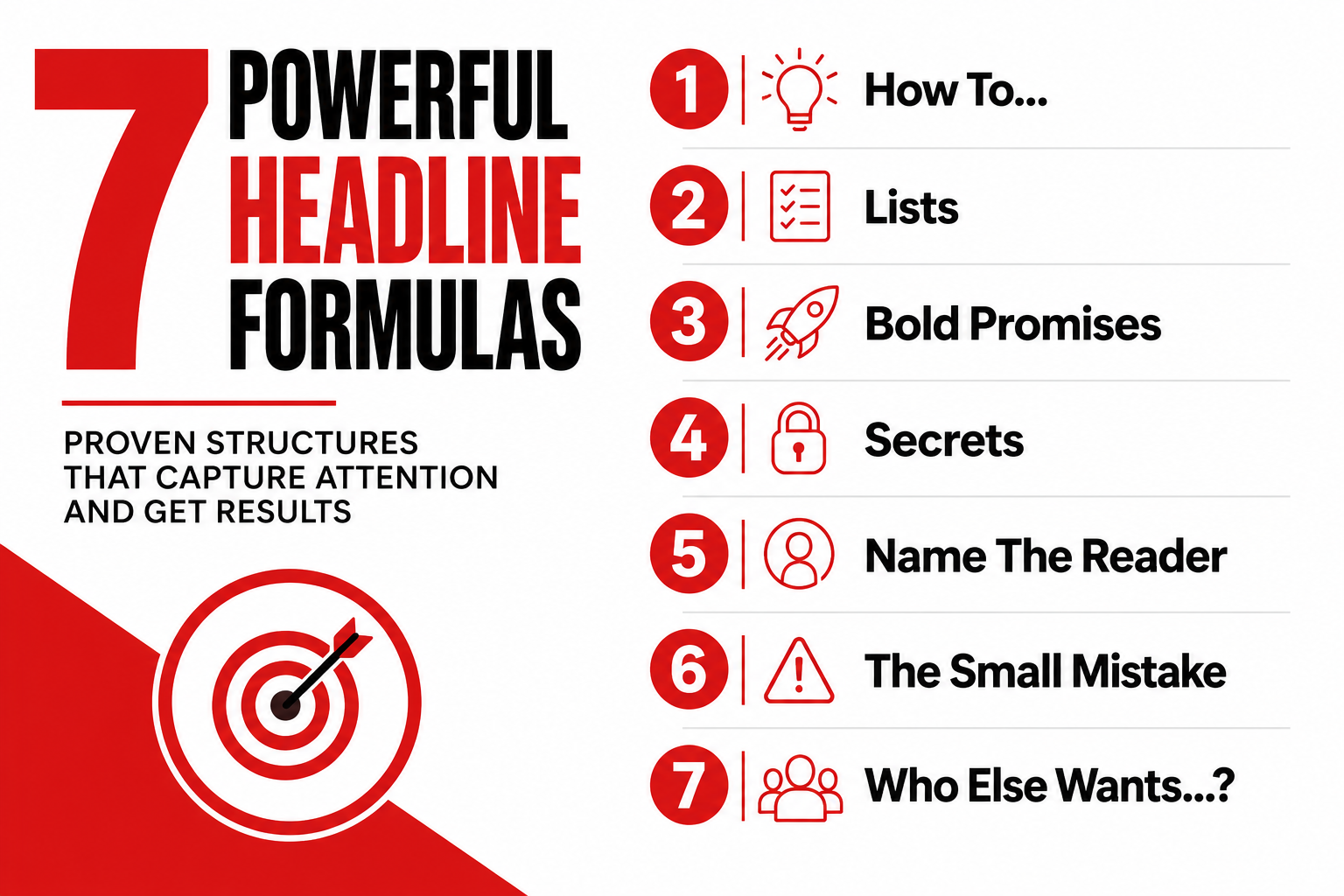
So in this article I'm going to give you seven of my favourite headline formulas. Think of them as templates rather than finished headlines. They're starting points. Scaffolding. You adapt them to suit your own audience.
Your headline's job isn't to sell. Its job is simply to earn the next few seconds.
Your headline has one job
Never forget what a headline is trying to achieve.
People sometimes spend hours trying to squeeze every benefit into one headline. You don't need to. The headline only has to persuade someone to continue reading. The rest of your copy takes over from there.
Think of it as the first domino. Its only job is to knock over the second one. Once you accept that, headline writing becomes far less intimidating, because you're no longer trying to make one line do the work of a whole page.
Formula one: How To...
The publisher E. Haldeman-Julius sold over one hundred million small books, advertised with nothing more than lists of titles. His testing proved just how powerful two little words can be. Adding "How To" frequently doubled, and sometimes quadrupled, sales.
Why? Because "How To" immediately tells people they're about to learn something useful. It's practical. It's specific. It promises progress.
One of the simplest versions is: how to achieve the result without suffering the cost. For example:
|
How to raise your fees without losing your best clients. |
That headline is doing two jobs at once. It promises something people want, higher fees. And it immediately removes the biggest fear, losing clients. You're not simply promising success. You're removing resistance.
Strong verbs matter
When I looked at that headline again, I realised there was something I wanted to improve. Originally I wrote, "How to put your fees up..." Then I stopped.
"Put up" isn't a particularly elegant phrase. It's clumsy. It relies on a little helper word. So I changed it to "raise your fees". Immediately the headline became cleaner. More direct. More confident.
That's an important lesson. Whenever you're editing your copy, look carefully at your verbs. Weak verbs weaken writing. Strong verbs strengthen everything. Instead of "you could lose...", perhaps say "you could sacrifice..." Notice how much more emotional that feels.
One of the easiest editing exercises you can do is simply highlight every verb, then ask yourself: is this the strongest word available? Could I replace it with something more vivid, more precise, more emotional? You'd be amazed how much stronger your writing becomes without changing anything else. Tiny improvements compound over the course of an entire sales page.
Formula two: Lists
People love lists. Why? Because they're organised. Predictable. Easy to consume.
A headline like "Seven Ways to Attract Better Clients" immediately tells the reader what they're going to receive. The brain likes certainty, and lists reduce uncertainty. That's why they're so effective.
Three ways. Five mistakes. Seven secrets. Ten questions. The number itself creates structure before the reader has even started. You're reading a list headline right now, which rather proves the point.
Formula three: Bold promises
Another classic approach is making a bold promise. For example, "Double Your Referrals in 90 Days" or "Increase Your Fees Without Working Longer Hours".
A promise creates anticipation. Of course, it has to be believable. There's no point making outrageous claims, because trust disappears very quickly. A promise should stretch belief, not destroy it.
Formula four: Secrets
People are naturally curious. We all wonder whether someone else knows something we don't. That's why headlines built around secrets continue to perform well.
For example, "The Pricing Secret Most Consultants Never Hear" or "The Hidden Reason Your Marketing Isn't Working".
The important point isn't the word "secret" itself. It's what the word implies. It suggests hidden knowledge. Scarcity. Exclusive understanding. Robert Cialdini writes extensively about scarcity in Influence, and information itself can become scarce. When something feels scarce, people value it more highly.
Formula five: Name the reader
One of my favourite techniques is speaking directly to the audience. If someone feels you're talking specifically to them, you've already won half the battle.
Imagine receiving an email whose subject line simply says your own name. I can guarantee I'd open it. Why? Because it's about me. That's the ultimate headline.
Now, we obviously can't personalise every headline to that degree. But we can get close. For example, "For Consultants Who Know They're Worth More" or "Why Business Coaches Are Still Undercharging".
The reader immediately thinks, "This is for me." That's exactly the reaction we're trying to create.
Formula six: The small mistake
This one is wonderfully effective. Point to one seemingly tiny mistake.
For example, "The Small Pricing Mistake That's Costing You Thousands" or "One Tiny Change That Doubled Our Response Rate".
People immediately wonder, what is it? Could I be making it? Small mistakes feel fixable. And because they feel fixable, people keep reading. Nobody wants to hear their whole approach is wrong. Everybody wants to fix one small thing.
Formula seven: Who else wants...?
This is another classic that's been around for decades, and it immediately creates social proof.
For example, "Who Else Wants to Charge What They're Really Worth?" or "Who Else Wants More Referrals Without Asking for Them?"
The phrase assumes other people already want this. Most readers instinctively want to belong. That's powerful psychology.
Notice something about all seven formulas. They're incredibly simple. None of them relies on clever language. None relies on complicated grammar. They're simply reliable structures. Once you've chosen one, all that's left is supplying the right words. That's why I think of them as building blocks.
Test everything
What impressed me most about Haldeman-Julius wasn't simply that he wrote great titles. It was that he tested them relentlessly.
If one title underperformed, he'd rewrite it. Then test again. Then improve it again. His entire business depended on getting the title right, so he never left it to opinion. He let the numbers decide.
Marketing isn't guesswork. It's experimentation. Too many people write one headline and assume that's the best they can do. Professionals don't. Professionals keep testing until the numbers tell them they've found something better.
And you don't need a publishing empire to do it. Test two subject lines on your next email. Try two different opening lines on the same LinkedIn idea a fortnight apart. Run two versions of the headline on your landing page. Small tests, run consistently, will teach you more about your own audience than any amount of theory.
The subject line isn't the headline
Here's a distinction that's worth remembering. Your email subject line isn't actually your headline.
It's more like the writing on the outside of an envelope. Its purpose is to persuade someone to open the envelope. Only then does your headline begin its work.
Many people confuse the two. Treat them as separate pieces of copy. Each has a different job. The subject line earns the open. The headline earns the read. The copy earns the response.
Questions make wonderful headlines
Why do questions work so well? Because the brain naturally wants to answer them.
Ask someone, "Are You Charging Enough?" and their brain immediately begins searching for an answer. Questions create participation. Statements create observation.
Whenever possible, invite your reader into the conversation. Don't simply lecture them. A reader who's already answering your question in their own head is a reader who's already engaged.
|
A quick exercise Take one headline you're currently using. Rewrite it seven times, once with each formula. Then choose the strongest two and test them against each other. Professionals keep testing until the numbers tell them they've found something better. |
Your next step
Great headlines aren't magic. They're built from clear thinking, proven structures, strong verbs and good questions. The people we admire simply spent years learning these patterns. The good news is, you can learn them too.
If the headline example about raising your fees struck a chord, that's no accident. It's the exact subject of my book The Profitable Business Coach, the fully revised edition of PAID!, which shows you how to raise your fees without losing clients and how to be richly rewarded for the value you deliver. You'll find it at peterthomson.com/the-profitable-business-coach
Choose one formula. Write one headline with it today. Then let it do its one job, earning the next few seconds.
Here's to your ongoing success.
Peter
Peter Thomson
'The UK's Most Prolific Business Development Author'
The next £5,000 a month may already be inside your business. Find out where with Your Gap Finder (free, 18 questions, about four minutes): https://yourgapfinder.com
Experience The British Business Coaches & Consultants Academy free for a month: https://www.peterthomson.com/bbcca
Stay connected with bite-size videos and updates!
Gain an unfair advantage and join fellow achievers who receive tgiMondays - FREE weekly bite-sized videos and blogs on business and personal growth and inspiration from my latest off the edge thinking and ideas.
We hate SPAM. We will never sell your information, for any reason.
