

Praemission: The Costly Marketing Mistake You Were Taught At School
Jul 10, 2026Have you ever written a piece of marketing and quietly asked yourself, will people believe me?
If you have, I'd take that as good news.
Because it means you're on the right track. Almost every successful person I've met in my 50+ years in business has asked themselves that very question at some point. Am I good enough for this? Why would they believe me?
In this article, you and I are going to answer it properly. Because there's a mistake, a costly and conversion spoiling mistake, that most people unwittingly make in their marketing. And they make it because of false ideas they were taught at school.
It's called praemission.
And once you see it, you'll never write a piece of marketing the same way again.
Table of Contents
What Praemission Actually Means
The Four Questions In The Right Order
Why School Taught Us The Wrong Order
The £20,000 Lesson
Let me tell you a story.
Way back in 1998, I launched my Achiever's Edge programme. I wrote an eight page sales letter. I added testimonials. I included a reply paid envelope, an order form, the outer envelope, the whole pack.
Then I prepared a 20,000 piece mailing. At a pound a mailer, everything included, that was £20,000 of my own money going into the post.
Imagine doing that today. With postage at around two pounds first class, that same mailing would cost you nearer £60,000.
So before I sent it out, I thought, hang on a minute. Who can I show this to, to prove I've got it right?
I sent it to my friend Stuart Goldsmith. Multi millionaire. Started as a radio engineer with the BBC and made himself a fortune. And one of the finest copywriters I've ever known.
Stuart read it and said, "Peter, you've made a mistake."
"Oh," I said. "What mistake have I made?"
And here it was. In my letter, I spoke about the programme. I spoke about the benefits of the programme. I spoke about what people had to do. And then, right at the end, I spoke about me.
Stuart said, "You've got to speak about yourself sooner. Much sooner."
Why?
You have to be believed to be heard.
What Praemission Actually Means
You'll have heard the expression, you have to be heard to be believed. And of course that's true. People can't believe what they never hear.
But the better version, the one that changes how you write everything, flips it around. You have to be believed to be heard.
Praemission is the name for the mistake of leaving your credibility until too late in the message. You send your reasons to believe on ahead, or you don't send them at all.
If the reader doesn't yet believe you, they don't really hear a word of your wonderful benefits. Their guard is up. They're scanning for reasons to dismiss you.
Establish who you are and why you're worth listening to early, and everything that follows lands differently.
I'd be surprised if anyone has shared this idea with you before. It's one of those quiet distinctions that separates copy that converts from copy that gets deleted.
The Neuroscience Of Trust
This isn't just an opinion of mine. There's solid neuroscience behind it.
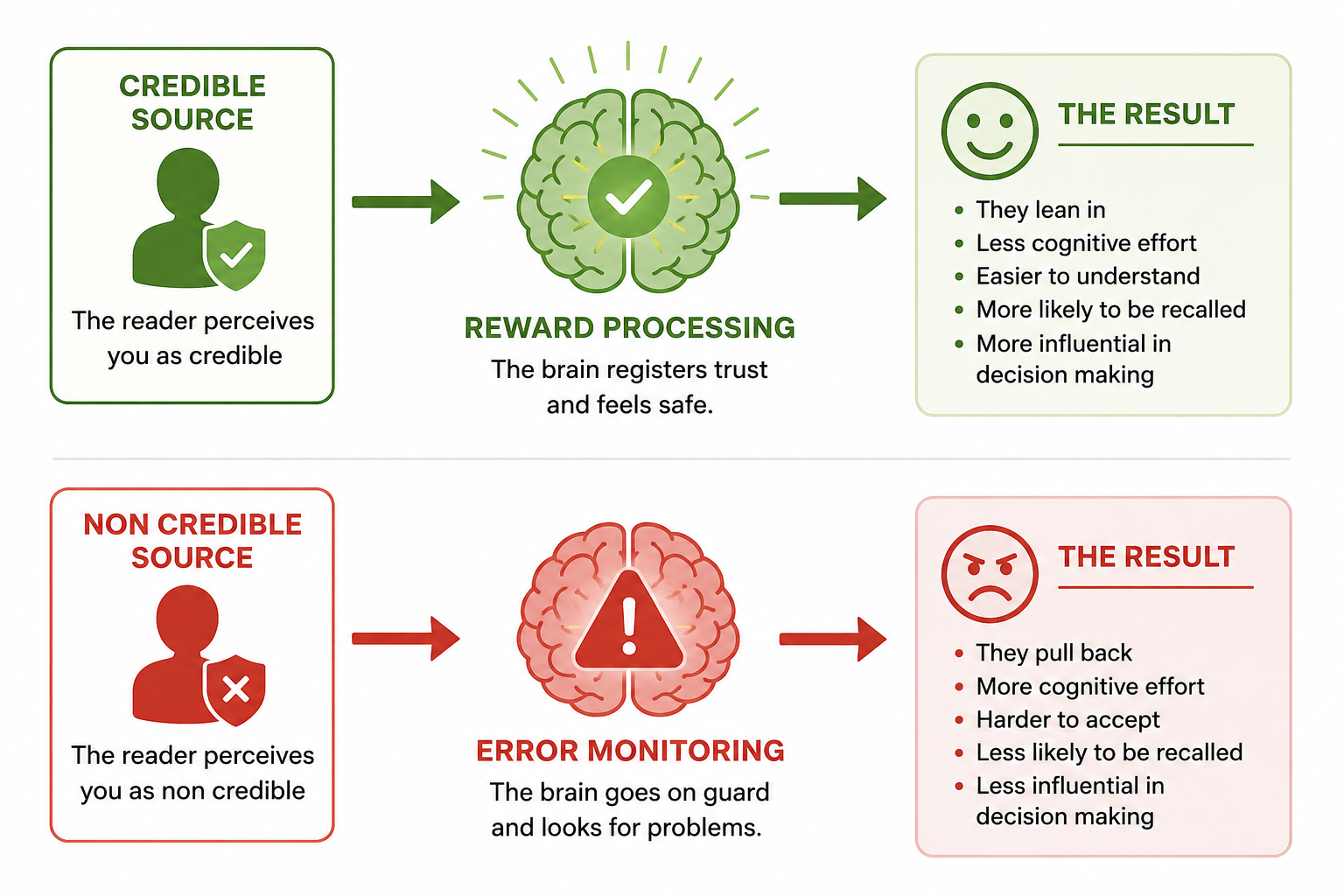
When your reader perceives you as a credible source, it activates reward processing in the brain. They lean in.
When they perceive you as non credible, it triggers error monitoring. In plain English, they start looking to catch you out. Every claim you make gets audited for what's wrong with it.
And here's the part I find fascinating. Messages from credible sources are processed with less cognitive effort. That makes them easier to understand and accept, more likely to be recalled, and more influential in decision making.
So let me make a statement and then ask you a question.
Credibility is the doorway every other part of your message must walk through. Given that, wouldn't we do everything possible to make sure we're seen as credible before we present a single benefit?
Of course we would. And that's exactly what the next section shows you how to do.
The Four Questions In The Right Order
Whenever you sit down to write a marketing message, an email, a video script or a sales page, there are four questions to answer. And the order matters enormously. I had them in the wrong order in 1998. These are the right way round.
- Why you? Tell the reader immediately, right up front, why this message is for them. You don't want someone opening your message and thinking, is this for me? Is this spam? You want them making a statement, not asking a question. Oh, it's for me.
- Why me? This is the praemission step, and it comes before you explain anything else. Before you tell them what it's about, tell them why it's you they should listen to. It's like the photograph on the cover of your book. People want to see your face. They want to know it's you.
- Why this? Now, and only now, do you present the idea, the offer or the programme itself, and the benefits it brings.
- Why now? Finally, give them a genuine reason to act today rather than someday. And always say why. Real reasons build trust.
Why you, why me, why this, why now.
I know I can record a video with just those eight words as my structure. If I know my topic, I can simply start, "If you're like me and you've been struggling to get qualified leads into the top of your marketing..." That's why you. Then, "This is the problem I had, and here's how I solved it." That's why me. You're in the game straight away.
Get the order wrong, why you, why this, why now, and only then why me, and you'll feel the response drain away.
Why School Taught Us The Wrong Order
So why do most of us make this mistake?
Because of what we were taught at school. Don't show off. Don't talk about yourself. Let your work speak for itself. Nobody likes a bragger.
Lovely manners. Terrible marketing.
In the playground, modesty wins friends. In the marketplace, misplaced modesty buries your credibility at the bottom of the page, where the only people who read it are the ones who already believed you.
This is not about arrogance. It's about giving the reader what their brain needs before it will relax and listen. Telling someone you've spent decades helping people like them isn't boasting. It's a kindness. It saves them the effort of doubting you.
So we've got to be strong about this. State your credentials early, warmly and honestly. Then get on with serving the reader.
Title, Trappings And Clothing
Now, how do you actually establish that credibility quickly? I learned a beautiful framework from Professor Robert Cialdini, whom I met and interviewed in London. A lovely man.
He identified three factors in being seen as the authority figure. Title, trappings and clothing.
Your title, these days, isn't Professor or Doctor. It's your strap line. When someone sees your name, you don't want them thinking, who on earth is that? You've got to tell people who you are.
Mine is, The UK's Most Prolific Business Development Author. Another I've used is, turns your knowledge, experience and expertise into ongoing streams of cash.
Your title can be what you do, who you are, or the benefit somebody gets. Or a combination of all three. But if you don't say it, they don't know it.
Trappings? You've got to be an author these days. Even if it's only a report to begin with, though preferably a book. Your website is trappings. Rightly or wrongly, we are judged by our trappings.
And clothing. Do we judge a book by its cover? Absolutely we do. Should we? Not necessarily. But we always do. It's why defendants arrive in court in a suit and tie, sometimes for the first time in their lives. The human brain looks at a person and decides, and then listens to the evidence for proof that its first opinion was correct.
If you'd like to go deeper on these persuasion principles, you can claim a free copy of my Persuasion Book here: peterthomson.com/the-Persuasion-Book.
Putting Praemission To Work
Let's make this practical, because there's one more distinction that trips people up.
A subject line is not a headline. The subject line is the teaser copy on the outside of the envelope, and an email is simply an envelope. The subject line has one job and one job only. To get the message opened.
The headline sits inside the message, at the top, doing the why you work. Then comes your why me, your praemission. Then the idea. Then the reason to act now.
Here's a simple exercise for you today. Take the last piece of marketing you sent out. An email, a sales page, a video, anything.
The Praemission Check
Find the exact point where you first tell the reader who you are and why they should believe you.
If it arrives after your pitch, or never arrives at all, you've found money you're leaving on the table.
Move it up. Why you. Why me. Why this. Why now.
This one change costs nothing and can transform your conversion. Stuart's advice certainly transformed mine, and that mailing went on to build a subscriber base I served for years.
Of course, credibility works hardest when it's pointed at the right people in the first place.
Your Next Step
So, a quick question for you.
Now you know how to be believed, wouldn't it be wonderful if the right people were arriving to hear you in the first place? Not a random trickle. A steady, dependable flow of qualified enquiries you can turn on whenever you choose.
That's exactly what I show you inside The Ultimate Lead Gen Tap.
It's where praemission, positioning and persuasion come together into a simple system for attracting the clients you'd love to work with. The ones who stay, say and pay.
Take a look here: The Ultimate Lead Gen Tap.
Until then, keep sharing your knowledge, experience and expertise. And keep being rightfully rewarded for the difference you make.
Peter
Peter Thomson
'The UK's Most Prolific Business Development Author'
Stay connected with bite-size videos and updates!
Gain an unfair advantage and join fellow achievers who receive tgiMondays - FREE weekly bite-sized videos and blogs on business and personal growth and inspiration from my latest off the edge thinking and ideas.
We hate SPAM. We will never sell your information, for any reason.
