

How to Prepare for Client Meetings That Get Better Outcomes for You and Your Clients
May 26, 2026There is a simple truth about consulting that took me over thirty years to fully appreciate.
The quality of every client meeting is decided long before the meeting actually starts.
It is decided by the preparation. By the agenda. By the question we choose to ask first. And by the goals we set for ourselves before we walk into the room or open the laptop.
Most consultants I have worked with over the years prepare for client meetings in roughly the same way. They glance at their notes ten minutes before. They make a mental list of what they want to cover. They turn up, exchange pleasantries, and hope it goes well.
That approach works. Sort of. But it leaves an enormous amount of value on the table.
In this article I am going to walk you through the exact system I have refined over the last few years for preparing for client meetings. It is the system I use myself, and it is the same one I share with the consultants and professionals I mentor.
You and I both know that better preparation leads to better outcomes. The question is how we structure that preparation so it actually produces results.
Let us get into it.
What You Will Find in This Article
Why Preparation Decides the Outcome Before You Arrive
The Two Types of Client Meeting Most Consultants Confuse
The Six Ps Principle and Why It Matters for Consultants
The One Question That Transforms Every Client Meeting
Building Your Client Meeting Agenda the Right Way
How to Set Goals Before a Client Meeting
The Morning of the Meeting: A Simple Pre Meeting Ritual
Common Mistakes Consultants Make with Client Meetings
How This Approach Changes Your Client Relationships
Your Next Step as a Consultant
Why Preparation Decides the Outcome Before You Arrive
Harvey Mackay said it best.
"Dig your well before you are thirsty."
That single sentence applies to almost every part of running a consulting business. It applies to lead generation, to networking, to writing your book, and most certainly to preparing for client meetings.
When we walk into a client meeting unprepared, we are drinking from a well we never bothered to dig. We are hoping that our experience and our charm will carry the day.
Sometimes they do.
More often, though, we end up running a meeting that is shapeless, that drifts, and that leaves the client feeling like they paid for an hour of pleasant conversation rather than a measurable step forward.
The clients who pay us well do not pay us for our time. They pay us for the outcomes we create. And those outcomes depend almost entirely on the quality of the thinking we bring into each meeting.
That thinking starts before the meeting. Not during it.
The Two Types of Client Meeting Most Consultants Confuse
Before we go any further it is worth making a distinction that most consultants gloss over.
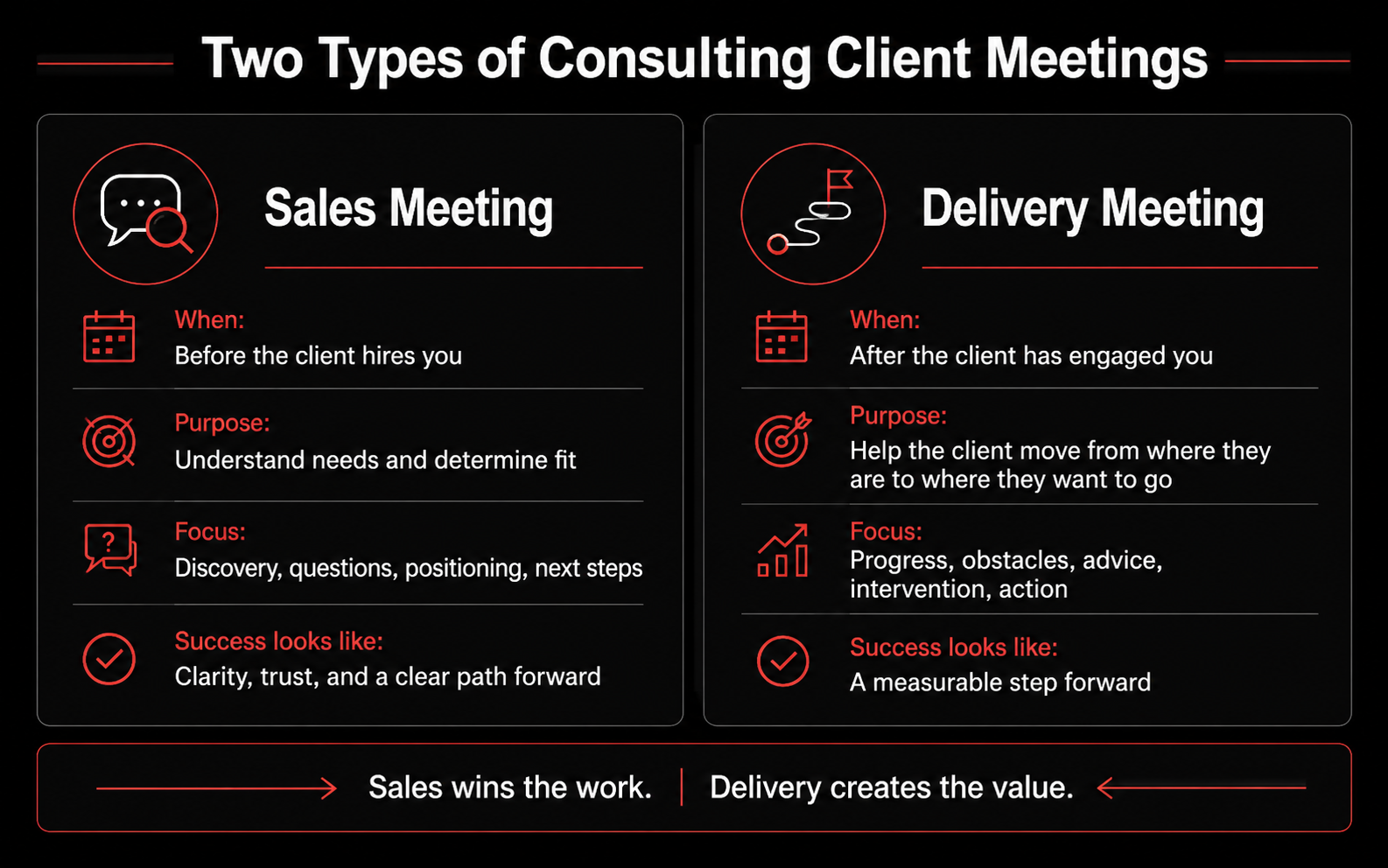
There are two types of client meeting we undertake.
The Sales Meeting
This is the first conversation, or perhaps the second, where we are meeting with a potential client. Maybe they came from a lead we generated through our marketing. Maybe they were referred by someone we have worked with before.
In this meeting our job is to find out what the client is trying to achieve, and then to position what we do so that those two things match together.
If you have read my book PAID, you will know I have a great deal to say about this type of meeting. The Client Gathering Document, the questions we ask, the way we use The Contrast Principle, the avoidance of price objections through proper conversation structure. All of that lives in the sales meeting category.
The Delivery or Intervention Meeting
This is the meeting that happens after the client has engaged us. We are now helping them move from where they are to where they want to go.
This is the meeting most consultants under prepare for, because they assume the work has already been won.
It is also the meeting where the real value is created or destroyed.
This article focuses on the second type. The delivery meeting. The intervention. The conversation where you are actually doing the work you were hired to do.
The Six Ps Principle and Why It Matters for Consultants
There is an old FBI expression that I have carried with me for a long time.
It is called the six Ps principle, and the polite version goes like this.
"Proper Planning Prevents Particularly Poor Performance."
There is a less polite version, which I will leave to your imagination.
The principle itself is straightforward. The amount of effort we put into preparing for a meeting has a direct and measurable effect on the quality of the meeting itself.
And yet most consultants do almost no formal preparation. They might check their calendar. They might skim an email thread. That is usually the extent of it.
Compare that with what happens when we treat preparation as a discipline. When we have a system. When we know exactly what we will think about, what we will write down, and what we will ask, before the meeting begins.
The difference is night and day.
|
A useful test Before your next client meeting, ask yourself: if a colleague looked at my notes and my plan for this meeting right now, would they be impressed, or would they be embarrassed for me? If the honest answer is the second one, you have just identified the single biggest lever you can pull to improve your client outcomes this quarter. |
The One Question That Transforms Every Client Meeting
I want to share with you the single change to my client meetings that has made the biggest difference over the last few years.
It is one question. Asked at the start of every meeting. After the rapport building, after the coffee, after the chit chat about the weather and the travel in and the state of the economy.
Here it is.
"What has to happen for you to consider our meeting today was a resounding success?"
Read that again. Slowly.
What has to happen, for you, to consider our meeting today, was a resounding success?
This question does several things at once.
- It puts the client in charge of defining the outcome of the meeting.
- It surfaces anything that has happened since you last spoke that they want to focus on.
- It saves you from running a meeting on autopilot when the client actually needs something different.
- It demonstrates, immediately, that you are there to serve their agenda, not to perform your own.
Now here is the part that catches consultants out.
Sometimes the answer to that question will throw your prepared agenda out of the window.
That is not a bug. That is the feature.
I had a client recently who I have worked with for a long time. He knows I am always going to ask this question, so he sent me a note beforehand explaining what he wanted to focus on. Despite all the preparation I had done, what he actually wanted on the day was to film some videos.
I knew I could help him do that. So when he turned up, I asked the question again just to confirm. And that is what we focused on.
The client got what he needed in that moment, on that day, in that hour. The agenda I had prepared became reference material rather than a script. And the meeting was, by his definition, a resounding success.
Building Your Client Meeting Agenda the Right Way
Let us talk about agendas.
Most consultants treat the agenda as either a formality or an afterthought. Either it is a tick box exercise for the client, or it does not exist at all and the meeting just unfolds however it unfolds.
Both approaches leave value on the table.
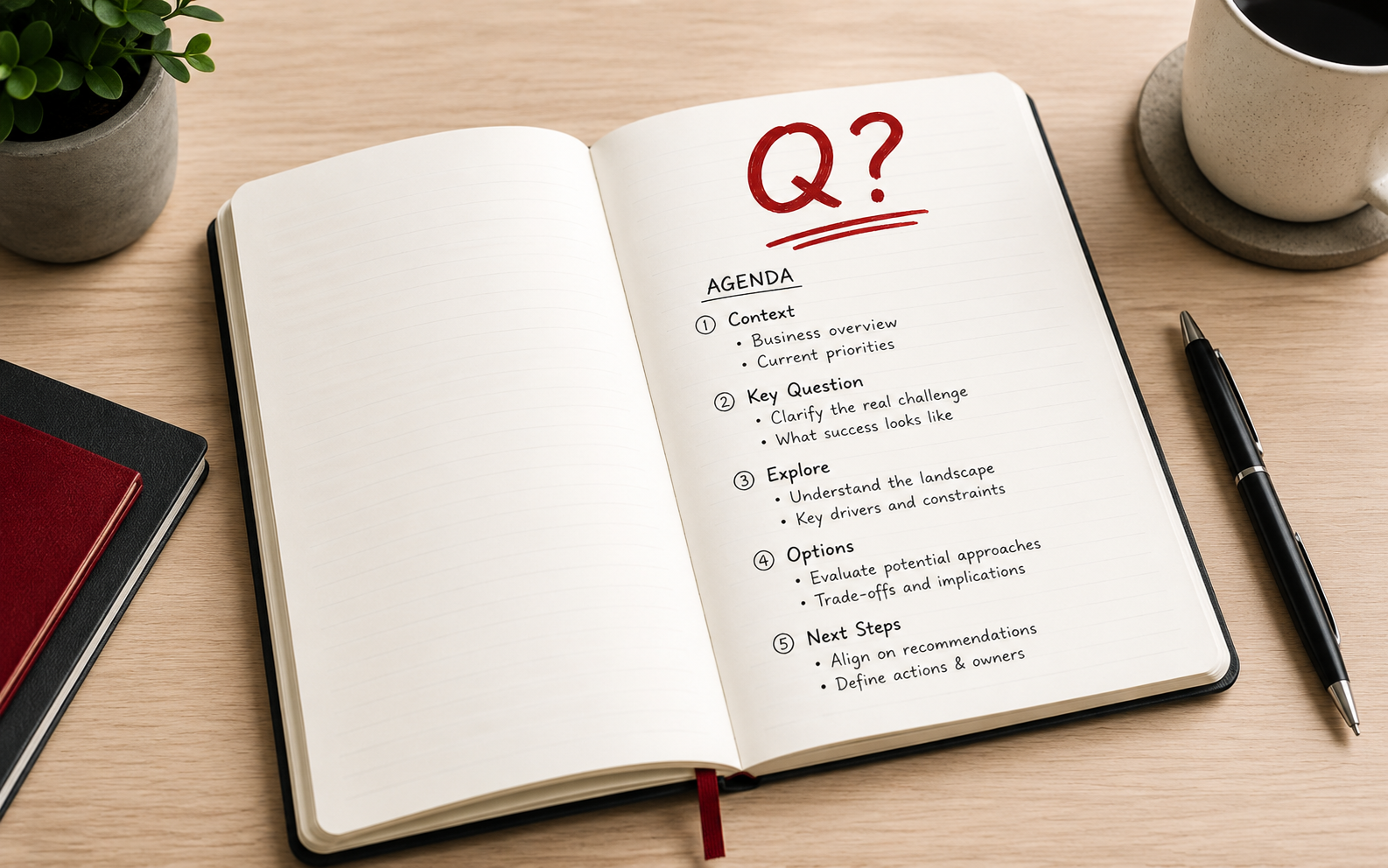
The agenda I use for delivery meetings has a specific structure. It looks something like this.
Item One: The Question
In my notes this is simply a big Q with a question mark and an arrow. Q and question work in the same way in my mind, so I use them interchangeably.
This is where I ask the question we just talked about. Everything that follows is shaped by the answer.
Item Two: Where Have You Come From
What has been happening since we last met? What has the client done, learned, struggled with, or noticed? This is the update piece. It is not small talk. It is genuine context.
Item Three: Where Are You Now
Where does the client stand right now, in this moment, on the issue we are working on? Not where they were last month. Not where they hope to be. Where are they actually?
Item Four: Where Are You Trying to Get To
What does success look like for the client? Not the meeting outcome, but the broader outcome. The reason they engaged you in the first place.
Item Five: What Is in the Way
What obstacles, real or perceived, sit between where they are and where they want to be?
Item Six: What Are We Going to Do
This is where the intervention happens. The advice, the framework, the worked example, the next action. This is what they pay you for.
The whole agenda is built on six simple questions that I have used for years.
- Where are you now?
- How did you get here?
- Where do you want to go?
- Why do you want to go there?
- What obstacles get in the way?
- What are we going to do about it?
That is the basic formula. It is very, very simple. Which is exactly why it works.
How to Set Goals Before a Client Meeting
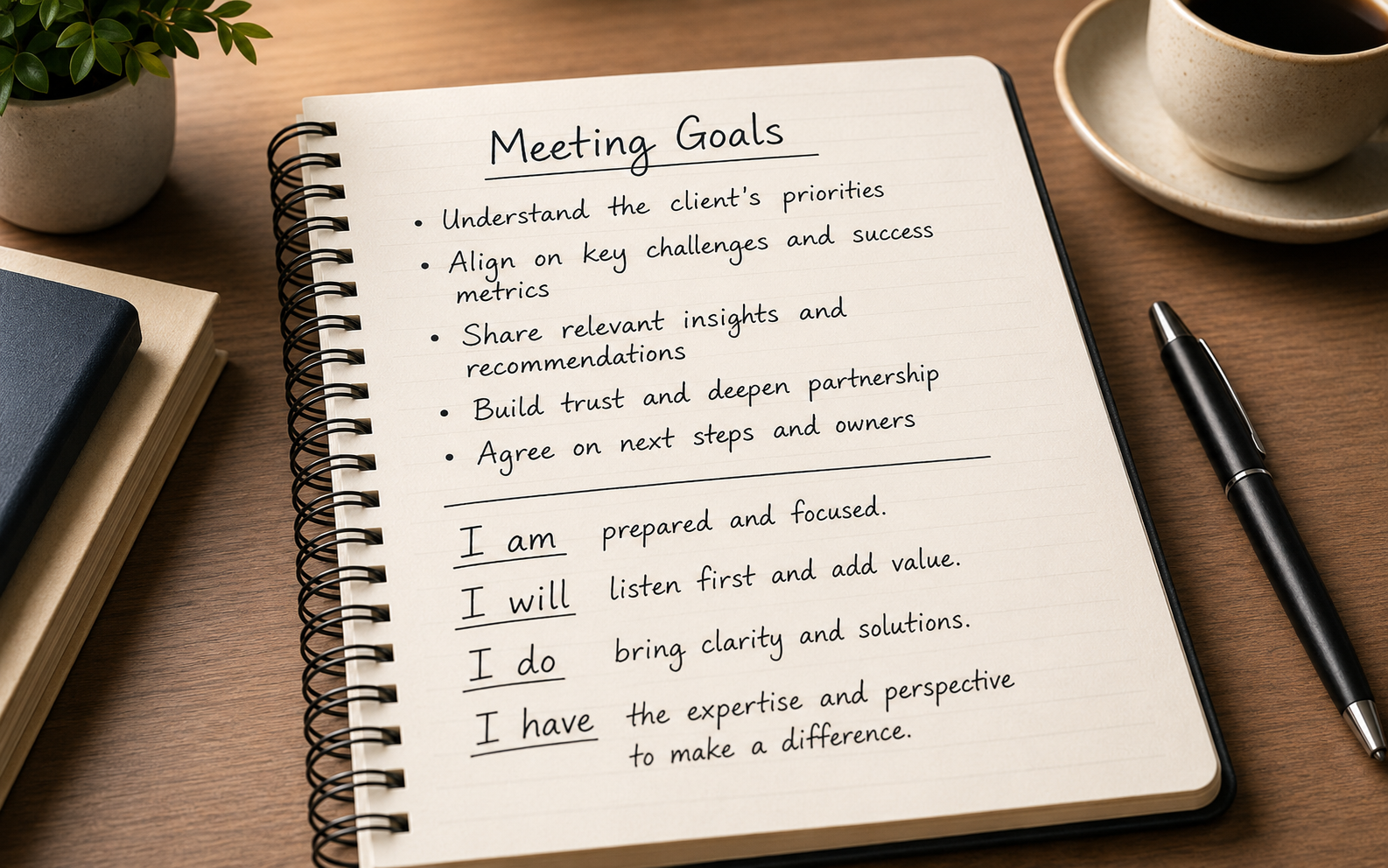
Once the agenda is in place I set goals for the meeting itself.
I write these in my notes, with a focus question at the top.
"What are my goals for [client name] in the meeting on [date and time]?"
Years ago somebody referred to our brains as our neck top computer. I thought that was a wonderful expression. So I think of the question mark on the end of any prompt as being the enter key on my neck top computer. It is what makes me go off and find the answer.
My goals for a client meeting are outward focused. They are about what the client wants, not about what I want.
When I stand and speak somewhere, I write goals before I take the stage for exactly the same reason. Being outwardly focused diminishes nerves and concerns. Because I am not thinking about me.
The second part of my goal setting is making sure I am living and acting in accordance with my identity, my beliefs and values, and my purpose.
In other words, my why.
I know that if my goals are aligned with those areas, then I am going to be outwardly focused, and I am going to be living in the right way to make a difference for the client.
The Four Word Sign Off
This sounds slightly strange but stay with me.
After I have written my goals out, I sign them in a particular way. I write four short statements.
- I am
- I will
- I do
- I have
Then I sign and date the page.
Why do I do this?
Because as you may have heard me say before, people will never consistently do who they aren't. The flip side is just as true. People will consistently do who they are.
So the I am is confirming that I am acting in accordance with my identity. That makes everything easier to do, because it is in alignment with who I already am.
The I will, I do, I have works on three tenses.
- I will is future tense.
- I do is present tense.
- I have is past tense, as if it has already happened.
What I am doing here is programming my own mind so that the outcome of the meeting feels inevitable rather than uncertain.
It is a small ritual. It takes about three minutes. And it has a noticeable effect on how I show up.
The Morning of the Meeting: A Simple Pre Meeting Ritual
On the morning of the meeting itself I reread my client notes.
I keep all of mine in Good Notes on my iPad. Each client has their own folder. Each meeting has its own page. Which means I can find anything I need in seconds.
If you are still keeping client notes in scattered Word documents, in your inbox, on the back of envelopes, or worse, in your head, this is the single change that will make the biggest difference to your consulting practice this year.
After I reread the notes, I sign them again, just to confirm I am fully focused on this client for the next hour.
Then the meeting starts. I am happy to do the small talk. The weather, the coffee, the catch up about family. All of that builds the relationship.
And then I launch into the key question.
What has to happen for you to consider our meeting today was a resounding success?
Common Mistakes Consultants Make with Client Meetings
Over the years I have noticed a pattern in the mistakes consultants make when preparing for client meetings. Here are the most common ones.
Treating Every Meeting the Same
A sales meeting and a delivery meeting are not the same thing. They have different purposes, different structures, and different success criteria. If you prepare for both in the same way, you are doing at least one of them badly.
Confusing Activity with Outcome
Lots of consultants prepare by making lists of things they want to cover. That is activity preparation. It is not outcome preparation. Outcome preparation starts with what the client needs to leave with, and works backwards from there.
Skipping the Goal Setting
Most consultants do not write goals for their client meetings. They have a vague sense of what they want to achieve, but they have not articulated it. Vague intentions produce vague results.
Not Capturing the Notes Afterwards
This article is about preparation, but it is worth a quick mention. If your post meeting note taking is poor, your next preparation will be poor too. The two are linked.
Asking the Wrong First Question
Plenty of consultants open with how have you been or what is new. Those are fine for a friendly chat. They are not adequate for a paid consulting conversation. The question we discussed earlier is the question that sets the meeting up to succeed.
How This Approach Changes Your Client Relationships
When you start preparing this way, three things shift.
First, the client experiences your meetings differently. They feel more useful. More focused. More valuable. They start looking forward to them rather than tolerating them. Some clients will tell you this directly. Others will simply renew, refer, and pay more.
Second, you experience the meetings differently. Because you have done the thinking before the meeting, you are not trying to do it during the meeting. You are present. You are listening. You are responding to what is actually happening rather than executing a script.
Third, your sense of your own value goes up. Because you are demonstrably doing more for the client than you were before, the case for charging premium fees becomes much easier to make. Both to yourself and to them.
This last point matters more than people realise.
Most of the consultants I work with are not undercharging because they lack confidence in their pricing. They are undercharging because they have not yet built the quality of delivery that would justify a much higher fee. Once they build that quality, the price conversation gets easier.
|
The compound effect of better client meetings If you run, say, eight client meetings a week, that is around four hundred client meetings a year. A ten percent improvement in the value of each one is the equivalent of forty extra fully delivered client meetings. Forty. In a year. Just from a tighter preparation system. |
Your Next Step as a Consultant
If you take just one idea from this article, let it be the question.
What has to happen for you to consider our meeting today was a resounding success?
Ask it at the start of your next three client meetings. Watch what happens. I think you will be surprised.
And if you would like to go deeper into the systems, frameworks and conversations that allow consultants to be rightfully rewarded for the value they create, checkout my book, PAID. It walks you through the positioning, persuasion and pricing methods I have developed and used with consultants and professionals over the last thirty years. You can find more about it at peterthomson.com/paid.
Whichever path you take, I wish you every success in all of your adventures, both in consulting and beyond.
Until the next time.
Peter Thomson
The UK's Most Prolific Business Development Author
Stay connected with bite-size videos and updates!
Gain an unfair advantage and join fellow achievers who receive tgiMondays - FREE weekly bite-sized videos and blogs on business and personal growth and inspiration from my latest off the edge thinking and ideas.
We hate SPAM. We will never sell your information, for any reason.
