
Attention Is a Decaying Asset: How to Hook Your Reader All the Way Through
Oct 08, 2026Most people believe a hook is one clever line at the top of the page.
Write it, land it, and the rest of the copy will carry itself.
That notion is now thoroughly out of date, and I want to show you why.
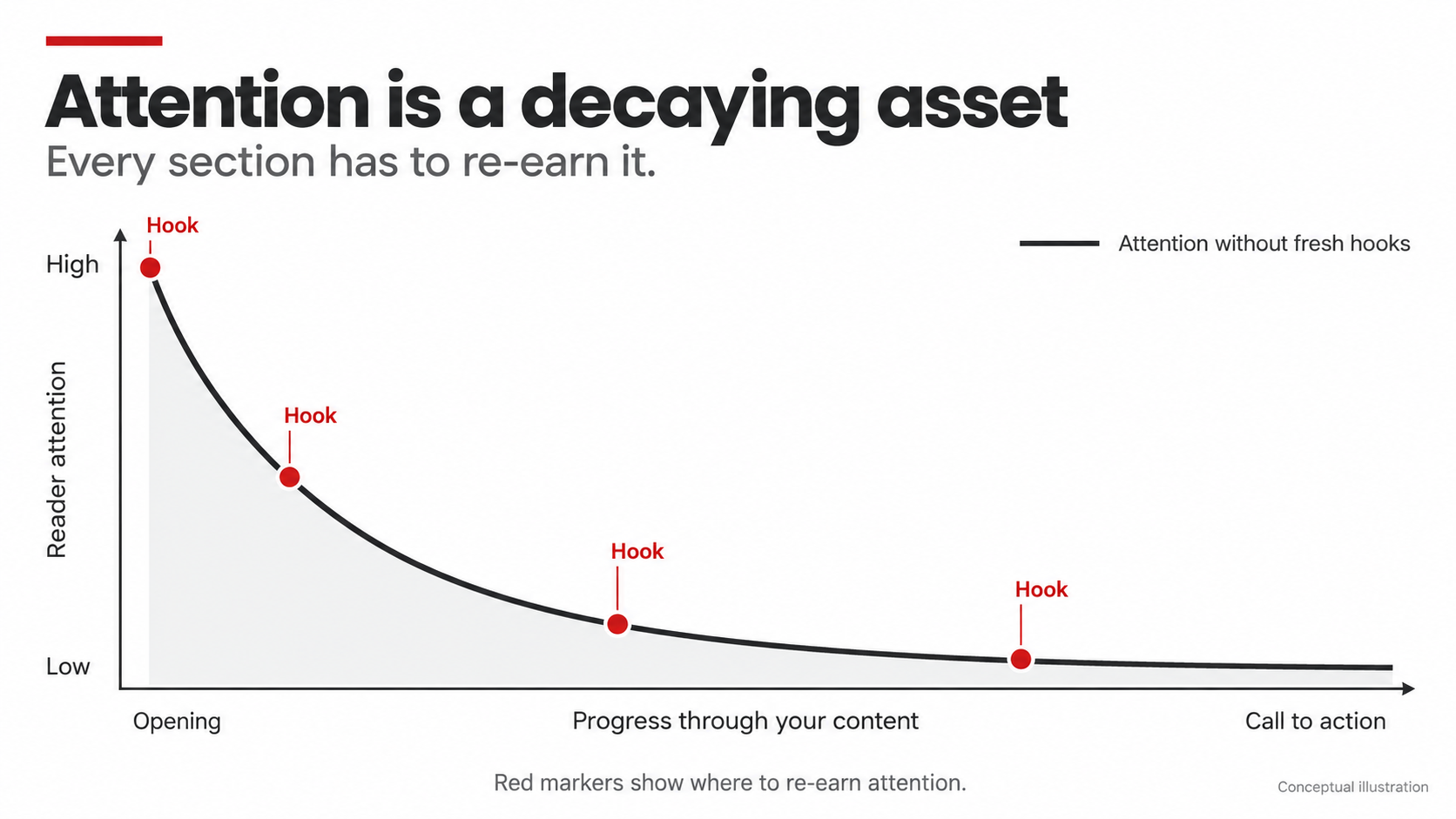
Attention is a decaying asset.
The moment your reader stops being interested is the moment they leave, and that moment can arrive at any point between your first word and your call to action.
So the job is not to grab attention once, it is to keep re-earning it, and by the end of this you will have a structure for doing exactly that.
1. Why One Hook Is Never Enough
Think about the last webinar you attended that lost you.
The opening was probably fine.
You turned up, you settled in, and somewhere around minute eleven your hand reached for your phone.
Nothing offensive happened, the presenter simply stopped giving your brain a reason to stay.
The goal is not merely to grab attention, it is to keep the brain in an active state of pursuit.
Pursuit is the key word there.
A brain that is chasing something stays put, and a brain with nothing left to chase wanders off.
I should credit Joanna Wiebe here, whose thinking on hook structure prompted a good deal of what follows, and whose work I have followed for years.
What I have added is my own testing over four decades and a good many marketplace mistakes.
2. The Four Layers of Attention
Rather than one hook, think of a hierarchy with four layers working together, so the reader never has a clear moment to leave.
The big hook. This is the largest open question of the whole piece and the reason your reader turned up at all. You never resolve it early. If you answer it in paragraph three, everything after paragraph three is optional.
The major hooks. These are subordinate questions, each one carrying the reader towards the payoff. A major hook usually sits at each section break, and in a letter it lives in your subheads.
The minor hooks. Quick hits sprinkled through the body copy. A surprising number, an unexpected word, a short sentence after three long ones. Small doses of interest that keep the engagement level up between the bigger moments.
The reminder hooks. These point back at the big hook so the reader remembers why they are still here. "Before I answer the question I opened with" is a reminder hook, and it buys you another few minutes every time.
| Map your next piece before you write a word. One big hook, three to five major hooks, minor hooks wherever the energy dips, and a reminder hook roughly every third section. |
3. Write Your Big Hook First
Before you draft anything, fill in this sentence.
By the end of this, my reader will know how to ...
Then apply three tests to whatever you wrote.
Is it specific?
Is it surprising?
Is it worth the amount of time you are about to ask somebody to spend?
Here is a weak one.
"By the end of this, you will know how to improve your hooks."
Improve by how much, in what way, and why would anybody give you ten minutes for that?
Here is the one I used at the top of a recent session.
"By the end of this, you will know how to hook ten times the viewers and hold them for at least ninety per cent of the video, or through to the call to action in your copy."
Specific, surprising, worth the time.
Enlarge the payoff and the hook very nearly writes itself.
4. Movement, Magnet and Mismatch
Now to the mechanism inside an individual hook, which comes down to three M's.
Movement is the verb, the signal that something is happening. "Most business owners ignore" has movement, because "ignore" is doing something.
Magnet is the specific payoff. What exactly do they get? Five thousand pounds a month is a magnet. "Better results" is not.
Mismatch is the gap between expectation and reality. "Until it is too late" is a mismatch, and so is "and nobody tells you why".
Assemble the three and you get something like this.
"Most business owners unwittingly ignore a simple system that adds five thousand pounds of profit to their business, until it is too late."
Now, I do not know about you, but I would want to know what that system is.
Here is a hook you have seen a thousand times.
"Something crazy happened today."
It opens a loop in the brain, technically speaking, and yet the brain refuses to chase it.
Why?
Because there is nothing specific to want.
Curiosity on its own is not enough, and this is the mistake I see most often in the work members bring me.
Curiosity needs something concrete on the other side of it, otherwise the reader shrugs and moves on.
| The concrete magnet test. Look at your hook and find the number, the result, or the tangible detail. If there is not one, the hook has no bite and it needs rewriting. |
Note the difference between this and the empty suitcase technique, where you point at a thing without naming it.
In the empty suitcase, the reader knows exactly what category of thing they are being offered, they simply do not yet know which one.
6. Widening the Gap
If the reader is not surprised, the hook will not hold, and surprise comes from the size of the gap.
Here is a template that widens it beautifully.
"I never thought it was possible to ... but ..."
Look at what that does in a single sentence.
It establishes a belief, then breaks it, and the "but" leaves the door standing open.
A few that members have produced when I have set this exercise.
- I never thought it was possible to increase my business by a hundred per cent in three months, but ...
- I never thought it was possible for AI to replace an employee, but ...
- I never thought it was possible to generate a full month's income on day one, but ...
Notice the second one uses "replace" rather than "use".
"Use AI instead of an employee" is limp, because "use" is one of the laziest verbs in the language.
"For AI to replace an employee" has consequence in it, and consequence is what widens gaps.
7. Four Amplifiers That Make a Narrow Gap Wider
Sometimes your hook is true and useful, but the gap is simply too narrow to pull anybody in.
Here are four amplifiers, and each one is doing more than it appears to.
Raise the stakes with a high status subject. "The ones losing these deals were not the juniors. They were the firm's most senior partners." That carries implied social proof and it raises the stakes at the same time.
Add concrete authority. "I have tested this with more than two hundred sales teams." You almost certainly have a version of this sitting in your testimonials, and if you phrase it so it is completely true, it is proof rather than boasting.
Compress the time frame. "We saw the change inside a fortnight." People want to know how soon they will see a return, and a believable time frame does more than a bigger promise.
Match the case study to the reader. This one gets ignored far too often. If your reader runs the corner shop, do not tell them about Barclays Bank. They will switch off, because it plainly does not apply to them, however impressive it sounds to you.
8. Four Reality Flips You Can Use Today
These are structural patterns for major hooks, and they work because they overturn something the reader already believes.
Take each one and personalise it for your own world, because in my words they will only ever be examples.
The reality flip
"You think you are losing business to your competitors. You are losing it in the gap between the enquiry and the first conversation."
"You think clients are pushing back on price. What they are really questioning has nothing to do with the number."
And that second one happens to be true, by the way. Price falls into insignificance when belief is high enough.
The unnamed threat
"There is a reason enquiries go quiet after the first call, and most consultants have never put a name to it."
"There is a reason happy clients still do not refer you, and most business owners have never put a price on what it costs them."
The complexity paradox
"You think winning new business takes a bigger network. It takes this better question on your next call."
"You think standing out means saying more about yourself. It means saying it differently, and here is how."
The authority inversion
"Everything you were taught about asking for referrals is the reason your pipeline runs dry."
"You think your proposal is where the selling happens. The selling was already over before you sent the document."
One caution on the authority inversion, and it is an important one.
It only works if you are believable to the person reading it.
Overturn a widely held belief without the standing to do it and you sound like somebody showing off, and the reader will leave faster than if you had said nothing at all.
9. The Patterns AI Has Worn Out
A word of warning, because two of these structures are now in trouble.
"It is not X, it is Y" has been used so heavily by AI writing tools that readers have started to recognise the shape of it.
The same is happening to "you think it is hard, actually it is simple".
Neither is dead, and I still use both, but I use them sparingly and I make sure the content underneath them is genuinely surprising.
"Little known" has the same problem, though for a different reason, since we have simply worn it out ourselves over thirty years.
"Hidden" is doing rather better at the moment, and I have been slipping it into things with pleasing results.
The broader lesson is that a pattern works until enough people copy it, and then it becomes a signal that you are not the one who came up with it.
10. Putting It All Together
Here is how I would build your next piece, whether that is a webinar, an email sequence or a long sales letter.
Start with the sentence "by the end of this, my reader will know how to", and refuse to move on until it passes all three tests.
Then list your three to five major hooks, one for each section, and check each one has movement, a magnet and a mismatch.
Then write the body, and as you go, drop in the minor hooks wherever you feel the energy sagging.
Then, roughly every third section, remind the reader of the big open question you have still not answered.
And then, at the end, answer it properly and completely.
A conversation is not a one-off occasion, it is a road you and your reader are travelling together.
Your job is to make sure there is always something interesting a little further up that road.
Attention does not hold itself. Every section has to re-earn it.
Where to Take This Next
Everything here rests on one underlying idea, which is that all communication is an attempt to persuade someone to do or avoid doing something, now or in the future.
Hooks are simply how we hold somebody's attention long enough for the persuasion to happen.
|
The Persuasion Book is yours free. It sets out the full framework behind these hooks, including the questioning structures and the language patterns I have tested in the marketplace over four decades. Claim your free copy of The Persuasion Book If you would rather work on your own hooks alongside other coaches, consultants, trainers and accountants, come and join us inside The BBCCA |
Go and write your big hook, then go and measure what it does.
Stay connected with bite-size videos and updates!
Gain an unfair advantage and join fellow achievers who receive tgiMondays - FREE weekly bite-sized videos and blogs on business and personal growth and inspiration from my latest off the edge thinking and ideas.
We hate SPAM. We will never sell your information, for any reason.
