

Why Most Talented Professionals Struggle to Get Clients: The Belief Barrier
Apr 21, 2026The Question I Keep Hearing
Over more than 50 years in business, and 30+ of those spent specifically working with coaches, consultants, speakers, trainers and accountants, I have encountered the same frustration again and again.
Highly skilled professionals. Deep experience. Real results for their clients. And yet they are struggling month to month, not because they are not good enough, but because they cannot seem to get enough of the right people through the door.
The question they ask me is always some version of the same thing: why is it so hard?
I know the answer. I have known it for years. And sharing it with you is the whole reason I am writing this.
It is not the quality of your service that determines your success. It is your ability to persuade people to become your clients.

It Is Not a Skill Problem
Here is the uncomfortable truth I share at every masterclass I run.
The difference between those who are succeeding in the helping industry and those who are struggling is not the quality of the service they provide. It is not the quality of the ideas they bring. It is not how good they are at the doing of their business.
It is how good they are at persuading people to become their clients.
And before you close this down thinking this is about being pushy or manipulative, stay with me. Because the kind of persuasion I am talking about is the opposite of that. It is ethical, values-led, and rooted in genuine care for the person you are talking to.
The goal is to learn how to sell, stop selling, and allow people to buy. That is a very different thing. And it starts with what I call the ABC framework.
The ABC Framework: Alignment, Belief and Confidence
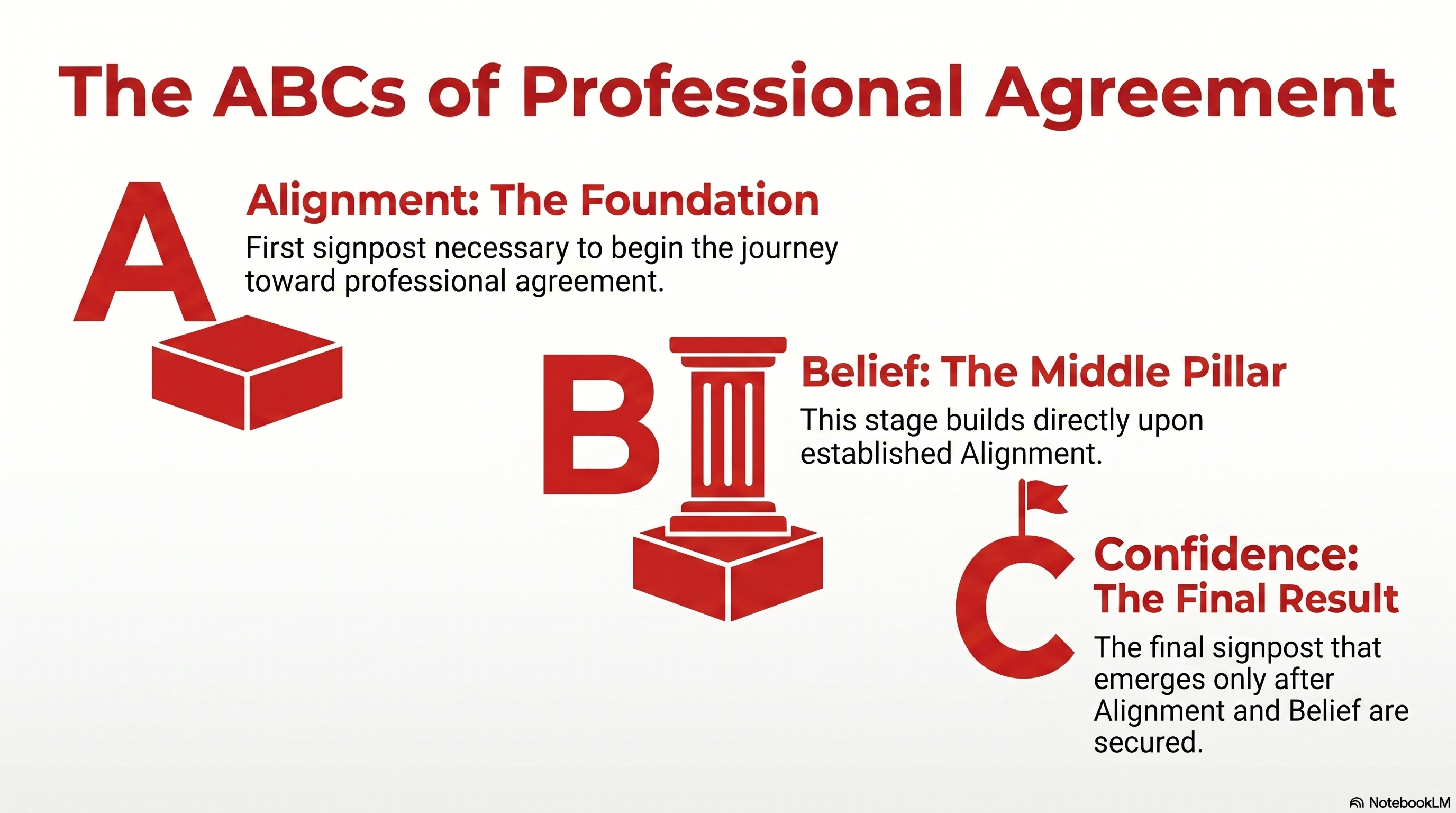
After decades of working with professionals across the helping industry, I identified three signposts that separate those who consistently get agreements from those who do not.
I call them the ABC. Not attitude, action, or any of the other words people guess when I pose the question. The three are alignment, belief, and confidence. And they need to be understood in that order, because each one builds on the last.
Let me take you through each one.
Alignment: People Will Never Consistently Do Who They Are Not
Years ago I wrote an expression that I believe to be one of the most important truths in all of personal and professional development.
People will never consistently do who they are not.
What does that mean in practice?
It means that if the way you are trying to build your business, position yourself in the market, or present your services does not align with your identity, your values, and who you genuinely believe yourself to be, it will not stick.
You might try the approach for a while. You might even have some early success. But at some point, you will drift back to the behaviours and attitudes of before. Not because you are weak or undisciplined, but because the new behaviour does not match who you are.
I see this happen all the time with training programmes. Someone attends a course, comes back to the workplace full of enthusiasm, uses the new techniques for a few weeks, and then gradually returns to the old ways.
The mismatch between the new behaviour (the what) and the person's identity (the who) is almost always the culprit.
The first question to ask yourself is this: is the way I am trying to grow my business genuinely aligned with who I am? If it is not, no amount of tactics or techniques will produce lasting results.
Belief: Most People Reach the Limits of Their Belief Before Their Talent
A good friend of mine, who has sadly passed away, once said something that has stayed with me ever since.
Most people reach the limits of their belief well before they reach the limits of their talent.
I have found this to be consistently true in my work. People are more capable than they believe they are. The ceiling is almost always made of belief, not ability.
This shows up in very specific ways in the helping industry.
It shows up when someone knows, intellectually, that their service is worth a certain fee, but cannot bring themselves to say the number out loud without stumbling or apologising.
It shows up when someone has extraordinary results for their clients but does not feel they have the right to promote those results confidently.
It shows up when someone keeps their very best ideas back, convinced that if they give them away freely people will simply take the information and not hire them.
The irony of that last one is particularly sharp. If you put your mediocre ideas out into the marketplace, people will conclude that you are mediocre. If you put your best thinking out there, people will think: if this is what they share for free, what must they have in the rest of the box?
Belief is also, importantly, contagious. When you are genuinely convinced of the value of what you do, that conviction transfers to the other person. And when you are not, that transfers too. People are extraordinarily good at sensing the difference.
The environment you place yourself in matters enormously here. As the old expression goes, you cannot fly with the eagles if you spend your time with the turkeys. Being around others who believe in what they do, who are working at the edge of their capability and being rewarded for it, raises your own ceiling of belief.

Confidence: Transferring Certainty to the Other Person
Once alignment and belief are in place, confidence becomes the natural outcome rather than the starting point.
This is why so many attempts to build confidence fail. People try to build confidence first, before they have aligned their approach with their identity, and before they have genuinely addressed the ceiling of their belief. And so the confidence feels forced, unconvincing, and brittle.
Real confidence, the kind that wins clients, is the by-product of alignment and belief working together. It is not arrogance. As I often say, you need to live in a little village just south of arrogant: north of confident, but not cocky.
And the important thing to understand about confidence in a client conversation is that you are not simply projecting a feeling. You are transferring it.
When you speak about what you do with quiet, unhurried certainty, the person you are speaking to picks that up. They feel it. And it gives them permission to feel the same certainty about choosing to work with you.
When that certainty is absent, when you stutter over your fees, apologise for the price, or hedge your promises, the other person absorbs that too. And suddenly they are uncertain, not about you necessarily, but about the decision itself.
Confidence is not about being loud or dominant. It is about being so clear on the value you create that the act of talking about it feels entirely natural.
The Three Ps: Person, Problem and Promise
Closely related to the ABC framework is a simple idea that I find useful when helping professionals structure any communication, whether that is a conversation with a prospective client, a piece of marketing copy, or a book title.
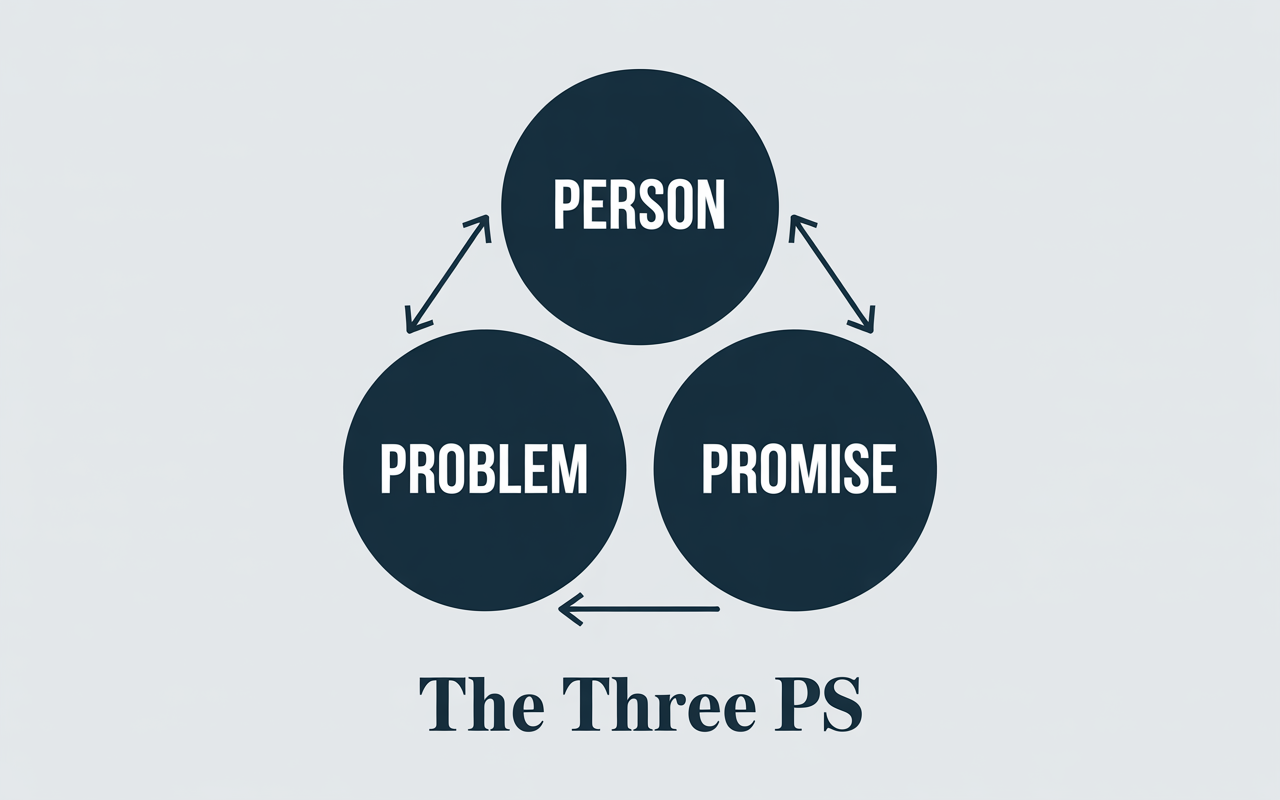
I call it the three Ps: person, problem, and promise.
- Person: who is this for? Be specific. Not everyone is your client.
- Problem: what specific problem do they have that you can address?
- Promise: what transformation or outcome can you credibly promise?
This framework works because it forces you to move from talking about yourself, your credentials, your methods, to talking about them, their situation, and what becomes possible.
People do not buy systems or processes. They buy the outcomes of those systems. They buy the transformation. The job title, the methodology, the years of experience: all of those are interesting. But what the person across the table really wants to know is simply this: can you help me get from where I am to where I want to be?
When your communication answers that question clearly, quickly, and with genuine confidence, the conversation moves in a very different direction.
Amateurs Practice Until They Get It Right
There is one further distinction I want to draw your attention to, because I think it is one of the most practically useful things I know about performance in client conversations.
Amateurs practice until they get it right. Professionals practice until they cannot get it wrong.
The difference between those two states is enormous.
Getting it right means you can do it under ideal conditions, when you are calm, prepared, and not under pressure.
Not being able to get it wrong means the behaviour has become so deeply practised that it runs automatically, even when you are in a high-stakes conversation, even when your confidence wobbles, even when the client pushes back on your fee.
This applies directly to the moment that many professionals find most uncomfortable: stating their price.
Over the years I have seen brilliant, experienced consultants stutter, stumble, apologise, and practically shrink as they say a number that is entirely reasonable for the value they deliver. Not because they lack belief in their work, but because they have never practised the moment of saying it until it becomes natural.
The solution is deceptively simple. Practise. With a colleague, with a friend, in the mirror. Describe the value. Then say the number. Again and again, until the act of saying it carries the same quiet certainty as everything else you say.
Professionals do not leave this to chance.
The Cascading Impact of What You Do
I want to close with something that I feel very strongly about, because I think it is the deepest reason why alignment, belief, and confidence in the helping industry matter so much.
When you help someone in this industry, the impact does not stop with them.
If I help a coach or consultant figure out how to make an extra £100,000, that is not just a number on a spreadsheet. That changes their life. It changes their family's life. It changes the life of the people in their community, through the taxes they pay, the businesses they support, the opportunities they create for others.
The work you do has a cascading impact that extends far beyond the moment of the conversation.
And that is precisely why I believe so firmly that people in the helping industry must be rightfully, regularly, and royally rewarded for the difference they make.
Not out of greed. Out of alignment with the value they genuinely create.
When your belief matches your talent, when your confidence matches your competence, and when you have built the skills to communicate your value clearly, people do not need to be persuaded. They simply need to understand what is possible. And they will say yes.
Your Next Step
If what I have shared here has resonated with you, I want to invite you to come and join us in The British Business Coaches & Consultants Academy.
You can experience it free for a month. It is where coaches, consultants, speakers, trainers and accountants come together to share practical, proven strategies for winning better clients, charging what they are genuinely worth, and building businesses and lives of real choice.
We go deep on all of the ideas in this article, and a great deal more besides. You will find people who are already flying with the eagles and who will help you do the same.
Come and join us. Your first month is free, and there is no long-term contract.
Join The Academy at peterthomson.com/bbcca
If you would like to go deeper on the strategies that help consultants and coaches in the helping industry to get paid what they are genuinely worth, my book PAID! covers the full system in detail.
The next £5,000 a month may already be inside your business. Find out where with Your Gap Finder (free, 18 questions, about four minutes): https://yourgapfinder.com
Experience The British Business Coaches & Consultants Academy free for a month: https://www.peterthomson.com/bbcca
Stay connected with bite-size videos and updates!
Gain an unfair advantage and join fellow achievers who receive tgiMondays - FREE weekly bite-sized videos and blogs on business and personal growth and inspiration from my latest off the edge thinking and ideas.
We hate SPAM. We will never sell your information, for any reason.
