

The Secret Of The Jar: The One Reason Your Best Clients Walk Past You
May 28, 2026Let me ask you a straight question.
Why do some of the people who would benefit most from working with you walk straight past your business and never realise what they have just missed?
It is not because you are not good at what you do. It is not because your fees are wrong. And it is not because the market does not need what you offer.
It is something far simpler. And once you see it, you cannot un-see it.
In This Article
The mismatch that quietly kills sales
How to find out what people really think of you
The three questions to ask your clients today
How to make your label crystal clear
The Hidden Cost Of Confusion
Some years ago I read a brilliant book called Decisive, by Chip and Dan Heath.
In that book is one of the sharpest sentences I have ever come across in the world of marketing and selling. I wish I had written it myself. Here it is.
"Resistance is created through a lack of clarity."
Read it again, slowly.
Because when there is a lack of clarity in the marketplace about who you are, what you actually do, and the benefits people get by working with you, the consequences are quietly enormous.
You do not build your list.
You do not increase your conversions.
You do not win the clients you should be winning.
And you do not build for yourself the business and life of choice that your skills, knowledge and experience say you should be enjoying.
It is a slow leak. You rarely see the lost client. You only see the empty diary and the disappointing month.
So if that is happening to you right now, or even just nudging at the edges of your business, the cause is almost certainly not what you think it is. It is something you and I are going to look at right now.
The Secret Of The Jar

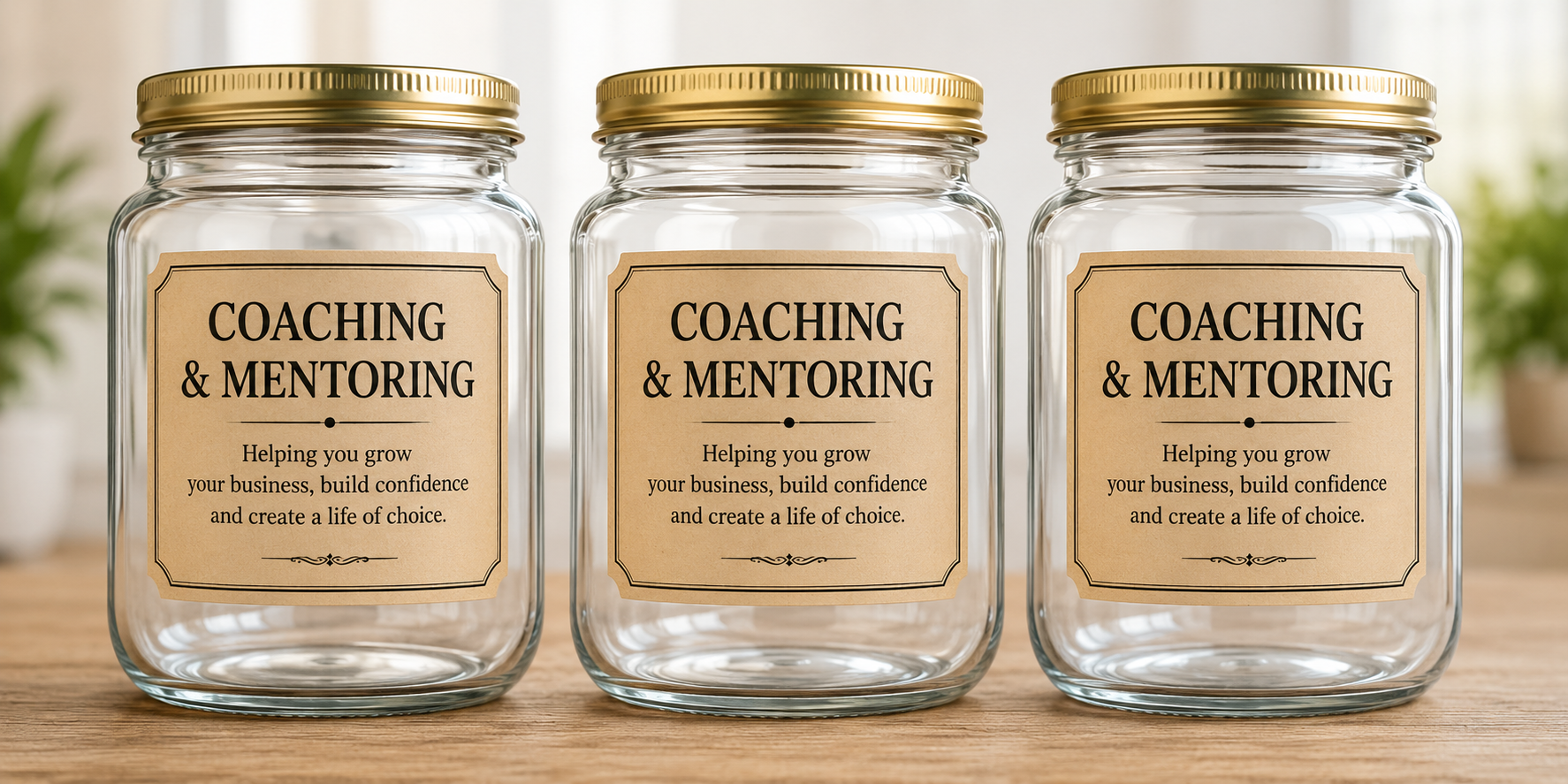
I want you to picture a glass jar.
Inside the jar is you. Inside the jar is me. Inside the jar is every coach, consultant, speaker, trainer and accountant who is brilliant at what they do.
From the inside, looking out, we are pretty clear. We know who we are. We know what we do. We know the difference we make when a client trusts us with their problem.
Now picture your client.
Your client is standing on the outside of the jar.
They cannot see inside. They cannot feel what you feel. They cannot hear the conversations you have had with yourself about your craft.
All they can see is the label.
"Clients do not buy what is inside the jar. They buy what is written on the label."
And this is where the trouble starts.
The Mismatch That Quietly Kills Sales
The label on your jar is everything the outside world sees of you.
It is your website. It is your LinkedIn profile. It is the words you used in that webinar last Tuesday. It is your business card, your email signature, your podcast intro and the thirty seconds you spend introducing yourself at a networking event.
It is, in short, every marketing message you have ever put out into the world.
And here is the challenge.
What you and I see from inside the jar, and what the client reads on the outside of the jar, are very often two different stories. They do not match. They miss each other. They mix each other up.
You think you are selling clarity, structure and a real shift in revenue. Your label says, in tiny letters, business advisor.
You think you are offering a complete transformation of how a leader handles their team. Your label says coach.
You think the outcome is a measurable lift in profit, retention and pricing. Your label says I help people grow their business.
Do you see the issue?
The work you do is in colour. The label is in black and white. And the client, standing outside the jar, has no way to tell the difference between you and the other ten suppliers who are using the same generic words on their jar.
How To Find Out What People Really Think Of You
If the problem is a gap between what is inside the jar and what is on the label, the solution starts with one thing.
Information.
You need to know, in their words and not yours, what your current clients, your past clients and your potential clients actually believe about who you are, what you do, and what they get.
Here are two ways I have used over the years that work beautifully.
1. Use surveys
Surveys are one of the simplest, fastest and most underused tools in your business.
You can run them across all kinds of social media. You can send them to your own list. You can send them to people who have bought from you and people who have only ever sat on the edges and watched.
Short surveys. Three or four questions. Not the twenty-question monster nobody finishes.
2. Speak to your clients
Pick up the phone.
Or get on a video call. Or sit down with a coffee. Speak to the people who already know you, and the people who used to be your clients, and ask them what they really think.
A survey gives you scale. A conversation gives you depth. You want both.
|
Insider tip When you speak to a client about your business, do not lead the witness. Ask the question, then go quiet. The silence is where the real answers live. Most of us rush in to fill it. Resist that urge. The answer they give after the pause is usually the one that changes how you write your next piece of marketing. |
The Three Questions To Ask Your Clients Today
If you only ever ask three questions of your clients, ask these.
Ask them honestly. And ask the client to be honest and straightforward back.
- Question one. In the context of the business we do together, who do you think I am?
- Question two. What is it that you think I actually do?
- Question three. From your point of view, what are the key benefits you get out of our relationship, our products or our services?
That middle question is the one that will surprise you.
After many, many years of running these conversations, I can tell you something that almost nobody believes until they try it for themselves.
"Very few clients can accurately list the products and services any supplier actually offers."
Not because your clients are not paying attention. They are paying attention to their own lives, their own problems and their own pressures. Your full product line is not at the top of their mind. It is at the top of yours.
So they buy what they happen to know you do. Not what you actually do.
And that one finding alone, when you really sit with it, will change the way you market your business for the rest of your career.
How To Make Your Label Crystal Clear
Once you know what people think you are, what they think you do, and the benefits they think they get, you have raw material that is worth its weight in gold.
Now you can rewrite the label.
And there are three rules I would urge you to apply when you do.
Rule one. The label must be true.
If the client buys based on the label and then tastes the marmalade inside the jar, the marmalade had better taste like the label promised.
If it does not, you have a much bigger problem than a marketing one. You have a trust problem. And trust, once broken, is very expensive to rebuild.
So before you sharpen up the outside, make sure the inside genuinely delivers what the outside is going to claim.
Rule two. The label must be readable from a distance.
People are busy. They are scrolling. They are skimming. They are deciding in seconds whether your jar is worth picking up at all.
Your label must be able to be understood from across the shop. Not just by the person who is standing right next to it with a magnifying glass.
That means plain language. That means the problem you solve, the person you solve it for and the result they get, all in words a thirteen-year-old could read.
Rule three. The label must be consistent on every jar.
If your website says one thing and your LinkedIn profile says another, and your podcast intro says a third thing, and the line you use at networking events says a fourth, the marketplace cannot get a clean read on you.
Pick the message. Test the message. And then put that same message, in slightly different clothes, on every single jar that has your name on it.
Key Takeaways
If you take nothing else away from this article, take these three.
- Spend more time thinking about what is actually written on your label, not what you wish was written on it.
- Test whether your message is crystal clear, by asking your clients in their words, not yours.
- Make sure that message is going out into the marketplace consistently, so people can come across you knowing who you are, what you do and what they get.
Resistance is created through a lack of clarity.
Take the resistance away, and the clients you should be working with start to recognise you. They stop walking past your jar. They pick it up. They read the label. And they say, this is for me.
Your Next Step
|
Want to fix the label on your jar properly? If you are a coach, consultant, speaker, trainer or accountant and you are tired of being undervalued by clients who simply do not see how much you bring to the table, this is exactly the problem my book paid! was written to solve. Inside paid! you and I work through the ten secrets of being richly rewarded for the value you deliver, including the proven models for positioning yourself, raising your fees without losing clients, and attracting a steady stream of right-fit clients who can read your label from across the room. Pop over to peterthomson.com/paid to get your copy. And if you would like to do this work with me and a small group of other professionals who are sharpening their labels right now, come and join us inside The Paid Up Club at skool.com/the-paid-up-club-1564. You will be very welcome. |
Until the next time, I wish you all success in your adventures in life as we have fun out there, making a difference and building for ourselves a business and a life of choice.
Peter Thomson
Stay connected with bite-size videos and updates!
Gain an unfair advantage and join fellow achievers who receive tgiMondays - FREE weekly bite-sized videos and blogs on business and personal growth and inspiration from my latest off the edge thinking and ideas.
We hate SPAM. We will never sell your information, for any reason.
