

The Magic Ingredient: Why Your Unique Perspective Is What Clients Are Really Paying For
Apr 28, 2026It was back in 1993 when I published my first book, Sell Your Way to the Top. And it was around that time I realised I had been making a costly mistake. Not a small one. A mistake that had been costing me thousands and thousands of pounds.
I was charging for my time. But that wasn't what I was actually selling.
You and I are in the business of delivering value. Real, tangible, life-changing value. And that value comes from a combination of four things: our knowledge, our experience, our expertise, and the one ingredient most coaches and consultants forget entirely.
"It's not the hours you put in. It's what you put in those hours." — Peter Thomson
In this article, I want to walk you through each of those four factors, explain exactly what the magic ingredient is, and show you why recognising it could be the single most important shift you make in how you price and present what you offer.
The Mistake That Cost Me Thousands of Pounds
When I first started consulting, I did what most people in the helping industry do. I looked at how long something would take. I worked out a day rate. I charged accordingly.
And here's what I didn't understand at the time: the client wasn't buying my hours. They were buying access to everything those hours represented.
The years of study. The hard-won lessons from real businesses, real failures, real breakthroughs. The perspective I had developed that allowed me to walk into a situation and see things others simply couldn't see.
I was giving all of that away at a rate that reflected none of it.
It took me a while to realise that I wasn't selling a service. I was offering something far more valuable. And until I understood that, I kept undercharging for it.

What Knowledge, Experience and Expertise Really Mean
Let's look at the first three factors properly, because they are often lumped together as if they are the same thing. They are not.
Knowledge
Knowledge is the foundation. It's what we have learned through study, research and observation. If you have spent years reading, attending courses, absorbing ideas from books and programmes, that is your knowledge base.
But here's the thing. Knowledge alone is not enough. Anyone can read a book. Anyone can do a course. Knowledge is widely available and, increasingly, it costs next to nothing to access it.
Experience
Experience is knowledge put into practice. It's what happens when you take what you've learned and you apply it in the real world. The mistakes you made along the way. The wins you earned. The situations where the textbook approach didn't work and you had to adapt.
Experience is wisdom in action. When you share your experience with a client, you are not simply sharing information. You are sharing something that took real time, real effort and real consequences to acquire.
Expertise
Expertise is what happens when knowledge and experience come together over an extended period of time. It's the deep understanding that allows you to see patterns, anticipate what is coming, and come up with creative solutions that others wouldn't think of.
Your expertise is what makes you genuinely valuable to the people you work with. It is the product of years of investment in yourself and your craft.
"When a client comes to you, they are not just buying your time. They are buying access to all the years of accumulated wisdom, hard-won insights, and a perspective they simply cannot get anywhere else."
The Magic Ingredient: Your Take on It
Here's where it gets interesting.
Knowledge, experience and expertise are all valuable. But they are not, in themselves, what sets you apart from every other coach, consultant, speaker or trainer in your field. Plenty of people have accumulated knowledge, experience and expertise.
What nobody else in the world has is your take on it all.
Your take is your unique perspective. It is your personal interpretation of everything you know and everything you have experienced. It is the way you connect the dots that only you can connect. It is the insight that comes from your specific path, your specific lens on the world, your specific way of making sense of things.
This is the magic ingredient. And it is the part most coaches and consultants completely forget to charge for.
Think about it. Two people can have read exactly the same books, done exactly the same training, worked in the same industry for the same number of years. But their take on it all will be completely different. Because they are different people, with different histories, different ways of seeing, different things that matter to them.
Your take is irreplaceable. No one else has it. Not one person on the planet.
 Why Clients Don't Pay for Information
We live in a world where information is everywhere. If a client wants facts, they can find them on Google in seconds. If they want general frameworks, they can find those too. There are podcasts, YouTube videos, free articles, AI tools. Information has never been more accessible.
So if your value proposition is essentially, 'I know a lot of stuff,' you are competing with everything that is free. And that is a race to the bottom you cannot win.
What clients cannot get from Google is your unique combination of knowledge, experience, expertise and personal take. They cannot get the feeling of sitting with someone who has been through what they are going through, who understands the specific pain of it, who can see not just the problem but the pattern behind it. And who has a perspective on how to move forward that no article or algorithm could produce.
That is what they are paying for. And until you understand that, you will keep pricing your work as if you are selling hours instead of impact.
"You don't get paid for the hour. You get paid for the value you bring to the hour." — Jim Rohn
The Four Factors That Make You Truly Valuable
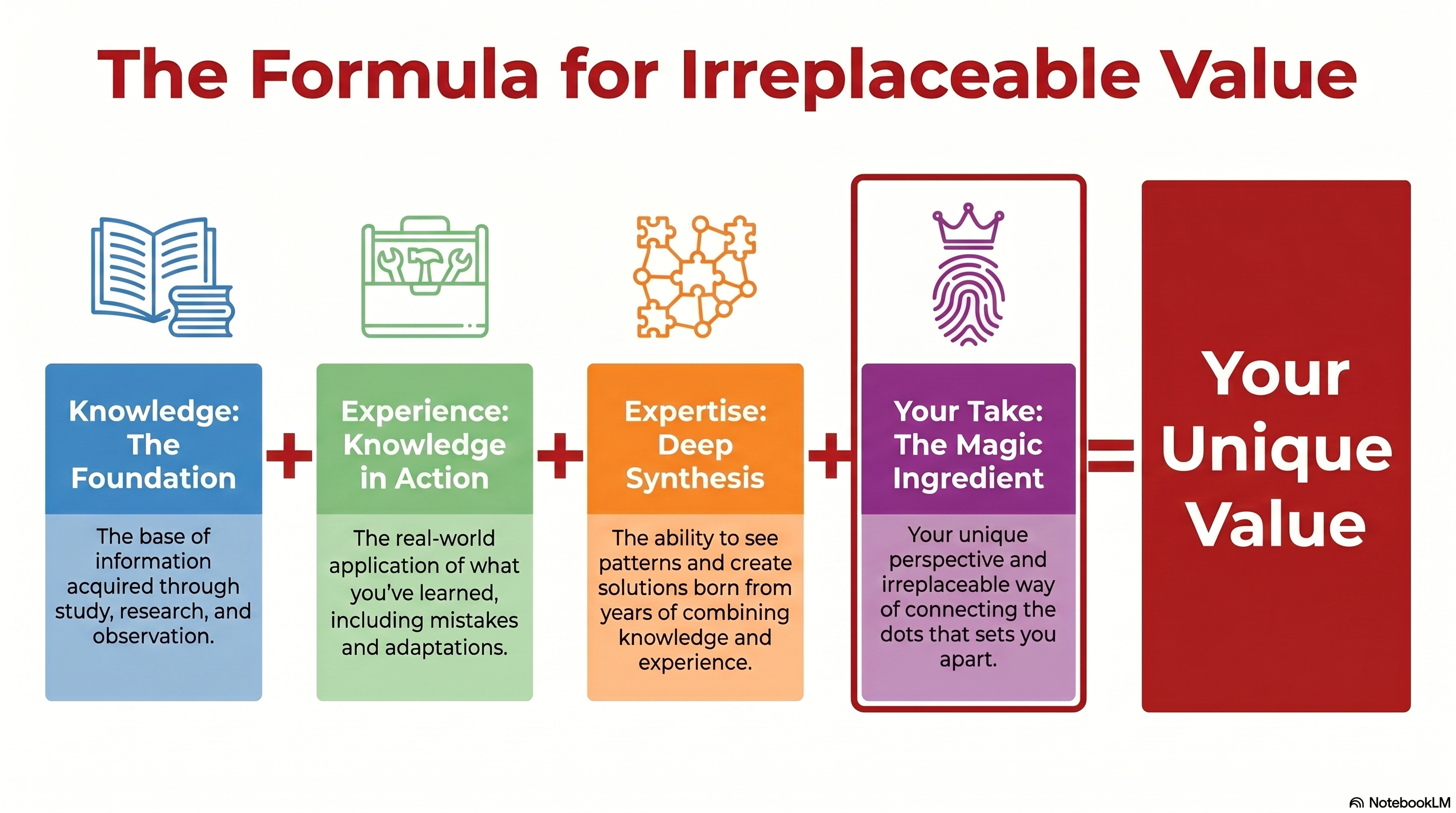
Let me bring this together clearly. The four factors that form your unique value as a coach, consultant, speaker or trainer are:
- Your knowledge: everything you have studied, researched and learned
- Your experience: knowledge applied in the real world, including the mistakes and the wins
- Your expertise: the deep pattern recognition and creative problem-solving that comes from sustained practice over time
- Your take on it: your unique perspective, your personal interpretation, the way you connect the dots that only you can connect
None of these four factors exists in isolation. Together, they create something that is genuinely one of a kind. And that combination is what your relational client, the client who is looking for an expert rather than a commodity, is actively searching for.
As Roy Sheppard once explained to me, the relational client looks to you as the expert. Price is a factor for them, but it is not the factor. They are not trying to find the cheapest option. They are trying to find the right person. And when they find that person, they stay, they pay, and they happily tell others about the experience.
Those are the clients you and I want to attract. And the way to attract them is to clearly understand and confidently communicate the full value of what we bring to the table.
How to Recognise and Communicate Your Worth
This is where many coaches and consultants get stuck. They intellectually accept that they have value. But when it comes to articulating what that value is, they shrink. They default to describing what they do rather than the impact it creates.
Here are three things I encourage every person in the helping industry to do.
1. Take stock of what you actually know
Sit down and genuinely audit your four factors. What have you studied? What have you been through? What have you seen work and fail in the real world? What is your perspective on your field that is different from the prevailing view? What do you know that your clients don't?
Most people are genuinely surprised by how much they have accumulated when they actually take the time to look at it all together.
2. Articulate the value you deliver, not the service you provide
There is a meaningful difference between 'I offer six sessions of one-to-one coaching' and 'I help business owners who are working too hard for too little to build a model that rewards them properly.' One describes a product. The other describes an outcome.
When you talk to potential clients, focus on the transformation you deliver and the value that transformation creates in their business and their life. That is the value of the value, as I like to call it. Not just the pounds in the bank but what those pounds mean. Freedom, security, choice, legacy.
3. Keep refining your take
Your take on it is not static. It evolves as you keep learning, keep working with clients, keep developing your thinking. The most valuable thing you can do is stay curious, keep adding to your knowledge and experience, and keep sharpening your perspective.
The more clearly and consistently you express your take on your field, the more powerfully you differentiate yourself from every other practitioner out there.
"Most people reach the limit of their belief well before they reach the limit of their talent." — Jeff Pettitt
Money as the Silent Applause
I have said this many times over the years: money is the silent applause for a job well done and value delivered to other people.
When you truly understand the value you bring, and when you communicate that clearly to the right clients, something shifts. The conversation about fees changes. It is no longer awkward or apologetic. It is simply a reflection of the impact you are going to make.
I have seen this play out many times, including in my own business. I remember the day I quoted 2.5 times my normal rate to a businessman who had approached me at an event. He accepted it without hesitation. And over time, I did more than £300,000 of business with that company.
Not because I was the cheapest option. Because I was the right option. And I had learned to price myself accordingly.
When your clients can feel your absolute focus on delivering value, that confidence communicates itself in everything you say and write and do. And it creates the kind of relationship where they are not just happy to pay your fees. They are delighted to.
What to Do Next
If you are a coach, consultant, speaker, trainer or accountant who has been undercharging for your work, this is the moment to stop and ask yourself a direct question.
What would you advise someone exactly like you to charge?
The advice-giving effect is real. When we tell someone else how much they should charge, we somehow find it easier to be fair and honest than when we are assessing our own value. So try it. Write down what you would tell a colleague in your position to charge. Then ask yourself why you are not charging that.
The answer, more often than not, is that you have not yet fully taken on board the combination of your knowledge, your experience, your expertise, and especially your take on it.
You have been selling hours. It is time to start selling wisdom.
Ready to build a business that rewards you properly?
My book The Profitable Business Coach, the fully revised edition of PAID!, walks you through the complete framework for pricing your expertise, attracting relational clients, and building a business that reflects the true value you deliver. You can get your copy at:
peterthomson.com/the-profitable-business-coach
And if you would like to connect with other coaches, consultants and helping professionals who are doing the same work, experience The British Business Coaches & Consultants Academy free for a month at:
The next £5,000 a month may already be inside your business. Find out where with Your Gap Finder (free, 18 questions, about four minutes): https://yourgapfinder.com
Experience The British Business Coaches & Consultants Academy free for a month: https://www.peterthomson.com/bbcca
Stay connected with bite-size videos and updates!
Gain an unfair advantage and join fellow achievers who receive tgiMondays - FREE weekly bite-sized videos and blogs on business and personal growth and inspiration from my latest off the edge thinking and ideas.
We hate SPAM. We will never sell your information, for any reason.
