

The Jigsaw Analogy: 20 Powerful Lessons About Goals That Actually Get You There
Mar 19, 2026Where This Idea Came From

It was 1997. I was sitting in my study, thinking about goal-setting, something I've spent a lifetime working on, when my mind drifted to a jigsaw puzzle sitting on the table in the other room.
And I thought: that's it. That's exactly what it's like.
What followed became a report I've shared with clients and colleagues for nearly thirty years. I've dug it out, updated it, and I want to share it with you here, because the analogy is as sharp and useful today as it was when I first wrote it down.
Before we get into the twenty parallels themselves, let me give you a bit of context about where my interest in goal-setting really started.
When I was 21, I worked for an American company called Diversi, selling cleaning chemicals across Herefordshire and Worcestershire. I was covering 50,000 miles a year. My sales manager at the time — first a man called Steele, then Lou Franks — would phone me at seven in the morning and say, "Peter, I'm coming out with you today. Where are we going?"
Lou would ride along with me, recording our sales calls on a cassette player. And then we'd park up in a lay-by on the A444 just outside Hereford and play the recordings back. He'd tell me where I'd got it right, where I could do better, and what to focus on next.
One day, sitting in that lay-by, Lou asked me whether I set goals.
I said I didn't think I did.
And he said this: "If you don't know where you're going, all roads lead there."
That stuck with me. It still does. And it set me on a path of thinking seriously about how goals actually work — and why so many people don't achieve them, not for lack of trying, but for lack of the right framework.
Why Most Goal-Setting Advice Misses the Point

Here's something worth saying upfront: there's a difference between goals and tasks.
A task is something you know how to do. It just needs doing. Measure twice, cut once. Write the proposal. Book the meeting. Those are tasks. They require discipline and organisation, but there's no mystery about how to do them.
A goal is something you don't yet know how to achieve. If you already knew exactly how to do it, it wouldn't be a goal, it would be a task in disguise.
That distinction matters, because once you understand it, you stop being frustrated with yourself when a goal feels uncertain or uncomfortable. That uncertainty is what makes it a goal. Your job is to set it clearly, build the framework, and trust the process.
As Brian Tracy once put it: goals allow you to control the direction of change in your favour.
And as Zig Ziglar liked to say: if you aim at nothing, you'll hit it every time.
So let's look at exactly what the jigsaw puzzle can teach us about doing this well.
The 20 Jigsaw Parallels
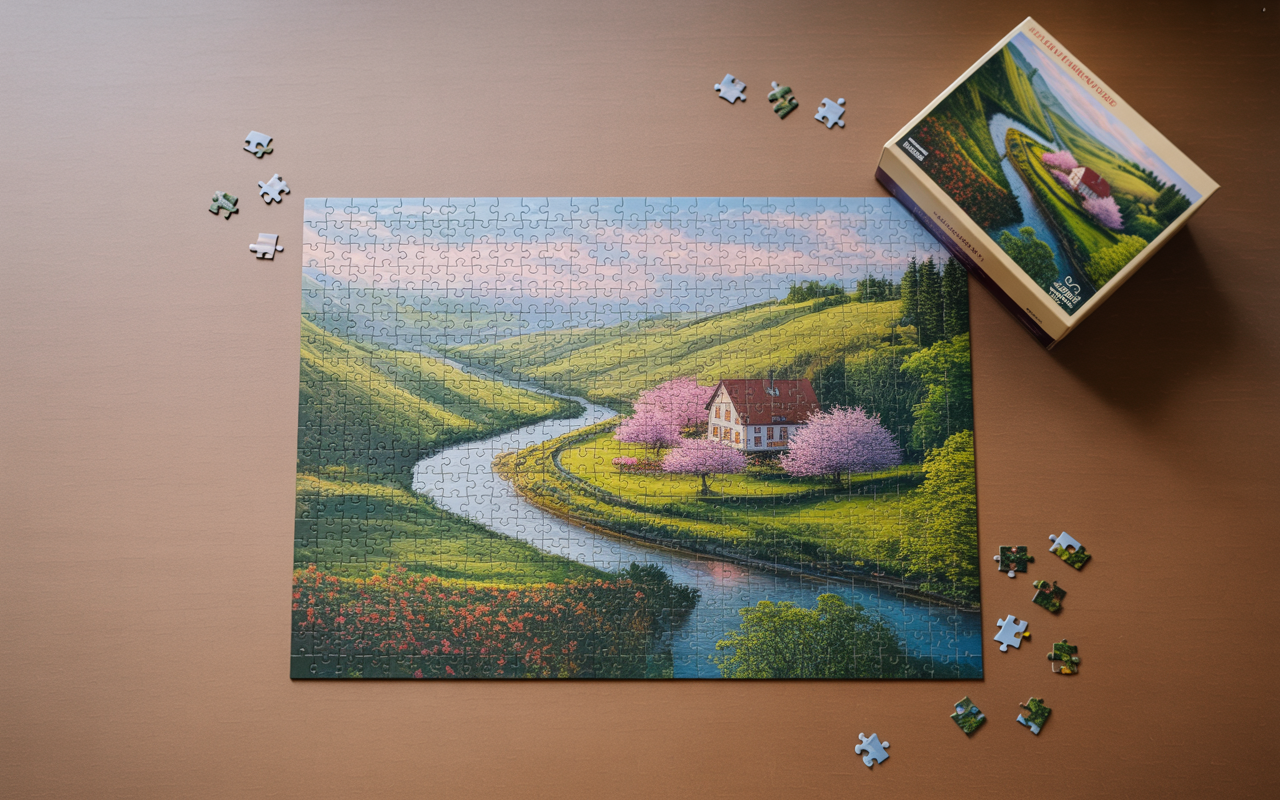
1. You know what it looks like when it's done.
Without the picture on the box, you're just shuffling pieces. A clear, detailed vision of the outcome is not optional. It's where everything else starts.
2. You know the rules to play by.
Goals come with boundaries and guidelines. Most people who do a jigsaw start with the corners, then the edges. That framework gives you a structure to work within. Your goals need the same kind of framework, and the clearer it is, the more easily you make decisions along the way.
3. If you force a piece in the wrong place, it won't stay.
It might look right briefly. But the mistake becomes obvious over time. The beauty of having a clear goal is that you spot the misfit faster. Without a goal, you can travel a long way down the wrong road before you realise it.
4. If it won't fit now, you can leave it.
Not every outcome has to happen right now. Patience is part of the process. Putting a piece to one side isn't failure — it's wisdom.
5. Short-term wins keep you going.
There's something deeply satisfying about the corners going in, then the edges, then the first section of colour. That dopamine hit is real. Build it into how you think about your goals. Celebrate the small completions.
6. You believe you'll get it done.
Setting a goal you don't believe is achievable isn't really a goal — it's wishful thinking. True goal-setting comes with a conviction that you will find a way. You don't need to know how yet. You just need to believe you'll figure it out.
7. No effort is wasted.
Every piece you try, even the ones that don't fit right now, is information. Every action you take towards your goal has value. Progress is always happening as long as you're moving.
8. You can leave it and come back.
Life interrupts. That's fine. Knowing your goal clearly means you can pick up exactly where you left off, without losing direction.
9. Your mind gives you answers because it knows what you want.
This is the reticular activating system at work. Once you've set a clear goal, your brain starts looking for information that serves it. You start noticing relevant connections, ideas, and opportunities that were always there but invisible to you before. The goal opens the filter.
10. You get short-term wins that fuel momentum.

Momentum was a word I was taught by Jay Abraham, someone I spent a great deal of time with over the years. And it's one of the most important concepts in achievement. Each small win doesn't just feel good — it creates energy for the next one.
11. Fun comes from progress. Progress comes from clarity.
When goals feel like drudgery, it's usually because the goal isn't clear enough. The clearer the picture, the more engaging the process becomes.
12. You can't blame anyone else for non-completion.
This is your puzzle. The ownership of the outcome is both the challenge and the reward. Nobody else is responsible for whether your pieces go in.
13. The clearer the picture, the more connections you spot.
Goals help you see the patterns and links that others miss. Ideas from completely different areas suddenly click together. This is Zig Ziglar's insight brought to life: what you learned today gives value to what you learned yesterday.
14. Completion feels extraordinary.
That final piece. The sense of "I did it." Goals aren't about the destination — except for that extraordinary moment when you arrive at it. Allow yourself to feel it properly when it happens.
15. You control the pace.
Nobody sets the speed. It's entirely up to you. Same with your goals. You decide the urgency. You decide the timeline. That's a freedom most people underestimate.
16. People like to help when they can see where you're heading.
Shared goals create collaboration. When the people around you understand what you're building, they naturally contribute. They spot pieces you missed. They bring connections you didn't expect.
17. Others can see the fit when you might not.
Sometimes we get too close to our own progress to see it clearly. A good accountability partner, mentor, or community can see the picture from a slightly different angle — and their perspective can save you weeks of wrong turns.
18. Other people's pieces don't belong in your picture.
This is the one that gets the biggest reaction when I share it. Comparing your progress to someone else's puzzle is pointless. You have no idea what picture they're building, what pieces they started with, or what rules they're playing by. Your puzzle is yours.
19. You need the right surface to play on.
The right environment, the right business, the right role. You cannot build a great picture on an unstable surface. If the foundations of your business or your life aren't solid, the goal-setting work gets dramatically harder. Choose where you play as carefully as you choose what you build.
20. If you haven't got a puzzle of your own, you're almost certainly a piece in somebody else's.
Without your own goals, you end up serving someone else's. Being a piece in another person's puzzle means they decide where you fit. The most important decision you can make is to start your own puzzle.
The Most Important Question to Ask Yourself
After all twenty of those, there's one question I want to leave you with.
Do you have your own puzzle?
Not a vague aspiration. Not a loose intention. A clear, detailed picture of what you're building — in your business, in your life, in your relationships, in your income.
If the honest answer is no, then that's the first piece to put in place. Everything else follows from it.
And if you do have goals but they're sitting somewhere in a document you haven't opened in months, this might be the nudge to go back, revisit them, and reconnect with the picture on the box.
REAL Goals: Results, Experience, Learning
Here's a framework I use for thinking about goals that I want to share with you.
When I look at my goals, I don't just think about the result I want. I think about three things: results, experience, and learning. In fact, the acronym is REAL — Results, Experience, And Learning.
The result is the obvious part, what you want to achieve.
But the experience matters too. What will it be like to work towards this goal? What will you go through? What will you create? Is the experience worth having even if the result takes longer than you expected?
And the learning is what stays with you permanently. What will you know at the end of this that you didn't know at the start? What will you become in the process?
When a goal scores well on all three, you've got something worth pursuing properly.
Records and Why the Best People Keep Them
There's a saying I've used for years: the people who keep records are the people who break records.
Why? Because the others don't know.
If you're not tracking your progress, you can't tell whether you're improving. You can't see the momentum building. You can't spot the patterns. And you can't celebrate the wins, because you're not sure what you've achieved.
Keeping records doesn't have to be complicated. It can be as simple as a weekly note to yourself about where things stand against your goals. The point is the habit — the act of checking in, noticing what's working, and making conscious adjustments.
I've been running client meetings this way for years, starting every session by asking: "What has to happen for you to consider this meeting a resounding success?" That question, every time, keeps us focused on the goal rather than just the activity.
Apply the same discipline to your own goals. At least once a week, look at the puzzle. Are the pieces going in? Is the picture getting clearer? Is there something you've been avoiding placing?
Your Next Step
I'd like you to do one thing after reading this.
Block an hour in your diary, today if you can, this week if not, and sit down with your goals. Not your task list. Your goals. The things you want to build. The picture on the box of your professional and personal life.
If you've got them written down already, review them. Update them. Add the detail that makes them vivid.
If you haven't got them written down yet, now is the time to start.
And if you want a deeper foundation in the business development principles that sit behind all of this, including how to price with confidence, generate consistent leads, and position yourself as the go-to expert in your field, my book PAID! is the place to start.
Do you have your own puzzle? There's no better time than right now to start building it.
Stay connected with bite-size videos and updates!
Gain an unfair advantage and join fellow achievers who receive tgiMondays - FREE weekly bite-sized videos and blogs on business and personal growth and inspiration from my latest off the edge thinking and ideas.
We hate SPAM. We will never sell your information, for any reason.
