

Why You. Why Me. Why This. Why Now: The Four Questions That Remove Resistance in Marketing Before It Starts
Apr 23, 2026Why Most Good Offers Get Ignored
Here is a scenario I have seen play out hundreds of times across my years of working with coaches, consultants, speakers, trainers and accountants.
A professional has something genuinely valuable to offer. Their service works. Their clients get real results. And yet they consistently struggle to communicate what they do in a way that lands. Emails go unanswered. Conversations stall. Proposals come back with polite declines, or worse, no response at all.
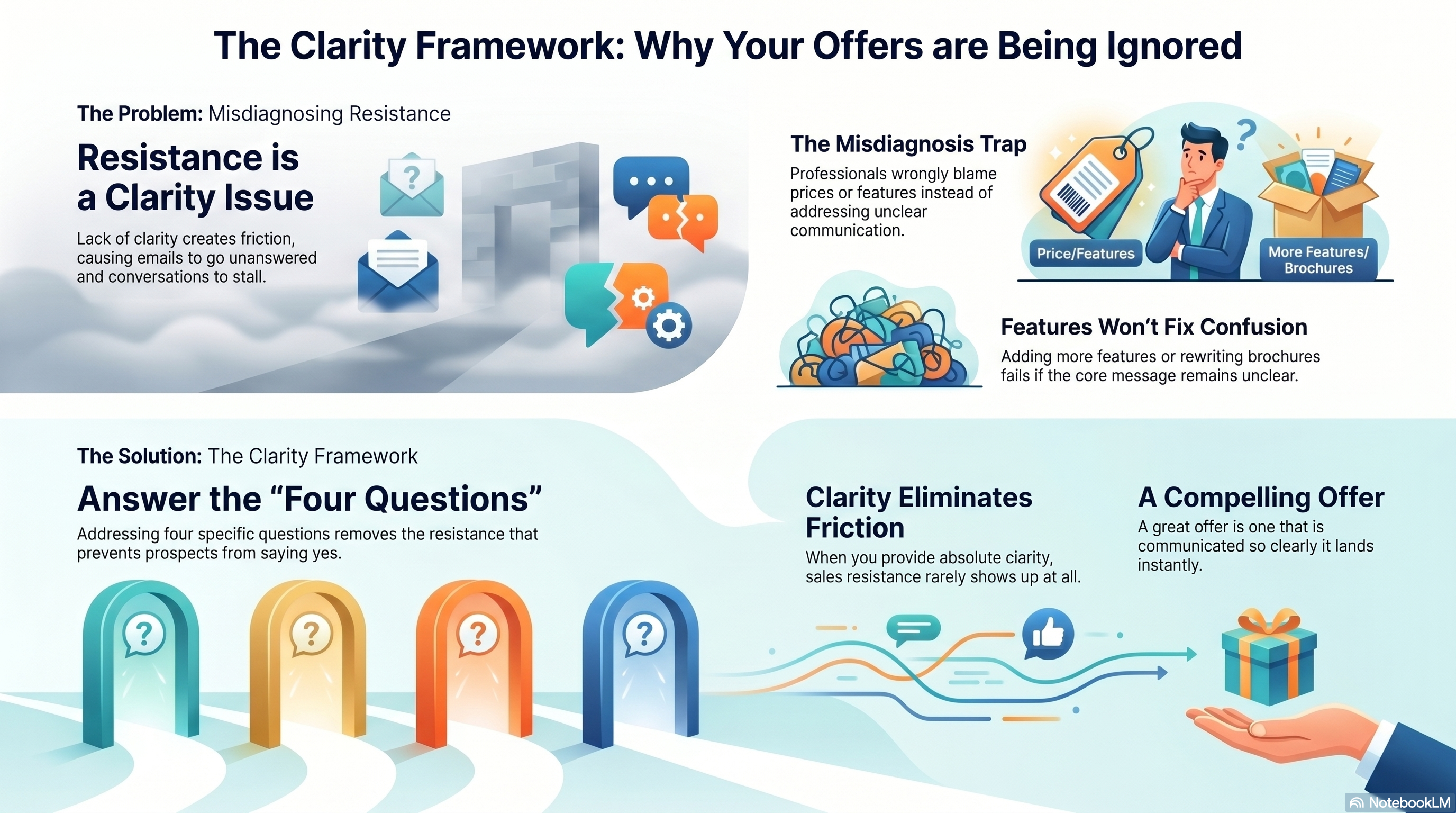
And the professional concludes, almost always incorrectly, that the problem is the offer itself. So they lower the price. Or they rewrite the brochure. Or they add more features.
None of it works, because none of it addresses the real problem.
The real problem is clarity. And the solution is four questions.
Resistance is created through a lack of clarity. Answer these four questions and resistance rarely shows up at all.
The Real Cause of Resistance
When someone pushes back on an offer, delays a decision, or simply does not respond, the most common assumption is that they are not interested. Or that the price is wrong. Or that the timing is off.
Sometimes those things are true. But far more often, the resistance is created by something that happened, or more precisely did not happen, earlier in the communication.
The person never understood why it was for them.
Or they were not given a reason to trust the source.
Or the offer itself was presented before the context was established.
When those things are missing, the mind does what it always does when it lacks information. It hesitates. It looks for reasons not to commit. It creates friction.
The four-question framework eliminates that friction before it can form.
The Four-Question Framework
I have used this framework for years across every form of communication I create. Videos. Emails. Web pages. Talks. Proposals. Conversations with prospective clients.
The four questions, always in this order, are:
- Why you? Why is this relevant to the specific person you are communicating with?
- Why me? Why should they listen to you rather than anyone else?
- Why this? What exactly is it you are offering and why is it the right solution?
- Why now? Why does this matter today, and what happens if they do nothing?
Each question does a specific job. Together, they create a context in which the person can say yes without hesitation, because every potential objection has already been addressed.
Four questions. Four paragraphs. One framework that works everywhere you communicate.
Question One: Why You?
This is the question most people skip entirely, and it is the most important one of all.
Before you say anything about yourself, your offer, or your credentials, you need to tell the person why this communication is specifically for them.
If you do not do this, the person is already asking the question in their head: is this for me, or is this just noise? And the moment that question forms without an answer, you have lost them.
The why you does not need to be long. A single clear sentence that speaks directly to the person's situation, role, or problem is enough. But it has to be specific. Generic openers like 'for any professional who wants to grow their business' do not do the job. They wash over people because they could apply to anyone.
The more precisely you can name the situation the person is in, the more powerfully this first question lands.
Examples of a strong why you opening:
- If you are a consultant who is brilliant at what you do but finding it hard to communicate your value at the fee level you deserve, this is for you.
- If you have been in business for several years and you know you are leaving income on the table but you are not sure exactly where, read on.
Notice that both of those speak to a specific situation. The person reading them either recognises themselves or they do not. And if they do, they are already leaning in.
Question Two: Why Me?
Once you have established that this is for them, the next question the person asks is: who is telling me this and why should I listen?
This is where your credibility does its work. And it needs to do that work here, before you present anything, not after.
Most professionals make the mistake of leading with their credentials in a way that feels like a CV. Years of experience. Qualifications. Clients worked with. These things matter, but they land very differently when they are framed as proof of your ability to solve the person's specific problem, rather than as a general claim of authority.
The most powerful why me answers are specific and evidence-led. They connect your background directly to the problem you identified in question one.
This is also where a well-placed Signature Snapshot, a short true story of a result you created for someone in a similar situation, can do extraordinary work. It answers the why me question not through claims but through demonstration.
If you would like to read more about how to build and use a Signature Snapshot in your marketing, you will find a full guide at peterthomson.com/signature-snapshot.

Question Three: Why This?
Now, and only now, do you talk about what you are actually offering.
The timing matters enormously. When you have already established that this is for them and that you are a credible source, the presentation of your offer lands in a completely different way. The person is already engaged. They already have a reason to pay attention. The cognitive effort required to take in what you are saying is lower because trust has been established.
The why this should focus on outcomes, not features.
People do not buy systems, methodologies or processes. They buy the results of those systems. They buy the transformation. The ten-module programme, the twelve-week engagement, the monthly retainer: none of those things are what the person is paying for. They are paying for what those things produce.
Keep the why this clear and specific. What does this do? What does the person end up with that they did not have before? What problem does it solve and how completely does it solve it?
The simpler and more direct your answer to those questions, the more persuasive the why this becomes.
People do not buy systems. They buy the outcomes of systems. Lead with the transformation, not the method.
Question Four: Why Now?
This is the question that turns interest into action. And it is the one that needs to be used most carefully.
A genuine why now answers the question: what changes if the person does nothing?
That might be the financial cost of continuing with the current situation. It might be a time-sensitive opportunity. It might simply be the accumulating weight of a problem that has already gone on too long.
What it should never be is a false deadline or a manufactured urgency. Tactics like 'this offer expires in 24 hours' or 'only three places remaining' when neither of those things is true do work in the short term. But they damage trust, and in the helping industry, trust is everything.
Real urgency is always more powerful than invented urgency. If there is a genuine reason to act now, say so. If there is not, the why now can be as simple as drawing the person's attention to how long the problem has already been there and what it is costing them to leave it unsolved.
Sometimes the most persuasive why now is simply this: the best time to have solved this was a year ago. The second best time is today.
How to Use the Framework Everywhere
One of the things I love most about this framework is how universally it applies.
When I am recording a promotional video, I structure it as four short sections: why this is for you, why you should listen to me, what it is, and why now. The whole thing can be done in two minutes. And it works.
When I am writing an email to a cold prospect or a warm contact I have not spoken to in a while, the same four questions provide the structure. Each question gets a paragraph. The email almost writes itself.
On a web page, the four questions map naturally onto the flow of the copy. The headline and opening paragraph answer why you. The about section or credibility elements answer why me. The offer section answers why this. And the call to action section, if there is a genuine reason to act, answers why now.
In a sales conversation, the same sequence applies, though it is woven into the dialogue rather than stated directly. The questions become the invisible architecture of the meeting.
[IMAGE: Graphic showing the four questions mapped across different communication formats: email, video, web page, conversation]
A Real-World Example
Let me show you how this plays out in practice with a short example.
Imagine I am writing to a management consultant who has been in business for eight years and is looking to position themselves more effectively in their market.
Why you: If you are a consultant with years of real expertise who knows their fees should be higher but is not quite sure how to make that case to clients, this is written for you.
Why me: I have spent more than 30 years working with professionals in the helping industry, coaches, consultants, trainers and speakers, helping them articulate their value more clearly and charge what they are genuinely worth. I have written 14 books on the subject and my clients have used these ideas to generate significant additional income in their businesses.
Why this: My book PAID! sets out the complete system for positioning your expertise, pricing with confidence, and having the kind of client conversations that lead to better agreements. It is built entirely from real client situations and tested methods.
Why now: Every month that passes without a clear positioning strategy is a month of fees left on the table. If you have been meaning to address this for a while, this is a good moment to start.
Four paragraphs. Four questions. A complete, persuasive communication.
The Framework in Writing
I want to say something specific about using this framework in written communication, because there is an important nuance that many people miss.
When you are writing to a reader, you are writing to one person, not a crowd. The temptation is to use language like 'for those of you who' or 'many of my readers' or 'some of you will know.' Resist it.
Every piece of written communication should feel like it was written for the individual reading it. That means using 'you' and 'your' throughout. It means writing in a natural, conversational voice rather than the slightly formal register that people often slip into when they sit down to write.
As I often say: write as you speak. If you would not say it out loud, do not write it down. The best test is to read your communication back to yourself. If it sounds like a person talking to another person, it is working. If it sounds like a brochure, it needs to be redone.
The four-question framework, written conversationally and aimed at a single reader, is one of the most effective pieces of communication architecture I know.
Write as you speak. Every written communication should feel like a conversation, not a brochure.
What Happens When You Get It Right
When all four questions are answered clearly and in the right order, something very specific happens in the other person.
The resistance that would otherwise build up simply does not form.
They understand that this is for them. They trust the source. They understand what is being offered and what it will do for them. And if the why now is compelling, they have a reason to act rather than postpone.
The decision becomes easy. Not because they have been pushed, but because everything they needed to know in order to say yes has been provided clearly and in the right sequence.
This is what I mean when I say that the goal is to learn how to sell, stop selling, and allow people to buy. When the communication is structured well, the person does not feel sold to. They feel understood. And from that place, they make their own decision.
That is the only kind of persuasion that builds the long-term relationships and referral-based practices that the best professionals in the helping industry enjoy.
[IMAGE: Peter Thomson in conversation or at a desk, representing the moment a client says yes]
Your Next Step
If this framework is new to you, the best thing you can do right now is take one piece of communication you have already written, an email, a web page, a proposal, and test it against the four questions.
Does it open with a clear why you? Does it establish your credibility before presenting the offer? Does it lead with outcomes rather than features? And if appropriate, does it give a real reason to act now?
You will almost certainly find that one or more of the questions is missing or underserved. And when you add it in, the piece will immediately become more persuasive.
If you would like to go deeper on this and every other aspect of communicating your value clearly and winning better clients, come and join us in The British Business Coaches & Consultants Academy.
You can experience it free for a month. It is for coaches, consultants, speakers, trainers and accountants. We go deep on persuasion, positioning, fee conversations and the business development approaches that actually work in the helping industry.
Come and join us. Your first month is free, and there is no long-term contract.
Join The Academy at peterthomson.com/bbcca
For a deeper look at how to position your expertise and charge what you are genuinely worth, my book PAID! is the place to start.
The next £5,000 a month may already be inside your business. Find out where with Your Gap Finder (free, 18 questions, about four minutes): https://yourgapfinder.com
Experience The British Business Coaches & Consultants Academy free for a month: https://www.peterthomson.com/bbcca
Stay connected with bite-size videos and updates!
Gain an unfair advantage and join fellow achievers who receive tgiMondays - FREE weekly bite-sized videos and blogs on business and personal growth and inspiration from my latest off the edge thinking and ideas.
We hate SPAM. We will never sell your information, for any reason.
