

The 3 Key Questions That Will Transform Your Business Growth (And Why Most Owners Get It Wrong)
Jan 05, 2026Let me share something with you that completely changed how I think about growing a business.
I've been in business since 1972. I built three successful companies, selling the last one to a public company for £4.2 million after only five years of trading. That allowed me to retire at 42. But here's the thing – I was still learning.
A friend of mine, David Hughes, who was the managing director of Nightingale Conant in the United Kingdom at the time, told me about a seminar he'd been to in Los Angeles. The presenter was Jay Abraham, the famous marketing expert.
David suggested I go. I went. And what I learned on that seminar has stayed with me ever since. It's helped thousands of my clients increase their turnover, profits, and personal income. And today, I'm going to share it with you.
Introduction: Where These Questions Came From
You see, the ideas I'm about to share aren't just theory. They're proven in the real world, time and time again.
Following that seminar, I went on to speak at six Jay Abraham events myself. I've used these questions – and my own special take on them – with thousands of personal clients over the last 30+ years.
Later, I interviewed Ted Nicholas, one of the most successful self-published authors and a marketing genius responsible for billions of dollars of sales. Ted confirmed everything I'd learned and gave me even more answers to these questions.
I also interviewed Paul Dunn, another top marketer and businessman. And Paul was the person who had shared these questions with Jay Abraham.
So, that's the background. Now let's get to the questions themselves.
The Three Key Questions of Business Growth
Here they are. The three most important, the three key, the three critical questions of business growth:
Question 1: How do I (or we) increase the number of customers who use our business?
Question 2: How do I (or we) increase the average order value?
Question 3: How do I (or we) increase the average order frequency of purchase?
Three very simple questions. And yet – and this is the important part – the answers to them will provide every necessary strategy you need to build turnover, profit, and bonuses.
You might be thinking, "Peter, I already know these questions." And you know what? You probably do. Perhaps not quite in the same way, or with the same clarity, but the concepts won't be foreign to you.
What might surprise you, though, is what happens when you start working with all three questions together. That's where the magic happens.
How the Numbers Actually Work
Let me show you exactly how these numbers work. This is where it gets really interesting.
Let's say you and I have a business together. We have 100 customers who spend, on average, £100 each time they buy from us. And they make that purchase twice in the period we're examining – that could be twice a year, twice a month, twice a week. It doesn't matter for this example.
So we have:
- 100 customers
- £100 average order value
- 2 purchases per period
The turnover of our joint business would be: 100 × £100 × 2 = £20,000
Turnover is simply the multiplication of how many customers we have, multiplied by how much they spend each time, multiplied by how often they spend that amount.
Simple enough, yes?
Now let me show you why this matters so much.
Why Most Businesses Grow the Hard Way
Here's what most businesses, most firms, and most organisations do: they spend the majority of their time, effort, and marketing budget on getting new customers. Some focus only on this activity.
Now, you and I know that we do need to get new customers. We're bound to lose some of our current customers over time. That's just the reality of business. However, trying to build a territory, a region, or a business by only getting new customers is the hard way.
Let me show you why.
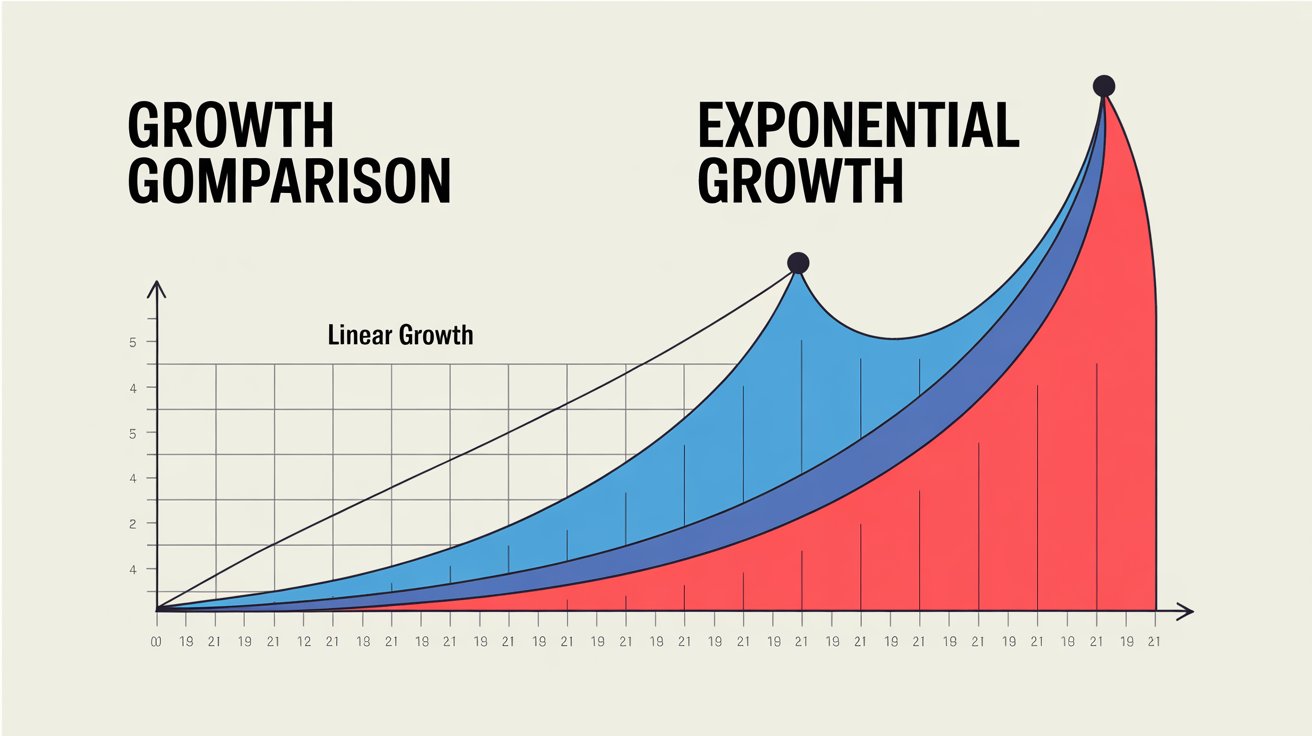
Linear Growth vs Exponential Growth
Let's say in our business we were able, through sales and marketing effort, to get 10% more customers.
Now we'd have:
- 110 customers
- Still spending £100
- Still buying twice
Our turnover would have risen by 10%. Simple. We increase one factor in the equation by 10%, and therefore we increase the total by 10%.
Yes, that is one way to grow. But it's linear growth. And there's a better way.
The Exponential Growth Formula
What happens if we were able to increase all three factors by just 10%?
- Number of customers +10% = 110
- Average order value +10% = £110
- Average order frequency +10% = 2.2 times
This produces a turnover of £26,620 – compared to the original £20,000.
That's an increase of 33.1%.
And remember – this is achieved by increasing each area by only 10%.
Working with only one question gives us linear growth.
Working with all three gives us exponential growth.
Can you see the difference?
Let's Try Some Other Figures
What if we achieved:
- Customers +23%
- Average order value +16%
- Average order frequency +5%
This produces an increase of £9,962, or nearly a 50% increase in turnover.
The numbers don't lie. When you work on all three questions simultaneously, the results multiply rather than simply add up.

The Profit Impact That Will Surprise You
Now let's look at what this does to profits. Because ultimately, that's what matters, isn't it?
Let's take our original business:
- Turnover: £20,000
- Fixed overheads: £9,000
- Variable overheads: £9,000
- Profit: £2,000
After increasing all three areas by 10%:
- Turnover: £26,620
- Fixed costs: still £9,000 (they don't change)
- Variable costs: increased to £11,000
- Profit becomes £6,620
That's a 231% increase in profit.
Read that again. A 10% improvement in each of the three areas produced a 231% increase in profit.
Why? Because your fixed costs – rent, rates, core salaries, insurance – they stay the same. The extra £6,620 in turnover, after covering the additional variable costs, drops almost entirely to your bottom line.
This is the power of working on all three questions together.
The Supermarket Example: Understanding Lifetime Value
Let me give you a practical example to really drive this home.
A supermarket customer spends, say, £100 per week. Over a year, that's about £5,200.
If that customer stays for 20 years, what are they worth?
20 × £5,000 = £100,000
And those figures don't even allow for inflation.
You can see why supermarkets are so keen on loyalty schemes. They understand the lifetime value of a customer. Do you know the lifetime value of your customers?
Putting These Questions Into Action
I know these are examples. But I've seen companies achieve these increases – and more – once they shifted their focus from just getting new customers to working across all three questions.
The change in mindset you'll go through, as I did when I first learned these questions, will amaze you. You'll start to see opportunities in so many different places.
Here are the actions to take right now:
- Find out how many customers you currently have – This might sound obvious, but many business owners don't actually know this number with precision.
- Calculate your average order value – Add up your total revenue and divide it by the number of transactions. Simple but powerful.
- Work out your average order frequency – How often does each customer buy from you in a given period?
- Brainstorm ideas around all three questions – Not just the first one. All three.
- Allocate responsibility for action – Who in your team is going to own each area?
- Always test on a small scale first – Brainstorming often produces great ideas, and people want to implement them immediately. That enthusiasm is good – but testing first is crucial.
A Word on Testing
Before rolling anything out across your entire business, always test ideas on a small scale. Test different approaches. Measure the results. Then, and only then, roll out what works.
This principle has saved my clients countless thousands of pounds over the years. Don't skip it.
Your Next Step
With a systemised process built around these three questions, you can increase turnover, increase profits, increase customer retention, increase penetration rates, and increase market share.
If three simple questions can do all that – and they can – you'll be pleasantly surprised at just how straightforward success can be.
In my next article, I'll share specific strategies for each of these three questions – practical ideas you can implement in your business immediately. We'll cover everything from systemised referrals to back-end products, from pricing strategies to programming of purchase.
But here's the thing – knowing these questions is one thing. Having the systems, strategies, and support to implement them consistently is another.
That's exactly why I created The Paid Up Club.
Come and experience The Paid Up Club for only £1 for the first month.
Inside, you'll get access to my complete library of strategies for growing your business. Monthly live sessions where I share what's working right now. A community of like-minded business owners who are implementing these ideas and getting results.
The strategies I've shared today? They're just the beginning. There's so much more waiting for you inside.
Learn more about The Paid Up Club here
Peter
Peter Thomson.
'The UK's Most Prolific Business Development Author'
Until the next time – goodbye for now.
Stay connected with bite-size videos and updates!
Gain an unfair advantage and join fellow achievers who receive tgiMondays - FREE weekly bite-sized videos and blogs on business and personal growth and inspiration from my latest off the edge thinking and ideas.
We hate SPAM. We will never sell your information, for any reason.
