

How to Write a Business Book in One Month (I Did It in 80 Minutes)
Feb 12, 2026Introduction: The £50 for Two Minutes Question
"How long does it take to write a book?"
I get asked this question constantly. And I love answering it, because the answer reveals something fundamental about how we think about value, time, and achievement.
Let me start with a story. I think Brian Tracy told me this one, and it's stuck with me for decades.
A man with terrible toothache phones his dentist on Friday afternoon. The pain is unbearable. He desperately needs help.
"Can I come in today?" he asks.
"I'm afraid not," the dentist replies. "I'm going away for the weekend. But first thing Monday morning, 8 o'clock, I'll see you. Be in the chair."
So this poor fellow suffers through the weekend. Paracetamol, Ibuprofen, ice packs, whatever he can find. Come Monday morning, he's at the dentist's office, dreading what's to come because, well, he hates dentists.
The dentist examines him and delivers the verdict: "It's a bad one. It's going to have to come out."
"Oh no," the patient groans.
"Is it going to hurt much?"
"Not too much," the dentist reassures him. "I'll numb you up properly."
"Well then, how much will it cost?"
"£50."
"And how long will it take?"
"About two minutes."
The patient's eyes widen. "£50 for two minutes of work? That's outrageous!"
The dentist smiles calmly and says: "I can take as long as you like."
That's the answer to "How long does it take to write a book?"
It can take as long as you want it to. I know people who've been "writing a book" for ten years. They'll probably never finish. I also know people who've written books in weeks. And I wrote one in 80 minutes.
Now, before you think I'm some kind of wizard, let me give you the full story.
The Truth About How Long It Really Takes
Here's what most people don't understand about writing business books: the time it takes has almost nothing to do with the quality of the book, and everything to do with having a system.
Think about it. You've probably got 20, 30, maybe 40 years of experience in your field. You've helped countless clients. You've solved the same problems dozens of times. You've developed methods, frameworks, processes that work.
All of that knowledge is already in your head. The book isn't about generating new ideas. It's about capturing what you already know.
So why does it take some people years to write a book? Because they're overthinking it. They're trying to write War and Peace when they should be writing a focused, practical guide that people will actually read and use.
Let me give you the real numbers for writing a business book that people will actually finish:
- 60-page book = approximately 12,000 words
- Writing time (at 25 words per minute) = 8 hours
- Preparation and planning = 8 hours
- Editing, formatting, adding visuals = 8 hours
- Total time investment = 24 hours
That's it. Twenty-four hours of focused work.
Now, you're probably not going to sit down and write for 24 hours straight. But if you dedicate just one hour per day? That's one month to become a published author.
Half an hour per day? Two months.
Either way, by this time next quarter, you could have a finished book with your name on the cover.
The 30-Year Journey to an 80-Minute Book
[Image placeholder: Author journey timeline]
Right, let me tell you about my 80-minute book. Because yes, I wrote it in 80 minutes. But there's more to the story.
It took me 30 years to learn how to write a book in 80 minutes.
Thirty years of:
- Writing 1500+ TGI Monday messages (some on video, some in text)
- Running an audio newsletter for 13 years with 72+ minutes of content every single month for 156 months straight
- Creating over 100 audio programmes
- Producing over 100 video programmes
- Writing countless books, guides, and informational products
So yes, the actual writing took 80 minutes. But the knowledge, the systems, the understanding of how to structure content? That took three decades.
Here's the thing though: you don't need 30 years to write your book.
You just need to understand the system I figured out. And I'm going to share it with you right here.
You see, you don't get paid in life for what you do. You get paid for what you've done. And that makes all the difference.
The Maths: Breaking Down the 24-Hour Reality

Let me make this concrete for you. I'm going to show you exactly how the numbers work, because when you see it laid out, you'll realise just how achievable this really is.
Let's work with a 60-page business book. That's the sweet spot, as I'll explain in a moment.
The Writing:
- 60 pages at 200 words per page = 12,000 words total
- Average speaking/typing speed = 25 words per minute
- 12,000 words ÷ 25 words/minute = 480 minutes
- 480 minutes = 8 hours of actual writing
Now, I was talking to a client in mainland Europe just this morning (I'm not counting the UK as part of Europe for this purpose, though geographically it obviously is). He timed himself and discovered he writes at exactly 25 words per minute. That's probably a bit slow, to be honest. My speed's higher. But let's use 25 as our baseline because it's conservative.
The Preparation:
- Outlining your structure = 2 hours
- Gathering examples and stories = 2 hours
- Creating your framework = 2 hours
- Deciding on key messages = 2 hours
- Total prep time = 8 hours
The Editing and Finishing:
- First edit for flow and clarity = 3 hours
- Adding diagrams, action plans, quotes = 2 hours
- Creating a table of contents = 1 hour
- Final proofread = 2 hours
- Total finishing time = 8 hours
Grand Total = 24 hours
Now here's where it gets interesting. If you work on this just one hour per day:
- 24 hours ÷ 1 hour per day = 24 days
Let's call it a month to allow for life getting in the way.
If you work on it 30 minutes per day:
- 24 hours ÷ 0.5 hours per day = 48 days
That's about two months.
Either way, you're looking at having a finished book in your hands within the next quarter. And that book will position you as an authority, serve as a powerful lead magnet, and potentially generate revenue for years to come.
The question isn't whether you have time. The question is whether you're willing to commit one hour per day for the next month.
Dan Sullivan's Game-Changing Insight on Book Length
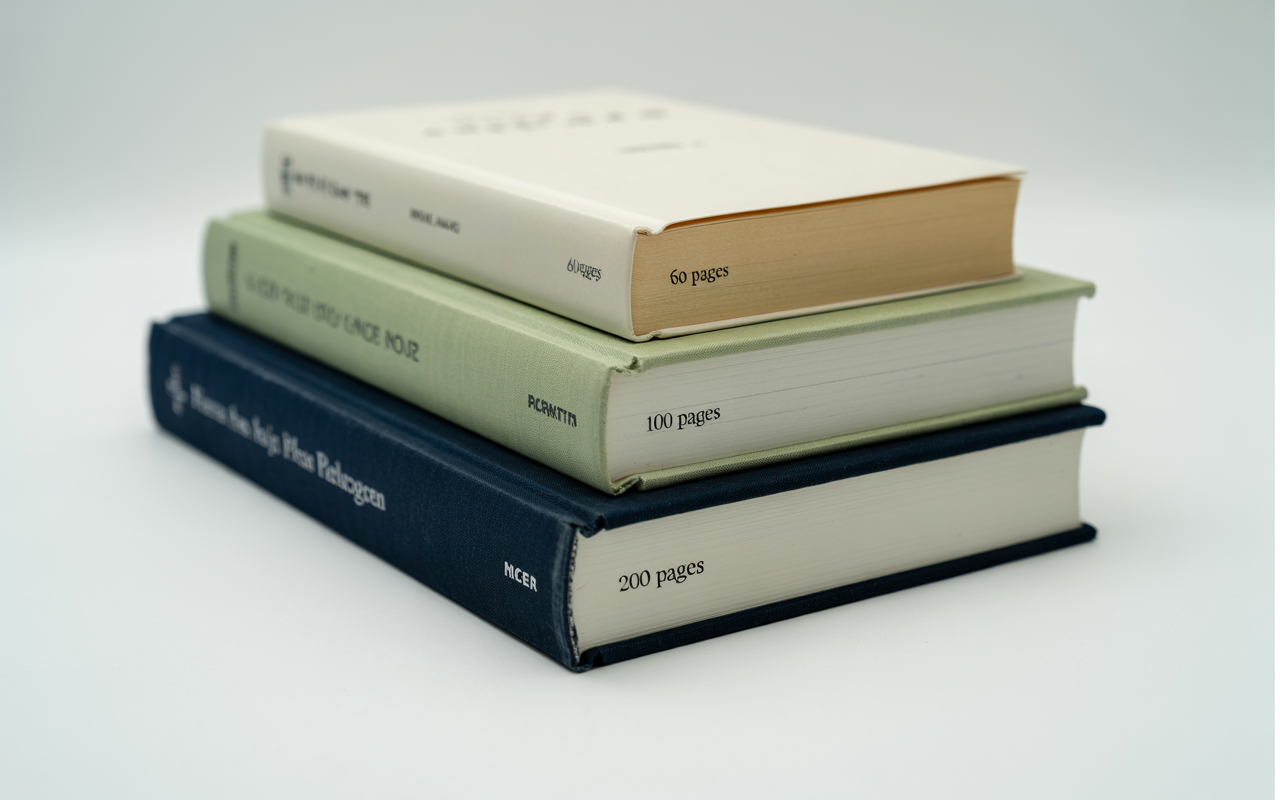
Now, let me share something that completely changed how I think about books. This comes from Dan Sullivan, the founder of Strategic Coach, and it's one of the most valuable pieces of advice I've ever received.
Dan told me this:
80-page books get 80-100% readership.
When you write an 80-page book, nearly everyone who starts it finishes it. They read the whole thing. They take in your ideas. They apply them. They get results.
100-page books? Readership drops to about 3%.
Hit that 100-page mark, and suddenly 97% of people who pick up your book never make it to the end. All that extra content? Wasted. Unread. Forgotten.
200-page books? Just 1% readership.
Write a 200-page book, and 99 out of 100 people who start it will never finish. They'll get through the first chapter, maybe two, and then it sits on their shelf gathering dust.
Think about that for a moment.
You could spend a year of your life writing a comprehensive 250-page masterpiece that 99% of readers abandon before reaching your best insights in the final chapters. Or you could write a focused 60-80 page book that people actually read cover to cover.
Which has more impact?
Which serves your readers better?
Which positions you more effectively as an authority?
The answer is obvious. The shorter book wins every time.
Now, the tighter the niche, the higher the readership can be even for longer books. If you're writing about a very specific technical topic for a highly specialized audience, they might read every word of a 300-page book. But for most business books aimed at consultants, coaches, accountants, and professionals? Shorter is better.
Dan understood this years ago. He's committed to writing a book every quarter for 25 years. That's 100 books. He's well down that road now, and it's brilliant positioning. He's not "the guy who wrote a book." He's "the guy who's written 50+ books on strategic thinking."
Why Three Short Books Beat One Long One
[Image placeholder: 1 large book vs 3 small books comparison]
Let's take this insight further, because there's a commercial reality here that most people miss entirely.
Imagine you're going to write 36,000 words of content. You've got two choices:
Option A: Write one 36,000-word book
- 180 pages
- Sell it for £10
- Revenue: £10 per sale
- Readership: Maybe 2-3% finish it
- Positioning: "I wrote a book"
Option B: Write three 12,000-word books
- Each book is 60 pages
- Sell each for £10
- Revenue: £30 per complete set
- Readership: 80-100% finish each book
- Positioning: "I've written three books on X, Y, and Z"
Same amount of writing. Three times the revenue. Far better reader outcomes. Stronger positioning.
It's not even close.
From your reader's perspective, they get actionable content they'll actually use. They finish the book feeling accomplished. They implement your ideas. They get results. They come back for the next book.
From your business perspective, you make more money, you create more touchpoints with your audience, and you have more opportunities to demonstrate value.
From a marketing perspective, you can use each book as a lead magnet for different segments of your audience, or create a natural ascension path where book one leads to book two leads to book three.
This is exactly what I've done with my own business. Multiple focused books, each serving a specific purpose, each solving a specific problem. And it works brilliantly.
My Fastest Method: The Webinar-to-Book System
[Image placeholder: Webinar to book process diagram]
Right, let me tell you exactly how I wrote that 80-minute book. Because this method works, and you can use it starting today.
Step 1: Create a Structured Outline
I spent time (this is part of the 30 years of learning) creating a clear outline for the content I wanted to cover. I knew exactly what I wanted to teach, in what order, and why.
Step 2: Build a Webinar Around That Outline
I took that outline and created a webinar. Not just slides, but a proper educational presentation that would deliver value to the people attending.
Step 3: Deliver the Webinar Live and Record It
I ran the webinar, taught the content, answered questions, and recorded the whole thing. This took 80 minutes.
Step 4: Have the Recording Transcribed
I sent the recording to a transcription service. Cost me about $80. Roughly a dollar per minute. Not expensive at all. There are plenty of services that do this: Otter.ai, Rev.com, and others.
Step 5: Edit the Transcript
The transcript came back at 14,500 words. My PA Rachel and I went through it, cleaned it up, removed the "ums" and "ahs," tightened the language, and got it down to just over 10,000 words.
Step 6: Add Visual Elements
We added diagrams, pulled out key quotes, created action plans, and inserted images to make it visually interesting. Nobody wants to read solid black text on white pages.
Step 7: Publish
Sent it to the printers. Done.
Total time for the actual content creation? 80 minutes of speaking.
Total cost for transcription? $80.
Total time for editing and formatting? Maybe another 8-10 hours.
The result? A professional, valuable book that positions me as an authority and serves as a powerful lead magnet.
Now, here's what's important: you could do this exact same process.
You know your subject. You could talk about it for an hour, couldn't you? Of course you could. So record yourself doing exactly that. Get it transcribed. Edit it. Add some visuals. Publish it.
That's your book.
The Real Reason People Never Finish Their Books
[Image placeholder: Person stuck in analysis paralysis]
I've worked with hundreds of consultants, coaches, and professionals over the years. And I can tell you the real reason most people never finish their books.
It's not lack of knowledge. You know more than enough to write a valuable book.
It's not lack of time. You have 24 hours. One hour per day for a month.
It's not even lack of writing skill. You can speak about your subject, and speaking creates perfectly good content when transcribed.
The real reason is perfectionism disguised as preparation.
People tell themselves they need to:
- Do more research
- Wait until they have more experience
- Find the perfect structure
- Develop a more comprehensive framework
- Read what everyone else has written
- Take that course on book writing
- Wait for the "right time"
Meanwhile, years pass. The book never gets written. And they continue to miss out on all the benefits that come from being an author.
Here's what I've learned: done is better than perfect.
A good book published today is infinitely more valuable than a perfect book that never gets finished. Why? Because you don't get paid for what you do. You get paid for what you've done.
That book sitting as an idea in your head? Worth nothing.
That book published and in people's hands? Positions you as an authority, generates leads, creates opportunities, produces income.
The other thing I see is people trying to write comprehensive textbooks when they should be writing focused guides. They think their book needs to cover every possible aspect of their subject. It doesn't.
Your book needs to solve one specific problem for one specific audience. That's it. You can write another book for a different problem. And another for a different audience.
But trying to write the definitive guide to everything? That's how you end up ten years into a project with nothing to show for it.
Your One-Month Book Writing Action Plan
[Image placeholder: Calendar with book milestones]
Right, let's make this practical. You're going to write your book in the next month. Here's exactly how to do it.
Week 1: Planning and Structure (7 hours)
Day 1 (1 hour): Define your reader and their problem
Day 2 (1 hour): Create your book outline (8-10 chapters)
Day 3 (1 hour): List 10 key points for each chapter
Day 4 (1 hour): Gather examples and stories
Day 5 (1 hour): Create your framework/system
Day 6 (1 hour): Refine your outline
Day 7 (1 hour): Review and adjust
Week 2: Content Creation (7 hours)
Day 8 (1 hour): Write chapters 1-2
Day 9 (1 hour): Write chapters 3-4
Day 10 (1 hour): Write chapters 5-6
Day 11 (1 hour): Write chapters 7-8
Day 12 (1 hour): Write chapters 9-10
Day 13 (1 hour): Write introduction and conclusion
Day 14 (1 hour): Review and fill gaps
Alternative for Week 2: Create and deliver a webinar covering your content. Record it. Get it transcribed. You now have your first draft.
Week 3: Editing and Enhancement (7 hours)
Day 15 (1 hour): First edit for flow
Day 16 (1 hour): Second edit for clarity
Day 17 (1 hour): Add diagrams and visuals
Day 18 (1 hour): Create action plans
Day 19 (1 hour): Add pull quotes and key points
Day 20 (1 hour): Create table of contents
Day 21 (1 hour): Review transitions
Week 4: Finishing and Publishing (3 hours)
Day 22 (1 hour): Final proofread
Day 23 (1 hour): Format for publishing
Day 24 (1 hour): Create cover and finalize
Days 25-30: Buffer for life interruptions
Total committed time: 24 hours over 30 days
Now, you might not stick perfectly to this schedule. Life happens. You might miss a day here or there. That's fine. The point is, with consistent daily effort, you will have a finished book in about a month.
And once you have that book, everything changes. You're no longer just another consultant or coach. You're an author. You're the expert who literally wrote the book on your subject.
Conclusion: You Get Paid for What You've Done
[Image placeholder: Finished book with celebration]
Let me leave you with this thought, because it's the most important thing I've learned in 50 years of business:
You don't get paid for what you do. You get paid for what you've done.
That book you're "planning" to write? Worth zero. It generates no income, creates no opportunities, positions you as nothing.
That book you actually write and publish? Positions you as an authority. Serves as a powerful lead magnet. Opens doors to speaking opportunities. Creates passive income. Differentiates you from competitors. Builds credibility instantly.
Same knowledge. Same expertise. The only difference is the book exists instead of just being an idea.
So here's my challenge to you: Stop planning. Stop researching. Stop waiting for the perfect time.
Start writing. Today. One hour. That's all I'm asking.
In one month, you could be a published author. Or you could still be "planning" to write that book someday.
Your choice.
I know which one I'd pick. And I think you do too.
Ready to Write Your Book?
Why not surround yourself with purpose-driven professionals focused on impact and income? Join our FREE Skool Community where we share strategies, support each other's growth, and help you get rightfully rewarded for the value you bring.
👉 Join The Paid Up Club on Skool
You'll find practical guidance, accountability, and a community of professionals who understand the journey you're on.
About Peter Thomson
Peter Thomson is 'The UK's Most Prolific Business Development Author.' He built three successful companies before retiring at age 42 after selling his last business for £4.2 million. For over 30 years, he's been helping consultants, coaches, accountants, and professionals charge premium fees and create information products that position them as authorities. He's created over 100 audio programmes, 100 video programmes, and written numerous books on business development.
Stay connected with bite-size videos and updates!
Gain an unfair advantage and join fellow achievers who receive tgiMondays - FREE weekly bite-sized videos and blogs on business and personal growth and inspiration from my latest off the edge thinking and ideas.
We hate SPAM. We will never sell your information, for any reason.
