

The Preparation Strategy Elite Consultants Use Before Every Client Meeting
Jan 27, 2026The Meeting That Changed Everything
Let me share something with you that completely transformed how I approach every client meeting.
Many years ago, I walked into what I thought would be a straightforward consultation. I knew my stuff. I had decades of experience. I was confident I could help this particular client. But here's what happened: I lost the engagement.
Not because I wasn't qualified. Not because my fees were too high. I lost it because I hadn't done the one thing that separates professionals who consistently win from those who consistently wonder what went wrong.
I hadn't prepared properly.
Now, before you think this is going to be another article about showing up on time and having clean shoes, let me be absolutely clear. The preparation I'm talking about has nothing to do with logistics and everything to do with psychology.
You see, most consultants, coaches, and professional advisors spend their preparation time thinking about what they're going to say. They rehearse their pitch. They polish their presentation. They perfect their proposal.
And all of that is completely backwards.
The preparation strategy I'm about to share with you flips the entire approach on its head. Instead of focusing on what you want to tell the client, you'll focus on understanding what the client actually needs to hear.
This isn't theory. This is a system I've used for over 30 years with clients ranging from solo consultants to FTSE 100 companies. It works because it's built on a simple truth: people don't buy what you're selling. They buy what they're already looking for.
Your job in that meeting isn't to convince them of anything. It's to demonstrate that you already understand what they want and can help them get there faster than anyone else.
Let me show you exactly how to do that.
The Six P Principle: Why Preparation Matters More Than Ever
You've probably heard some version of the Six P Principle before. In polite company, it goes like this: Proper Preparation Prevents Particularly Poor Performance.
I've heard other versions that are rather more colourful, but the message remains the same.
Here's what makes this principle more relevant today than ever before. In our world of instant access and unlimited information, your prospective clients have already done their research before they ever speak to you. They've looked at your website. They've read your LinkedIn profile. They've probably checked out your competitors too.
What they're looking for in that first meeting isn't more information about you. They're looking to confirm a decision they've already started making.
Think about that for a moment.
By the time someone agrees to meet with you, they've already formed an initial impression. They've already begun to believe you might be the right person to help them. What happens in that meeting either confirms their instinct or creates doubt.
Preparation, done properly, ensures you confirm their instinct every single time.
But here's where most professionals get it wrong. They prepare for the meeting they want to have rather than the meeting the client needs to have.
Let me give you a real example. I once worked with a consultant who specialised in helping accountancy practices grow their client base. Brilliant at what he did. Before every meeting, he would prepare a comprehensive presentation covering all the ways he could help.
The problem? He delivered the same presentation to every prospect, regardless of their specific situation.
Some prospects needed help with marketing. Some needed help with client retention. Some needed help pricing their services properly. But they all got the same generic overview.
When we changed his preparation approach to focus on understanding each prospect's specific situation before the meeting, his conversion rate nearly doubled within three months.
The difference wasn't in his expertise. It was in his preparation.
The Three Golden Questions
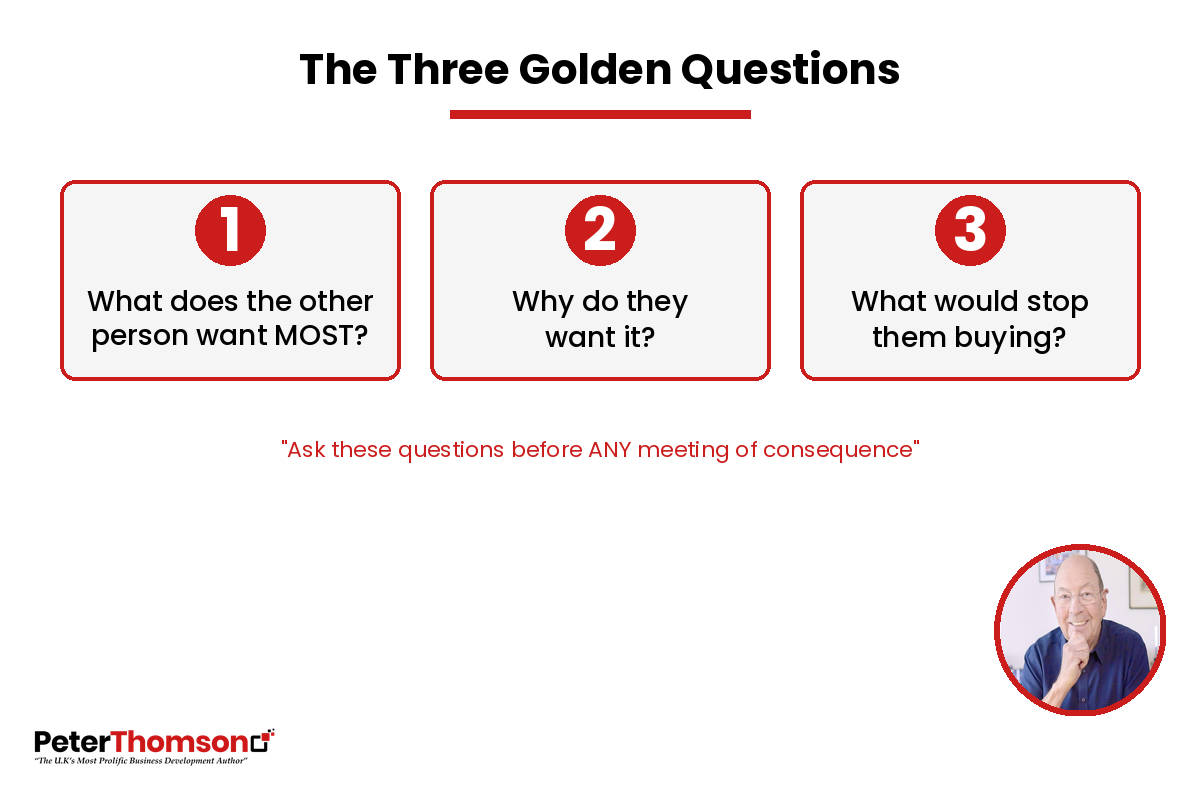
Before any meeting of consequence, whether it's with a potential client, an existing client, or even a colleague you need to influence, there are three questions you must answer.
These questions form the foundation of effective preparation. Get these right, and everything else falls into place. Miss any one of them, and you're walking into that meeting with a significant disadvantage.
Here they are:
Question One: What does the other person want most?
Question Two: Why do they want it?
Question Three: What would stop them buying it (or buying into it)?
Notice the precision in that first question. Not what they want. What they want most.
This is crucial. Your prospective client probably wants lots of things. They want more revenue. They want less stress. They want better clients. They want more free time. They want industry recognition.
But in the context of the meeting you're about to have, what is the ONE thing they want most?
When you know this, you can structure everything you say and do around helping them achieve that specific outcome.
Let me walk you through each question in detail.
Question One: What Does the Other Person Want Most?
This question forces you to prioritise. You can only pick one thing.
Why does this matter? Because human decision-making is fundamentally about trade-offs. We rarely get everything we want. We have to choose. And when we choose, we choose based on what matters most to us at that moment.
If you walk into a meeting offering to help someone with six different things, you've given them a choice to make. And when people have to make choices, they often default to making no choice at all.
But if you walk in demonstrating that you understand their single most important priority and showing how you can help them achieve it, you've aligned yourself with their existing thinking.
Here are some possibilities for what your client might want most:
- Information – They need to understand something better before making a decision
- A decision – They're ready to move forward but need clarity on their options
- Approval – They need validation that their thinking is correct
- A solution – They have a specific problem that needs fixing
- Reassurance – They're worried about something and need confidence
- Partnership – They want someone to share the journey with them
Notice that each of these requires a different approach from you. If someone wants information, you teach. If someone wants approval, you validate. If someone wants a solution, you prescribe.
Get this wrong, and you're speaking a different language from your prospect.
How do you find out what they want most? Research before the meeting. Look at their website, their LinkedIn activity, their recent press mentions. What problems are they publicly acknowledging? What successes are they celebrating?
Then, early in the meeting itself, ask directly. One of my favourite opening questions is simply: "What would make this meeting valuable for you today?"
Their answer tells you exactly where to focus your attention.
Question Two: Why Do They Want It?
Once you know what they want most, the next question is why.
This is where you move from understanding the surface level to understanding the emotion underneath.
Let me give you an example. Suppose your prospective client wants to increase their revenue. That's what they want most. But why do they want more revenue?
Possible answers include:
- Pressure from above – Their board or investors are demanding growth
- Personal ambition – They want to prove themselves capable of scaling
- Opportunity – They've identified a market gap and want to capitalise on it
- Fear – Their current revenue is declining and they need to reverse the trend
- Competition – Their rivals are growing faster and they're falling behind
- Legacy – They want to build something significant before they retire
Each of these "why" motivations completely changes how you should position your help.
For someone driven by fear, you emphasise security and stability. For someone driven by ambition, you emphasise growth and achievement. For someone driven by competition, you emphasise advantage and differentiation.
Understanding the motivation also tells you whether they're moving towards something they want or away from something they're trying to avoid.
This is what we call "towards" and "away from" motivation. Some people are energised by pursuing positive outcomes. Others are energised by avoiding negative consequences. The language you use should match their primary motivation.
A towards-motivated person responds to: "Imagine what it will feel like when your revenue hits that target..."
An away-from-motivated person responds to: "Consider what happens if the current trend continues for another twelve months..."
Same goal. Completely different emotional triggers.
Question Three: What Would Stop Them Buying?
This is the question most professionals forget to ask. And it's arguably the most important of the three.
Because here's the uncomfortable truth: most objections are created by what we didn't say or didn't do earlier in the conversation, rather than what we did say just before the objection was raised.
Read that again. It's important.
When a prospect says "It's too expensive" at the end of your meeting, that objection wasn't created in that moment. It was created earlier, when you failed to establish sufficient value to justify the investment.
When they say "I need to think about it," that hesitation wasn't created when you asked for the business. It was created earlier, when you failed to address some concern that was sitting in the back of their mind.
Common objections and their real sources:
"It's too expensive"
- You didn't establish the contrast between the cost of the problem and the cost of the solution
- You didn't position yourself as the natural choice before discussing fees
- You jumped to presenting before fully understanding the value they would receive
"I need to think about it"
- There's an unanswered question or concern you haven't addressed
- They're not convinced you fully understand their situation
- They don't trust that your solution will work for them specifically
"I'm already working with someone"
- You didn't differentiate yourself clearly enough
- You didn't identify what their current solution is failing to deliver
- You positioned yourself as a commodity rather than a specialist
"The timing isn't right"
- You didn't create urgency around the cost of waiting
- You didn't demonstrate quick wins they could achieve
- You didn't make implementation feel manageable
By anticipating these objections before the meeting, you can address them proactively during the conversation. This stops the prospect from ever forming the objection in the first place.
Think of it this way: if you know someone is worried about price, you establish value early. If you know someone is worried about implementation, you discuss your support process early. If you know someone is worried about making the wrong choice, you share relevant case studies early.
You handle the objection before they even think to raise it.
The Four Identity Questions
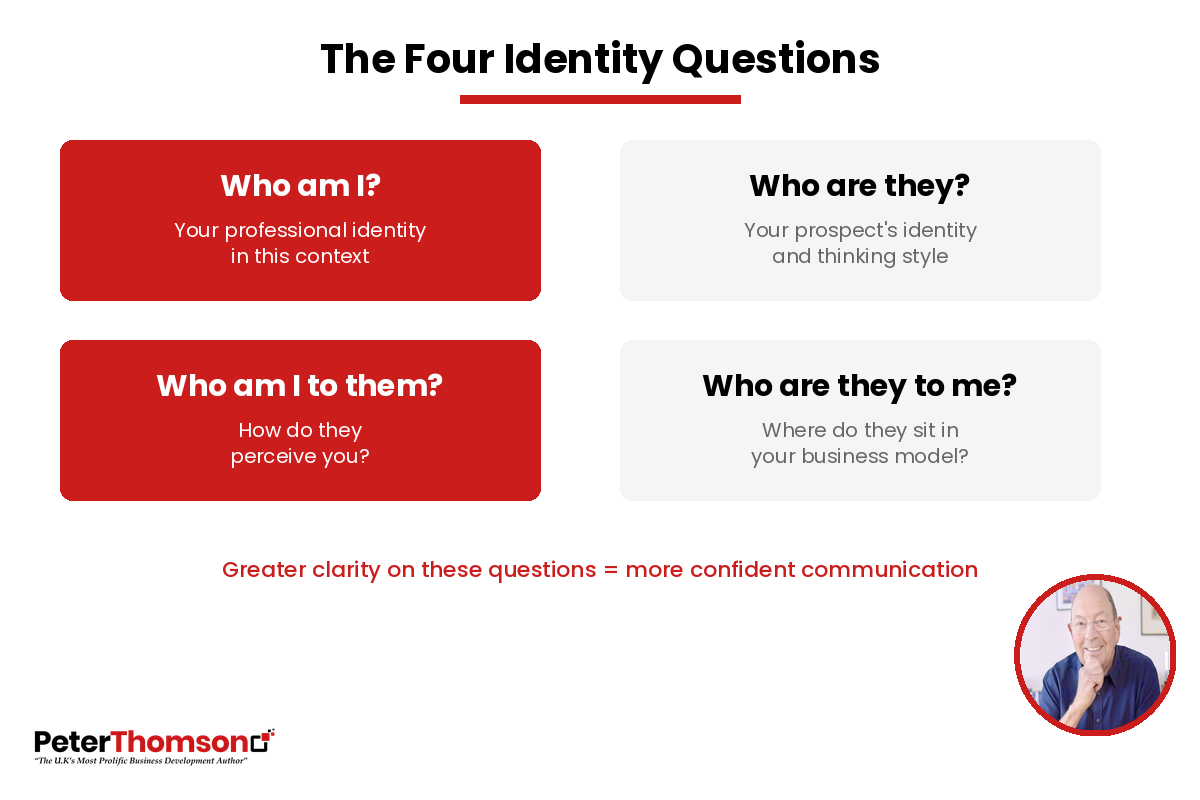
Beyond the three golden questions, there's another preparation framework that makes an enormous difference. I call these the Four Identity Questions.
They are:
Who am I? Who are they? Who am I to them? Who are they to me?
These questions seem simple, but answering them properly creates profound clarity about how you should show up in the meeting.
Who am I?
This isn't your job title. It's your professional identity in the context of what you're offering.
Are you a consultant? An advisor? A coach? A mentor? A partner? A supplier? A vendor?
Each of these identities comes with different expectations. A consultant provides expertise. An advisor guides decisions. A coach develops capability. A mentor shares experience. A partner collaborates. A supplier delivers. A vendor sells.
When you're clear about who you are, you communicate with greater certainty. And certainty is contagious. When you're certain about your identity, your prospect becomes certain about working with you.
Who are they?
What is your prospect's identity in this situation?
Are they a decision-maker or an influencer? Are they a business owner or a corporate manager? Are they a technical expert or a strategic thinker? Are they risk-averse or opportunity-driven?
Understanding who they are helps you match your communication style to their thinking style.
Who am I to them?
This is crucial. How do they see you?
Are you a trusted expert or an unknown quantity? Are you their natural choice or one option among many? Have they already decided to work with you, or are they still evaluating?
If you know how they perceive you, you can reinforce positive perceptions and address any gaps.
Who are they to me?
This is equally important. Where does this prospect sit in your business model?
Are they your ideal client? Are they someone you can genuinely help? Are they worth pursuing, or are they unlikely to be a good fit?
Not every prospect deserves the same level of investment from you. Understanding who they are to you helps you allocate your preparation time appropriately.
I have a full page of notes on these four questions that I review before every significant meeting. The clarity it provides is remarkable.
Pre-Handling Objections: The Art of Preventing Problems
Let me expand on something I mentioned earlier, because it's so important that it deserves its own section.
Most objections, and I'd say probably eight out of ten, are created by what you didn't say earlier in the conversation rather than what you did say just before the objection arose.
This is a game-changing realisation. Because it means you can prevent most objections simply by preparing properly.
Here's how this works in practice.
The eleven most common reasons for price objections:
- Forgetting to use the Contrast Principle (not establishing the gap between where they are and where they want to be)
- Not finding out what the client really wants to achieve
- Not finding out the true value of that outcome to them
- Not using a structured client conversation gathering document
- Not positioning yourself as the natural and logical choice to help them
- Not using an agenda for the meeting
- Not having premium versions of your offerings to create price anchoring
- Not having a planned, prepared, and practised opening to the conversation
- Jumping to the presentation stage before gathering sufficient information
- Not being confident when stating your fees
- Quoting fees that are far too low compared to the value delivered
Look at that list. Every single item is something you can address through proper preparation.
If you prepare properly, you'll use the Contrast Principle. You'll find out what they want and why. You'll gather information before presenting. You'll position yourself effectively. You'll quote your fees with confidence.
The objection never gets created in the first place.
This is what I mean when I talk about pre-handling objections. You handle them before they exist.
The Future First Present Next Technique
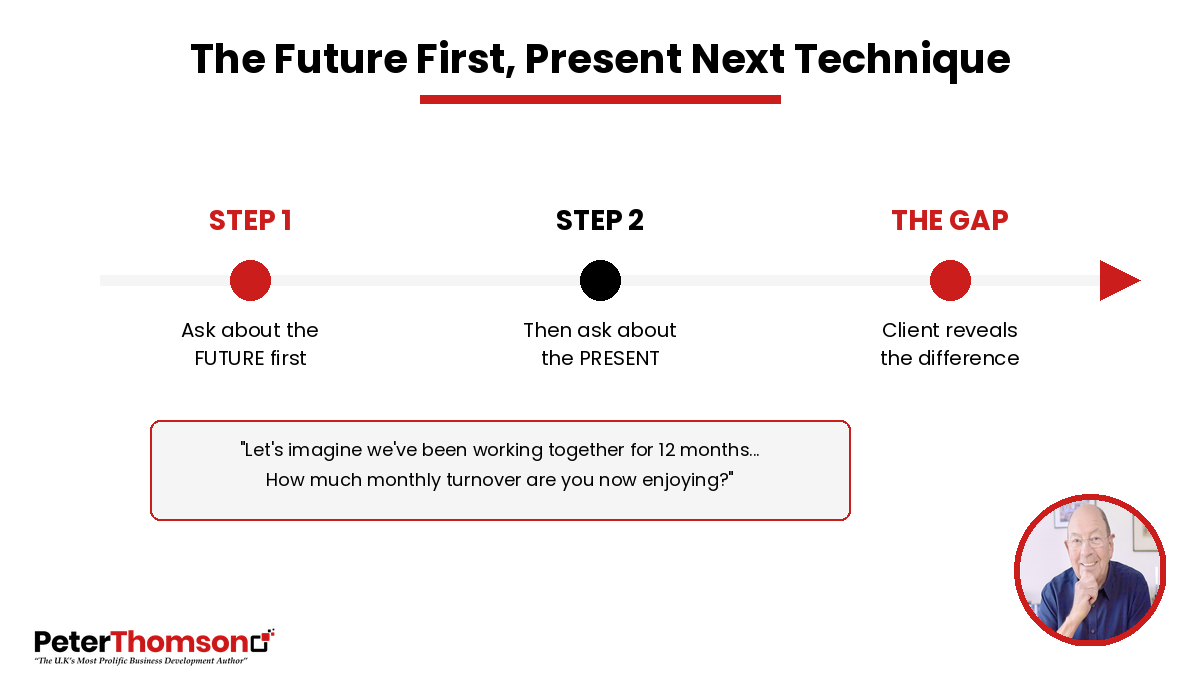
Here's a specific technique I've used for at least 40 years, and it's proved its worth time and time again.
When you're gathering information from a prospective client, particularly about their financial situation, there's a common problem. People tend to exaggerate their current position. Whether it's pride, optimism, or simply rounding up, the numbers you get when you ask "What's your current turnover?" are often... generous.
The solution is to ask about the future first.
Here's how it works. Instead of asking "What's your current turnover?" I ask something like this:
"Let's imagine you and I have been working together for 12 months. It's been going well. We've enjoyed it. We've had fun with serious intent. So here we are, 12 months down the road. Tell me, how much monthly turnover are you now enjoying?"
If the client doesn't give me a number quickly, I'll suggest some options: "Would that be £50,000 a month? £15,000 a month? £25,000 a month?"
You'll notice the number sequence is high, low, middle. This is deliberate. It helps the client anchor to a realistic range rather than defaulting to the highest number.
Let's say the client says £25,000 a month.
Then I ask: "And how does that compare to today?"
They might say: "That's an increase of £15,000 a month."
Now I have the gap. And crucially, I got it without asking for their current number first. The client gave me the difference themselves.
The conversation continues:
"So, you'd like me to help you to increase your turnover by £180,000 a year. Is that right?"
The client says yes. There's no other logical choice. I'm using the figures they gave me.
Then I might ask: "And how many more years are you aiming to be in business?"
If they say ten years, I continue:
"So, £180,000 a year for at least 10 more years is at least £1.8 million. And that's not even allowing for the increases year on year over those ten years."
Now my fees are positioned against a £1.8 million outcome, not against their current monthly revenue.
This is the Contrast Principle in action. And it all starts with asking about the future first, present next.
Creating Your Client Conversation Gathering Document
To implement everything I've shared with you, I recommend creating what I call a Client Conversation Gathering Document.
This is a simple template you use before every client meeting to gather your thoughts and prepare your approach.
Here's what it should include:
Section One: The Three Golden Questions
- What does this person want most?
- Why do they want it?
- What would stop them buying?
Section Two: The Four Identity Questions
- Who am I in this context?
- Who are they in this context?
- Who am I to them?
- Who are they to me?
Section Three: Research Notes
- What have I learned about them from their website?
- What have I learned from their LinkedIn profile?
- What have I learned from any mutual connections?
- What have I learned from their previous interactions with me?
Section Four: The Future First Approach
- What outcome do I believe they want to achieve?
- What is the likely gap between where they are and where they want to be?
- What is the financial or emotional value of closing that gap?
Section Five: Potential Objections
- What concerns might they have?
- How will I address each concern proactively?
Section Six: Meeting Agenda
- What's my opening question?
- What information do I need to gather?
- What do I want them to understand or believe by the end?
- What's my call to action?
This document takes 15-20 minutes to complete properly. But that investment pays for itself many times over.
Think of it this way: if the client you're about to see was the client who would be responsible for all your income for the next 10 years, how well prepared would you be?
We both know the answer.
Putting It All Together: Your Pre-Meeting Checklist
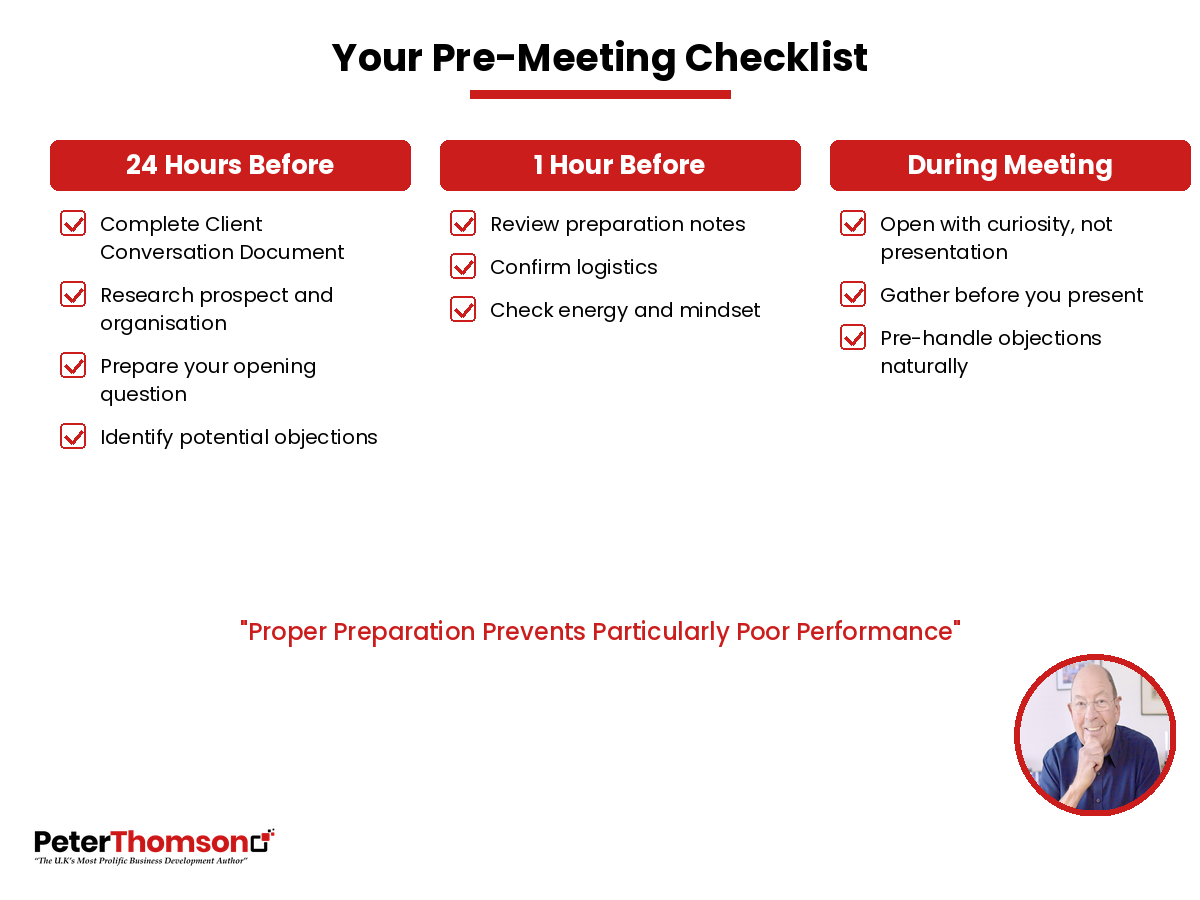
Let me give you a practical checklist you can use before every significant meeting:
24 Hours Before:
- Complete your Client Conversation Gathering Document
- Research the prospect and their organisation
- Prepare your opening question
- Identify three potential objections and how you'll pre-handle them
- Review your case studies for relevant examples to share
1 Hour Before:
- Review your preparation notes
- Confirm logistics (location, technology, time zone)
- Check your energy and mindset
- Prepare your physical or virtual environment
5 Minutes Before:
- Clear your head of other distractions
- Focus on how you can help this specific person
- Remember: they've already shown interest by agreeing to meet you
- Take a breath and commit to being fully present
During the Meeting:
- Open with curiosity, not presentation
- Gather before you present
- Listen for what they want most
- Pre-handle objections as they arise naturally
- Make your offer when the timing is right
After the Meeting:
- Send a follow-up within 24 hours (speed stuns)
- Deliver on any promises you made
- Continue to demonstrate the credibility you established
This system works. I've used it for three decades. Every member of The Paid Up Club uses some version of it. And when you implement it consistently, you'll notice a significant improvement in how your meetings go.
Your Next Step
If you've found this preparation strategy valuable, I'd like to invite you to take it further.
In my book PAID!, I go into much greater depth on the psychology of client conversations, including the complete Client Conversation Gathering Document, specific scripts for the Future First Present Next technique, and detailed strategies for every stage of the client journey.
For those who want ongoing support implementing these strategies, The Paid Up Club provides weekly training sessions, a community of like-minded professionals, and direct access to ask questions and get feedback on your approach.
Your preparation is the foundation of everything else. Get this right, and you'll be amazed at how much easier the rest becomes.
To your success,
Peter Thomson
The UK's Most Prolific Business Development Author
Stay connected with bite-size videos and updates!
Gain an unfair advantage and join fellow achievers who receive tgiMondays - FREE weekly bite-sized videos and blogs on business and personal growth and inspiration from my latest off the edge thinking and ideas.
We hate SPAM. We will never sell your information, for any reason.
