
Copy Is Not Written, It Is Assembled: The Craft Behind Persuasive Writing
Oct 20, 2026Eugene Schwartz said five words that changed how I approach every piece of marketing I produce.
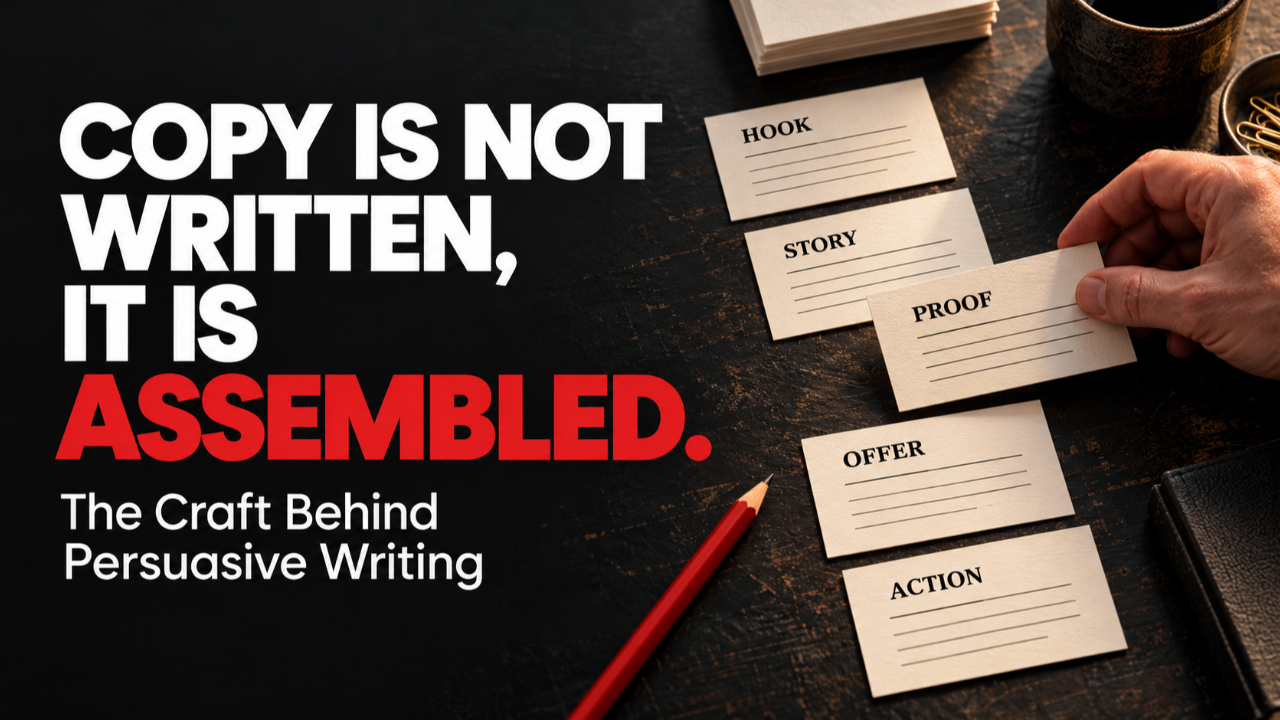
Copy is not written, it is assembled.
Sit with that for a moment, because it sounds like a small distinction and it is nothing of the sort.
Writing suggests inspiration, a blank page, and a person waiting for the muse to arrive.
Assembling suggests components, a workbench, and a craftsman who knows exactly which piece goes where and why.
The second person makes far more money than the first, and I want to show you how they work.
[IMAGE: A workbench with components laid out in order, warm light, red accent]
1. What Assembling Actually Means
When I sit down to produce a piece of copy, I am not really searching for words.
I am selecting components and deciding the order they go in.
A hook here, a story there, a piece of proof, a change of rhythm, a subhead that stops the skim reader, an assumption dropped in quietly.
Each component has a job, and the assembly is the decision about which job happens when.
I sometimes prefer the word crafting, because it carries the same sense of shaping something with your hands.
And that is the same reason selling works the way it does.
Selling takes place in the gathering stage, as people sell themselves through their answers to your well crafted questions.
Notice the phrase there, well crafted, not well written.
| The question that separates writing from assembling. Not "does this sound good?" but "what is this component doing, and is it in the right place?" |
2. Why AI Can Write But Cannot Assemble
This is where the distinction becomes commercially useful to you and I.
AI can produce an enormous volume of perfectly serviceable writing in a very short time.
It is genuinely useful, I use it every week, and I have no interest in pretending otherwise.
What it is not good at is the assembling.
Because assembling requires you to understand the feeling being created in a specific human being as they read a specific sequence of words.
It requires you to know that this reader has been burned before, that this audience distrusts numbers that end in three zeros, that this profession bristles at being told what to do.
So here is the division of labour I would suggest.
Let the machine generate raw material, and let it generate plenty of it.
Then you do the selecting, the ordering, the cutting and the sharpening, because that is where the persuasion actually lives.
Edit ruthlessly, and never send anything a machine produced without your fingerprints all over it.
3. Think, Feel, Do: The Three Questions Before You Start
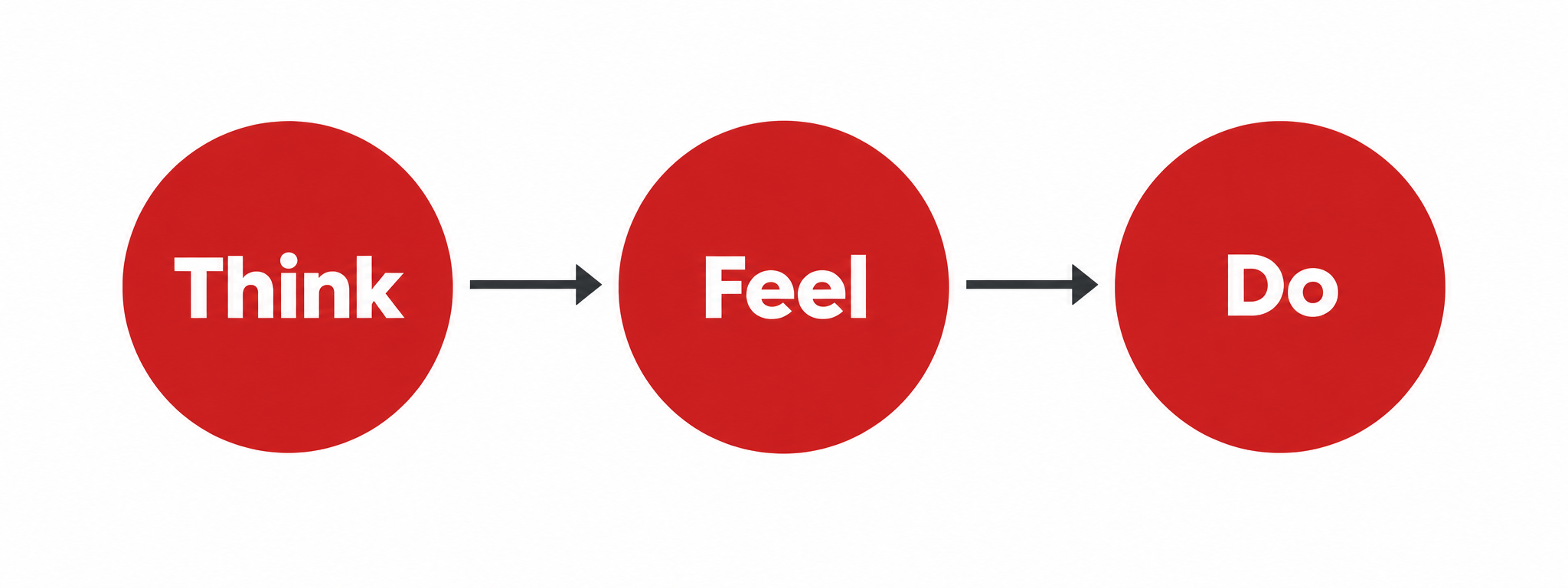
Before you assemble anything, answer three questions, and answer them in this order.
When somebody reads my words, what do I want them to think?
What do I want them to feel?
What do I want them to do?
Most people write first and work out the answers afterwards, if they ever work them out at all.
A member of mine who runs training workshops applied this to a presentation he was designing, and the answers came out beautifully clearly.
Think: this man knows what he is talking about.
Feel: I could work with him.
Do: sign up.
Once you have those three, the assembly practically directs itself, because every component either serves one of the three or it comes out.
4. Write the Headlines First
Claude Hopkins wrote that the purpose of a headline is to pick out the people you can interest.
Not to be clever, not to be admired, simply to select the right readers and repel the wrong ones.
Ted Nicholas told me the headline is the most important element of your advertising, and he had rather more evidence for that opinion than most people.
So here is a practical instruction, and it is one of the most useful things in this whole article.
Write your headlines when you are fresh, not when you are worn out.
When you sit down juiced up, excited and ready to go, write the headlines.
All of them, and I mean the subheads too.
Do not leave them until you have exhausted yourself producing three thousand words of body copy, because by then you will settle for whatever comes out.
Ask yourself, can I encapsulate this into a few words?
If you can, you have your headline, and very often you have the shape of the whole piece as well.
5. The Most Powerful Element Is the Truth
William Bernbach said the most powerful element in advertising is the truth.
I believe that completely, and here is why it matters mechanically rather than morally.
People can feel it when we are telling the truth.
They can feel it in writing, they can feel it on video, and they can certainly feel it on a call.
Something in the rhythm changes when a person is stretching a claim, and readers detect it long before they can explain it.
This is also the practical reason your testimonials need to match your reader.
A true story about a client just like them beats an impressive story about a client nothing like them, every time.
Robert Collier's advice fits neatly here too, which is to always enter the conversation already taking place in the customer's mind.
You cannot enter a conversation you have not bothered to listen to.
6. Ted Nicholas and the Four Stage Edit
Ted Nicholas gave me an editing process I have used ever since, and it is beautifully simple.
Once you have your draft, run every part of it through four categories.
Boring. It goes. No discussion, no defending it, out.
Boring but necessary. It stays, but you rewrite it to be as unboring as you can manage. Terms, guarantees and the practical details usually live here.
Exciting. Keep it.
Hot. Keep it, and consider giving it more room.
When Ted first explained this to me I pushed back, and I asked the obvious question.
Surely if everything is exciting or hot all the way through, it all loses its impact?
He said no, and his reasoning has stayed with me for thirty years.
People do not read your copy from top to bottom, they skim.
You have no idea where any individual reader is going to stop.
So wherever they stop, that bit has to be exciting or hot, because it might be the only bit they read.
Video behaves differently, since people rarely skip ahead. They simply click away when you bore them, which is arguably worse.
7. Every Sentence Earns Its Keep
Think of your copy as a supermarket shelf.
Every packet on that shelf has to justify the space it occupies, or the buyer delists it.
Your headline is a packet, your subheads are packets, and so is every single sentence.
If the headline does not earn its space, it goes.
If a subhead does not work, it goes.
If the first paragraph does not pull, it gets rewritten, however fond of it you have become.
This is slow work and I will not pretend otherwise.
But the time we spend on this pays back millions, and I do mean millions, because a piece of copy that works keeps working for years.
8. Marketing and Sales, In That Order
Steve Bimpson always insisted it is marketing and sales, never sales and marketing, and he was right.
The marketing happens first, and it does the heavy lifting.
It brings people to you ready, willing and able to engage, and if you have built qualification into the process, it brings the right ones.
By the time you are on a call with somebody, they are already predisposed to think well of you.
Which is why the copy matters so much, and here is the uncomfortable part.
In the short and medium term, the difference between the people who succeed in our business and the people who struggle is not how good they are at delivering what they do.
It is how good they are at marketing and sales.
No matter how good you are, the world is not going to beat a path to your door, and it does not matter how good your mousetrap is any more.
Your longer term success does rest on the quality of your delivery, of course it does, because that is when your referral system starts working.
Do the work brilliantly and systematise your referral process, and you may eventually need very little advertising at all.
But you have to get there first, and copy is how you get there.
9. Build Your Own Tool Chest
In my desk drawer there is a stack of cards.
Each one carries a pattern, a formula or a phrase that I have read, tested and found to work.
They came from years of reading the books at the end of this article and analysing the great advertisements line by line.
The value of that stack is not that it makes me clever, it is that I never get stuck.
When a piece will not come, I have somewhere to go.
Start your own, today, with one card.
Every time you read something that stops you, write down the pattern rather than the sentence.
The sentence belongs to whoever wrote it, but the pattern belongs to everybody.
| One habit worth copying. I write the date I finished each book inside the front cover, along with the time. It seems eccentric, and it means I can trace exactly when an idea entered my thinking and what I did with it afterwards. |
10. The Books That Taught Me This
Many years ago Jason Jackman gave me a list and told me to read every one of them.
I did, and almost everything I teach on copy traces back to that list plus four decades of testing it in the marketplace.
If you are as interested in this as I am, and I rather suspect you might be, here they are.
- The Robert Collier Letter Book, Robert Collier. My copy is covered in highlighting. Get hold of one if you possibly can.
- The First Hundred Million, E. Haldeman-Julius. If you are ever going to write a title for anything, read this.
- The Boron Letters, Gary Halbert, updated by Bond Halbert. Written from prison to his son, and one of the bibles of the craft.
- Scientific Advertising, Claude Hopkins. Short, quick and so modern it could have been written last week.
- Tested Advertising Methods, John Caples. My copy is thoroughly dog-eared, which tells you what I think of it.
- The Adweek Copywriting Handbook, Joseph Sugarman.
- Magic Words That Bring You Riches, Ted Nicholas. A wonderful man, and sadly no longer with us.
- How to Write a Good Advertisement, Victor Schwab.
- Influence, Robert Cialdini. My original copy dates from 1988 and it is still brilliant, and the newer work on pre-suasion is well worth your time too.
Alongside the books, study the great advertisements themselves.
The Lazy Man's Way to Riches by Joe Karbo. Do You Make These Mistakes in English. The Rolls Royce advertisement. And the Wall Street Journal letter, which is quite possibly the finest story advertisement I have ever come across.
Do not simply read them, take them apart.
Ask why each line sits where it does, and you will start to see the assembly rather than the writing.
Your Next Step
Take the last piece of copy you wrote and, before you touch a word of it, answer the three questions.
What should the reader think, what should they feel, and what should they do?
Then run every paragraph through Ted's four categories and be honest with yourself about which pile each one belongs in.
You will cut more than you expect, and what remains will be considerably stronger.
|
The Persuasion Book, free. Four decades of tested structures, questioning techniques and language patterns, gathered into one short and practical read. Claim your free copy of The Persuasion Book And inside The British Business Coaches & Consultants Academy we work on real copy together: members bring their own headlines to the live sessions, and we sharpen them together. |
Copy is not written, it is assembled.
Go and assemble something.
The next £5,000 a month may already be inside your business. Find out where with Your Gap Finder (free, 18 questions, about four minutes): https://yourgapfinder.com
Experience The British Business Coaches & Consultants Academy free for a month: https://www.peterthomson.com/bbcca
Stay connected with bite-size videos and updates!
Gain an unfair advantage and join fellow achievers who receive tgiMondays - FREE weekly bite-sized videos and blogs on business and personal growth and inspiration from my latest off the edge thinking and ideas.
We hate SPAM. We will never sell your information, for any reason.
