

The 5 Copywriting Frameworks That End the Fear of the Blank Page
Jul 17, 2026In this article
AIDA, and the version I actually learned
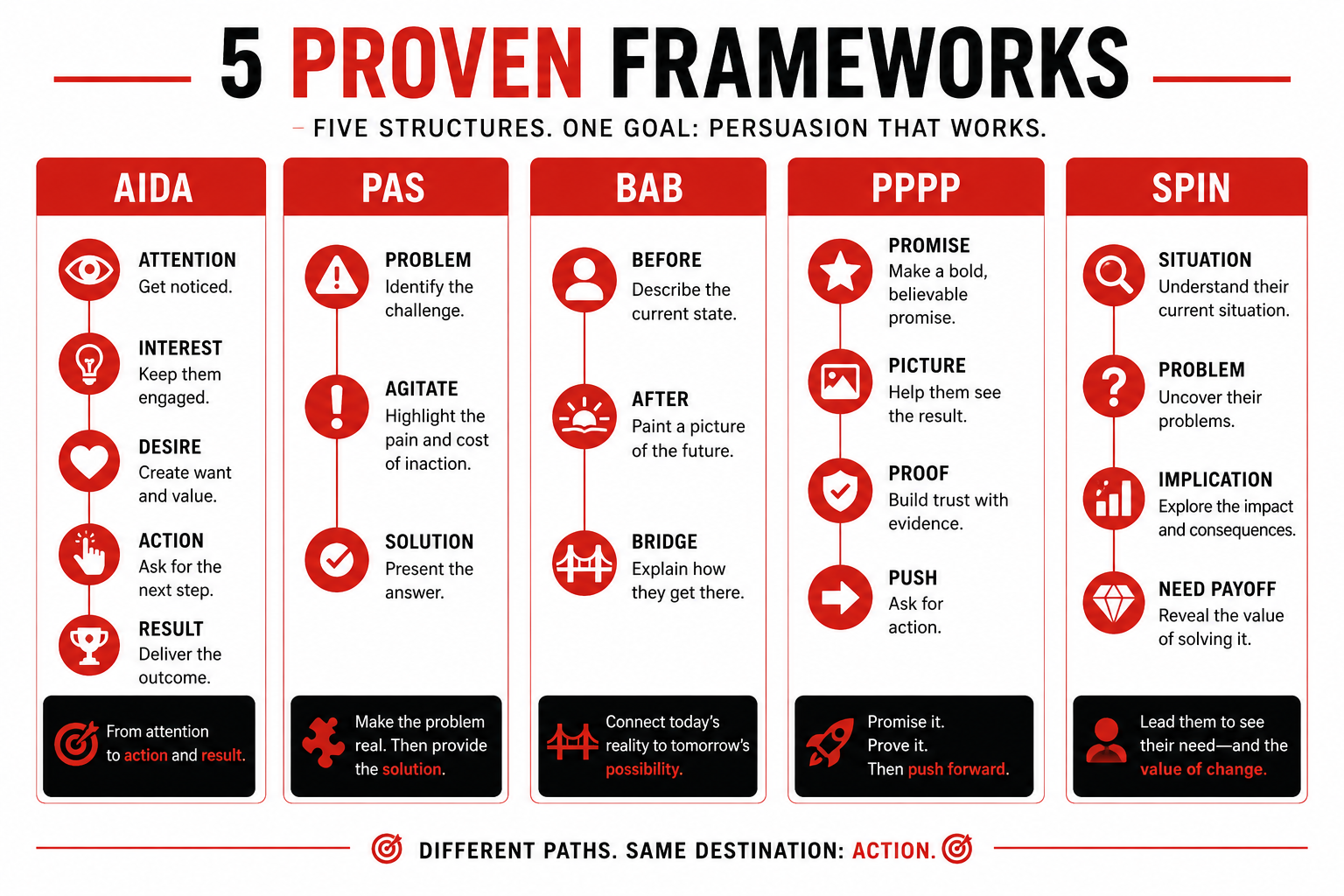
PAS: Problem, Agitate, Solution
PPPP: Promise, Picture, Proof, Push
SPIN: the framework for conversations
Which framework should you choose?
The one sentence that says it all
One of the biggest misconceptions about writing is that talented writers simply sit down and inspiration arrives.
It doesn't. Good writers use structure.
When you have a blank page in front of you, your brain has to work incredibly hard. What do I write first? How should I begin? What's the next sentence? That's a heavy cognitive load, and it's the real reason so many capable professionals put off writing the email, the sales page or the LinkedIn post they know they need to write.
But if someone gives you a proven structure, all that mental effort disappears. Instead of worrying about how to write, you can concentrate on what you want to say.
In this article I'll give you five frameworks that have stood the test of time, plus one sentence of persuasion that might be the most useful thing you read all year. Every one of them works because it follows the way people naturally think and make decisions.
A framework isn't there to restrict your creativity. It's there to remove unnecessary thinking.
Why frameworks set you free
Think of a framework as scaffolding around a building. It doesn't create the building. It simply supports the construction.
Some people worry that using formulas will make their writing sound mechanical. I believe exactly the opposite. Frameworks remove uncertainty. They free your mind to focus on ideas. The framework is invisible. The reader doesn't notice it. They simply experience a message that feels logical, engaging and persuasive.
That's why these structures have survived for decades. Human beings haven't fundamentally changed. Neither has the psychology behind effective communication.
AIDA, and the version I actually learned
Perhaps the best-known copywriting formula is AIDA. Attention. Interest. Desire. Action.
Years ago, I actually learned a slightly expanded version. I learned PAIDAR: Planning, Attention, Interest, Desire, Action, Result.
Planning comes first because great marketing always begins before the writing starts. Who are we talking to? What problem do they have? What outcome are we trying to create? Only then do we begin writing.
The first job is to grab attention. Without attention, nothing else matters. Once you've earned attention, you build interest. And interest isn't the same as attention. Attention says, "Look over here." Interest says, "Keep reading."
Then we move into desire. This is where we help people imagine the future. How will life improve? What changes? What becomes easier? You can build desire with additional value, bonuses, exclusivity, proof and genuine scarcity. And I do mean genuine. Artificial urgency damages trust. Real scarcity strengthens it.
Finally comes action. Many people forget this part entirely. They spend pages explaining everything and never actually ask the reader to do anything. It's rather like planting a field, watering it, looking after it for months, and never harvesting the crop.
Sometimes I prefer what I call a Call to Value rather than simply a Call to Action. Instead of saying "Buy now", I might say, "Yes Peter, I'd like to become recognised as the authority in my market." Notice what's happened. The action is still there. But the focus has shifted to the outcome. People buy futures. Not products.
PAS: Problem, Agitate, Solution
The next framework is wonderfully simple. Problem. Agitate. Solution.
Sometimes you'll hear marketers describe the middle section as "pressing on the bruise". Imagine someone has a painful shoulder. If I press gently on it, they're immediately reminded of the discomfort. That's exactly what effective copy does.
First, identify the problem. Then help the reader fully appreciate its consequences. Not to frighten them. Not to manipulate them. Simply to make the cost of inaction visible.
Once they've recognised the seriousness of the issue, they're ready to hear the solution. Many businesses rush straight to the solution, and that's a mistake. If someone doesn't fully appreciate the problem, your solution has very little value.
BAB: Before, After, Bridge
Another framework I use regularly is BAB. Before. After. Bridge. This one is beautifully visual.
Describe where the reader is today. Paint a picture of where they could be. Then explain how they get there. That's the bridge.
People buy transformation. They don't buy products.
- Nobody buys coaching. They buy confidence.
- Nobody buys a pricing course. They buy higher fees.
- Nobody buys AI. They buy time.
The bridge simply connects today's reality with tomorrow's possibility.
PPPP: Promise, Picture, Proof, Push
Start with a bold promise. Not an exaggerated promise. A believable one.
Then help people see what success looks like. Create a vivid mental picture, because people need to imagine themselves already enjoying the result.
After that comes proof. This is where testimonials, case studies, statistics and stories all become incredibly valuable.
Finally, push. Ask for action. Again, don't spend all your energy building desire only to forget asking people to move forward.
SPIN: the framework for conversations
You may already know SPIN Selling, one of the finest consultative selling models ever created. SPIN stands for Situation, Problem, Implication, Need Payoff.
Notice something interesting. Once again, the structure follows psychology. First understand where someone is. Then identify the problem. Explore the implications. Help them appreciate why solving it matters. Only then present your solution.
It's remarkably similar to PAS. The language changes. The psychology doesn't.
Which framework should you choose?
One question I'm often asked is, "Which framework is best?" The answer is, it depends.
- If someone already knows a solution exists and simply wants the best option, AIDA works brilliantly.
- If they're feeling genuine frustration or pain, PAS often works better.
- If they need help visualising transformation, use BAB.
- If you've got powerful testimonials and evidence, PPPP becomes extremely persuasive.
- If you're having a live conversation, SPIN is exceptionally effective.
Don't think of these as competing systems. Think of them as tools. A carpenter doesn't use the same tool for every job. Neither should we.
The one sentence that says it all
One of my favourite persuasion models isn't really a framework at all. It's a single sentence from Blair Warren, and I think it's one of the greatest pieces of persuasion thinking ever written.
Warren's insight is that people will do almost anything for those who do five things for them: encourage their dreams, justify their failures, allay their fears, confirm their suspicions and help them throw rocks at their enemies.
Let's break that down.
- Encourage their dreams. What does your audience hope for? What future are they trying to create?
- Justify their failures. Not by excusing poor behaviour, but by helping them understand why previous attempts didn't work. Sometimes they simply had poor advice, or the wrong system, or the wrong timing.
- Allay their fears. Every purchase carries uncertainty. Every decision carries risk. Your job is to reduce unnecessary fear.
- Confirm their suspicions. People already believe certain things. If you can show them they're right, trust increases dramatically.
- Help them throw rocks at their enemies. Every market has villains. Sometimes it's outdated thinking, poor advice, bureaucracy or unnecessary complexity. People naturally unite against a common enemy.
What I particularly like about this model is that it turns into a practical writing exercise. Before you write, ask yourself these questions, built directly on those five ideas.
What are your reader's dreams?
How will you encourage them?
What failures have they experienced?
How can you explain those failures?
What fears do they have?
How will you reduce them?
What suspicions already exist?
How can you confirm them?
Who or what are their enemies?
How can you help them overcome those obstacles?
By answering those questions honestly, you've almost written your sales letter before you've started writing. It's a thinking exercise. And thinking always comes before writing.
|
The blank page rule If you're staring at a blank page, you don't have a writing problem. You have a thinking problem. Choose a framework, answer its questions, and the writing takes care of itself. |
Frameworks make AI better too
These frameworks existed long before AI. They matter more than ever now, because AI needs good instructions.
Imagine giving AI a simple instruction: "Write me a sales page." You'll probably receive something OK ish.
Now compare that with this: "Use the PAS framework. Begin by identifying the problem. Agitate the consequences. Then introduce my solution. Write in a conversational style. Use curiosity. Finish with a strong call to action."
Suddenly the output improves dramatically. Why? Because you've given AI a framework instead of a blank canvas. Structure improves everything.
If your thinking is vague, AI simply produces vague content faster. If your thinking is structured, AI becomes an extraordinary assistant.
Your next step
You don't need to memorise all five frameworks immediately. Simply become familiar with them. The more often you use them, the more naturally they'll appear in your writing. Eventually you'll stop thinking "Which framework should I use?" and instinctively recognise which one fits the situation. That's when writing becomes dramatically easier.
And if you'd like to see persuasion applied to the part of your business where it pays best, your fees, my book The Profitable Business Coach, the fully revised edition of PAID!, shows you the ten secrets for being richly rewarded for the value you deliver. You'll find it at peterthomson.com/the-profitable-business-coach
Pick one framework. Write one piece with it this week. Then notice how much easier the page feels.
If you like this kind of content, have a look at The British Business Coaches & Consultants Academy. All the details are here: https://www.peterthomson.com/bbcca
Here's to your ongoing success.
Peter
Peter Thomson
'The UK's Most Prolific Business Development Author'
The next £5,000 a month may already be inside your business. Find out where with Your Gap Finder (free, 18 questions, about four minutes): https://yourgapfinder.com
Experience The British Business Coaches & Consultants Academy free for a month: https://www.peterthomson.com/bbcca
Stay connected with bite-size videos and updates!
Gain an unfair advantage and join fellow achievers who receive tgiMondays - FREE weekly bite-sized videos and blogs on business and personal growth and inspiration from my latest off the edge thinking and ideas.
We hate SPAM. We will never sell your information, for any reason.
